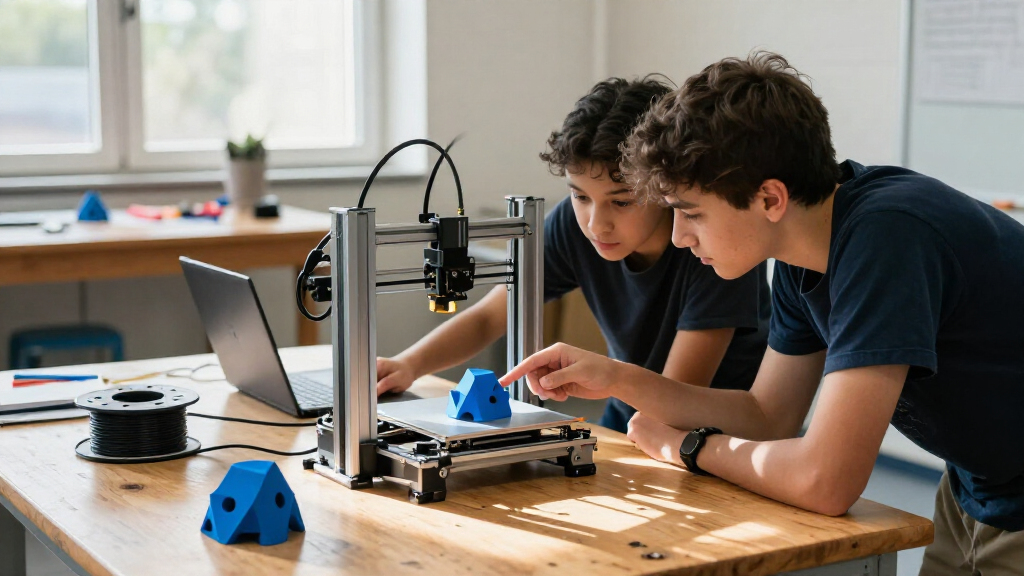
For most schools, I’d start with the Bambu Lab P1S Combo: its enclosed design and included AMS make it a versatile choice for supervised projects that use multiple colors. The Flashforge Adventurer 5M stands out for straightforward classroom printing, while the Entina Tina2C suits younger beginners and smaller learning spaces. The main tradeoffs are ease of supervision, print volume and speed, multicolor capability, and how much setup or maintenance teachers can take on. A printer that excels at complex projects may add workflow demands that a class does not need. Read on for the full breakdown of all 15 options and how I’d match them to different school settings.

Prime made for students and young adults
- Fast, free delivery for dorm and study essentials
- Prime Video and Amazon Music included
- Member-only deals
Complete the kit


Key Takeaways
- The P1S Combo is my most versatile classroom pick because it pairs an enclosed printer with an AMS for multicolor projects; that flexibility comes with more system complexity than a basic single-color setup.
- The Adventurer 5M favors a simpler classroom workflow, while the P1S Combo is the stronger fit when enclosure and multicolor capability matter more.
- Small beginner models such as the Entina Tina2C and HEPHI3D Tina2C are easier to place in compact learning areas, but their mini format is less suited to larger student prototypes.
- Multicolor options are not interchangeable: the Kobra X models, AD5X variants, P1S Combo, and toolhead-based Snapmaker U1 offer different approaches that affect setup, material use, and classroom workflow.
- School fit depends on supervision and support as much as speed; enclosed kid-focused models such as the TKID and AOSEED X-MAKER JOY AI+ may suit younger users, while faster or more capable machines call for more teacher involvement.
| TKID Enclosed 3D Printer for Kids with App Control, Live Camera, and 2 PLA Spools |  | Best for Young Beginners | Printer type: Enclosed 3D printer | Standard print speed: 220–250 mm/s | Maximum print speed: Up to 400 mm/s | VIEW LATEST PRICE | See Our Full Breakdown |
| ANYCUBIC Kobra X Fast 3D Printer with Native 4-Color Printing |  | Best for Classroom Color Projects | Printer type: FDM 3D printer | Build volume: 260 × 260 × 260 mm | Color printing: Native four-color printing | VIEW LATEST PRICE | See Our Full Breakdown |
| Bambu Lab P1S Combo 3D Printer with AMS |  | Best for Advanced School Makerspaces | Printer type: Enclosed CoreXY 3D printer | Included system: AMS | Maximum colors: Up to 16 with AMS | VIEW LATEST PRICE | See Our Full Breakdown |
| Flashforge Adventurer 5M 3D Printer |  | Best for Fast Single-Color Prototyping | Printer type: CoreXY 3D printer | Build volume: 8.7 × 8.7 × 8.7 inches | Maximum printing speed: 600 mm/s | VIEW LATEST PRICE | See Our Full Breakdown |
| Bambu Lab P2S High-Speed FDM 3D Printer |  | Best for Low-Intervention Classroom Printing | Printer type: FDM 3D printer | Maximum print speed: 600 mm/s | Calibration: Automatic calibration | VIEW LATEST PRICE | See Our Full Breakdown |
| Bambu Lab A1 FDM 3D Printer |  | Best for Low-Maintenance Classroom Use | Printing technology: FDM | Maximum acceleration: 10,000 mm/s² | Calibration: Automatic, including Z-offset and bed leveling | VIEW LATEST PRICE | See Our Full Breakdown |
| Snapmaker U1 3D Printer with Four Toolheads and 5-Second Tool Changer |  | Best for Multi-Material STEM Projects | Toolheads: 4 independent toolheads | Tool change time: 5 seconds | Maximum printing speed: 500 mm/s | VIEW LATEST PRICE | See Our Full Breakdown |
| Entina Tina2C Mini 3D Printer for Beginners |  | Best for First-Time Student Operators | Printer type: FDM | Print volume: 3.9 × 3.9 × 3.9 inches | Connectivity: 2.4 GHz Wi-Fi | VIEW LATEST PRICE | See Our Full Breakdown |
| Creality K2 Combo 3D Printer with CFS Multicolor Printing |  | Best for School Multicolor Demonstrations | Build volume: 260 × 260 × 260 mm | Maximum printing speed: 600 mm/s | Multicolor printing: Up to 16 colors with up to four CFS units | VIEW LATEST PRICE | See Our Full Breakdown |
| HEPHI3D TINA2C Beginner-Friendly Mini 3D Printer |  | Best Beginner Starter Kit | Assembly: Fully assembled | Bed leveling: Automatic | Connectivity: Wi-Fi, USB-C, TF card | VIEW LATEST PRICE | See Our Full Breakdown |
| HEPHI3D TINA2S Beginner-Friendly 3D Printer |  | Best for Compact Classroom Desktops | Printer type: FDM 3D printer | Assembly: Fully assembled | Bed leveling: Automatic | VIEW LATEST PRICE | See Our Full Breakdown |
| FLASHFORGE AD5X Multi-Color FDM 3D Printer with Intelligent Filament System |  | Best for Fast, Four-Color Classroom Projects | Printer type: FDM 3D printer | Color printing: Up to 4 colors | Filament system: Intelligent Filament System (IFS) | VIEW LATEST PRICE | See Our Full Breakdown |
| AOSEED X-MAKER JOY AI+ Enclosed 3D Printer for Kids |  | Best for Guided Learning with Kids | Printer type: Enclosed 3D printer | Printing mode: Single-color | Print speed: 220–250 mm/s typical; up to 400 mm/s | VIEW LATEST PRICE | See Our Full Breakdown |
| Anycubic Kobra X Multicolor 3D Printer |  | Best for Expanding Multicolor Coursework | Printer type: FDM | Built-in colors: 4 | Expandable colors: Up to 19 with four ACE 2 Pro units | VIEW LATEST PRICE | See Our Full Breakdown |
| FLASHFORGE AD5X Multi-Material 3D Printer with 4-Color Printing |  | Best for Multi-Material STEM Lessons | Printing colors: Up to 4 | Maximum printing speed: 600 mm/s | Maximum acceleration: 20,000 mm/s² | VIEW LATEST PRICE | See Our Full Breakdown |
| 3D printers for education | Printer type |
|---|---|
| TKID Enclosed 3D Printer for K | Enclosed 3D printer |
| ANYCUBIC Kobra X Fast 3D Print | FDM 3D printer |
| Bambu Lab P1S Combo 3D Printer | Enclosed CoreXY 3D printer |
| Flashforge Adventurer 5M 3D Pr | CoreXY 3D printer |
| Bambu Lab P2S High-Speed FDM 3 | FDM 3D printer |
| Bambu Lab A1 FDM 3D Printer | — |
| Snapmaker U1 3D Printer with F | — |
| Entina Tina2C Mini 3D Printer | FDM |
| Creality K2 Combo 3D Printer w | — |
| HEPHI3D TINA2C Beginner-Friend | — |
| HEPHI3D TINA2S Beginner-Friend | FDM 3D printer |
| FLASHFORGE AD5X Multi-Color FD | FDM 3D printer |
| AOSEED X-MAKER JOY AI+ Enclose | Enclosed 3D printer |
| Anycubic Kobra X Multicolor 3D | FDM |
| FLASHFORGE AD5X Multi-Material | — |
More Details on Our Top Picks
TKID Enclosed 3D Printer for Kids with App Control, Live Camera, and 2 PLA Spools
For a classroom or family starting with younger learners, the TKID puts ease of entry ahead of material range and advanced control. Leveling-free setup, app-guided filament loading, and access to more than 20,000 models give students several ways to begin making without learning every printer adjustment first. Its live camera and remote pause or cancel also let an instructor check a job without standing beside the machine. Compared with the Bambu Lab P1S Combo, it is smaller and more explicitly geared toward guided, kid-friendly use, while the P1S supports a broader range of filaments and more advanced projects. That simplicity comes with limits: the build volume is not provided, and the included PLA does not cover every classroom material. I’d choose it for introductory activities, not a lab that needs detailed capacity planning or varied materials.
Pros:- Leveling-free setup and guided filament loading reduce first-use hurdles for beginners.
- More than 20,000 ready-to-print models and AI creation tools offer starting points for student projects.
- Live camera and app controls support remote monitoring, pausing, and canceling.
- Includes two PLA spools and three sticker themes for early projects and personalization.
Cons:- The product data does not specify maximum build volume, making project-size planning difficult.
- The included PLA does not provide the material range needed for more advanced curriculum work.
- Its kid-focused guidance may offer less flexibility for users seeking detailed control over printer settings.
Best for: Elementary classrooms, makerspaces, and families introducing children to model-based 3D printing with guided setup and remote supervision.
Not ideal for: Schools planning large objects or a varied materials curriculum, since the build volume is unspecified and the included filament is PLA.
- Printer type:Enclosed 3D printer
- Standard print speed:220–250 mm/s
- Maximum print speed:Up to 400 mm/s
- Print precision:±0.05 mm
- Model library:More than 20,000 ready-to-print models
- Monitoring and control:App control with live camera; remote pause and cancel
- Setup:Leveling-free setup and app-guided filament loading
- Included accessories:Two PLA spools and three sticker themes
- Dimensions and weight:11.42 × 10.43 × 12.2 inches; 11.68 pounds
Our verdict“Choose the TKID for younger learners who benefit from guided app-based printing, but pick a more fully specified machine for advanced projects or broader material needs.”
ANYCUBIC Kobra X Fast 3D Printer with Native 4-Color Printing
The Kobra X makes the most sense when color is part of the lesson, not an occasional finishing touch. Its native four-color printing can produce multicolor models without students manually swapping filament during a print, while the 260 mm cubed build volume accommodates a useful range of classroom objects. 49-point auto-leveling, a monitoring camera with AI error detection, and recovery after power or filament interruptions also address common sources of wasted class time. Compared with the Flashforge Adventurer 5M, the Kobra X puts automated color and monitoring ahead of nozzle flexibility and an optional enclosure. The tradeoff is a fixed 260 × 260 × 260 mm workspace, and the advertised expansion to 19 colors requires four ACE 2 Pro units not specified as included. I’d favor it for color-rich projects, rather than a school focused on basic single-color prototyping.
Pros:- Native four-color printing supports multicolor student work without manual filament changes.
- 49-point auto-leveling is designed to simplify first-layer setup.
- 720p camera and AI error detection can flag print problems for remote attention.
- Power-loss and filament recovery help preserve longer classroom jobs.
Cons:- The 260 × 260 × 260 mm build volume limits the size of printable projects.
- Expansion to as many as 19 colors requires four ACE 2 Pro units, which are not specified as included.
- Color printing adds system complexity compared with simpler single-color classroom printers.
Best for: Middle-school and high-school teachers who regularly assign color-coded diagrams, models, or student-designed objects and want remote print monitoring.
Not ideal for: Programs that need larger-than-260-mm parts or expect the advertised 19-color setup without purchasing additional ACE 2 Pro units.
- Printer type:FDM 3D printer
- Build volume:260 × 260 × 260 mm
- Color printing:Native four-color printing
- Auto-leveling:LeviQ 3.0, 49-point leveling, 0.02 mm accuracy
- Camera:720p
- Monitoring:AI foreign-object and print-error detection, including spaghetti detection
- Recovery:Power-loss and filament recovery
- Noise level:45 dB
- Dimensions and weight:17.93 × 17.53 × 18.16 inches; 20.9 pounds
Our verdict“Pick the Kobra X when automated four-color output and print monitoring matter more to your curriculum than a larger build area or simpler single-color operation.”
Bambu Lab P1S Combo 3D Printer with AMS
For a school makerspace serving both introductory and advanced projects, the P1S Combo offers the widest material and workflow range in this group. Its enclosed CoreXY design and support for materials including PLA, PETG, TPU, ABS, and ASA make it a more versatile teaching platform than the PLA-focused TKID. The included AMS enables multicolor and multi-material printing, with up to 16 colors, while automatic bed leveling and a setup designed to take about 15 minutes lower routine setup demands. It is also the most demanding pick here: at 47.5 pounds, it is less convenient to move than the Kobra X or Adventurer 5M, and advanced materials call for appropriate classroom procedures and supervision. Carbon- and glass-fiber-reinforced polymers are not recommended. I’d choose it for a staffed lab with varied projects, not a first printer for young students.
Pros:- Included AMS supports multicolor and multi-material printing, with up to 16 colors.
- Enclosure and wide filament compatibility support a broader range of classroom projects than the TKID.
- Automatic bed leveling and a setup designed to take about 15 minutes reduce routine preparation.
- High stated speed and acceleration can help shorten print cycles for busy makerspaces.
Cons:- At 47.5 pounds, it is less portable than the Kobra X and Adventurer 5M.
- Multicolor printing depends on the AMS system and adds workflow complexity.
- Carbon- and glass-fiber-reinforced polymers are not recommended.
Best for: Secondary-school makerspaces and technical programs that need an enclosed printer for multicolor work and a broad selection of filament types.
Not ideal for: Elementary classrooms seeking a lightweight, kid-oriented first printer, or programs that need carbon- or glass-fiber-reinforced filament support.
- Printer type:Enclosed CoreXY 3D printer
- Included system:AMS
- Maximum colors:Up to 16 with AMS
- Maximum printing speed:500 mm/s
- Acceleration:20,000 mm/s²
- Bed leveling:Automatic
- Supported filaments:PLA, PETG, TPU, PVA, PET, ABS, and ASA; also capable of PA and PC
- Dimensions:15.31 × 18.03 × 15.31 inches
- Weight:47.5 pounds
Our verdict“Choose the P1S Combo for a supervised school lab that needs enclosed, multicolor printing and broad material options, rather than a lightweight beginner setup.”
Flashforge Adventurer 5M 3D Printer
The Adventurer 5M is a strong fit for classes where students need to iterate quickly on functional prototypes. Its CoreXY frame, high stated speed, and 20,000 mm/s² acceleration are aimed at reducing time spent waiting for prints, while automatic leveling with pressure-sensor compensation helps simplify first-layer setup. A quick-change nozzle system and PEI build plate give instructors practical ways to adapt the machine and remove finished parts between lessons. Compared with the multicolor Kobra X, the 5M is more focused on fast single-color production and nozzle flexibility than automated color changes. It also lacks a standard enclosure: optional hardware and user-printed panels are needed for a dust-free, temperature-controlled setup. Its roughly 8.7-inch cube build volume further rules out larger classroom models. I’d choose it for rapid prototyping with common filaments, not enclosed advanced-material work.
Pros:- High stated speed and acceleration support rapid prototyping and classroom print queues.
- Automatic leveling with pressure-sensor compensation helps with first-layer setup.
- Quick-release PEI plate and quick-change nozzles simplify print removal and nozzle swaps.
- Nozzle options from 0.25 to 0.8 mm let instructors trade fine detail for faster output.
Cons:- The enclosure is optional and requires additional hardware and user-printed panels.
- The 8.7-inch cubed build volume limits the size of student projects.
- It does not provide the Kobra X’s native automated four-color printing.
Best for: Design and technology teachers who want students to produce and revise small-to-medium prototypes quickly using common materials such as PLA, PETG, and ASA.
Not ideal for: Classrooms that need standard enclosure protection, large-format prints, or automated multicolor output without manual changes.
- Printer type:CoreXY 3D printer
- Build volume:8.7 × 8.7 × 8.7 inches
- Maximum printing speed:600 mm/s
- Acceleration:20,000 mm/s²
- Extruder temperature:Up to 280°C
- Build plate:MagSwitch PEI
- Leveling:Automatic, 25-point detection with pressure-sensor compensation
- Nozzle options:0.25–0.8 mm
- Connectivity:Flashforge app remote monitoring
Our verdict“Choose the Adventurer 5M for quick, mostly single-color prototyping and flexible nozzle changes, but look to an enclosed model for temperature-sensitive projects.”
Bambu Lab P2S High-Speed FDM 3D Printer
The P2S is aimed at educators who want a capable printer to handle routine calibration and catch some failures before they consume a full lesson. Automatic calibration and AI failure detection can reduce the number of manual checks, while active flow-rate compensation supports consistent output at its stated speeds. Its adaptive airflow and carbon filter also provide more control over cooling and heat retention than the unenclosed Adventurer 5M, which needs optional hardware for an enclosed setup. The P2S is a single-printer configuration, though: unlike the P1S Combo, it does not include the multicolor system, and multicolor printing requires the separate Combo version. The supplied information also gives no build volume, so I would confirm project capacity before assigning larger models. This is a better fit for a supervised classroom seeking reduced print oversight than for color-focused lessons.
Pros:- Automatic calibration and AI failure detection can reduce routine setup and print checks.
- Active Flowrate Compensation is designed to support consistent output at high speeds.
- Adaptive airflow supports different cooling and heat-retention needs.
- Carbon filter helps reduce airborne emissions during printing.
Cons:- Multicolor printing requires the separate Combo version, unlike the included AMS setup on the P1S Combo.
- The provided product data does not state build volume, limiting advance project planning.
- The listed filament-drying capability is associated with the separate AMS 2 Pro.
Best for: Teachers running recurring FDM assignments who want automatic calibration, AI failure detection, and airflow features to reduce routine printer supervision.
Not ideal for: Color-focused classes that need multicolor printing in the included configuration, or schools that must confirm a specific build volume before purchase.
- Printer type:FDM 3D printer
- Maximum print speed:600 mm/s
- Calibration:Automatic calibration
- Print monitoring:AI failure detection
- Flow control:Active Flowrate Compensation
- Air management:Adaptive airflow and carbon filter
- Chamber temperature:Up to 50°C
- Multi-color printing:Requires Combo version
- Dimensions and weight:18 × 21 × 18 inches; 38.9 pounds
Our verdict“Choose the P2S for classroom workflows that benefit from automated calibration and failure detection, but select the Combo version if multicolor printing is part of the lesson.”
Bambu Lab A1 FDM 3D Printer
I’d put the Bambu Lab A1 high on the list for classrooms where setup time and routine upkeep matter more than built-in multicolor printing. Its automatic Z-offset and bed leveling reduce the adjustments teachers may otherwise need to make before a lesson, while active flow rate compensation is designed to keep extrusion consistent. The quick-swap nozzle also makes maintenance more approachable than a printer that requires a longer nozzle change. Compared with the Snapmaker U1 or Creality K2 Combo, the A1 offers a simpler single-toolhead setup rather than their more involved multicolor systems. That keeps the learning curve narrower, but the tradeoff is clear: multicolor printing requires a separately purchased AMS lite or A1 Combo, and its 21.76-inch dimension calls for dedicated space.
Pros:- Automatic Z-offset and bed leveling reduce manual setup between prints.
- Active flow rate compensation is designed to improve extrusion consistency.
- Quick-swap nozzle makes routine nozzle maintenance more convenient.
- Active motor noise cancellation is suited to shared learning spaces.
Cons:- Multicolor printing requires a separately sold AMS lite or A1 Combo.
- Its listed dimensions require more dedicated space than the compact Tina2C models.
- The single-toolhead setup is less suited to lessons centered on multi-material printing.
Best for: Teachers who want automated setup and a straightforward FDM printer for regular classroom projects without needing multicolor output as standard.
Not ideal for: Programs that need multicolor printing included, or classrooms without room for a printer measuring 21.76 inches in one dimension.
- Printing technology:FDM
- Maximum acceleration:10,000 mm/s²
- Calibration:Automatic, including Z-offset and bed leveling
- Flow rate compensation:Active
- Multi-color printing:Requires AMS lite or A1 Combo
- Nozzle:1-Clip quick-swap
- Dimensions:21.76 × 20.83 × 12.87 inches
- Weight:22 pounds
Our verdict“Choose the A1 for classroom-friendly automation and maintenance, but pick the Snapmaker U1 or Creality K2 Combo if multicolor capability is a priority.”
Snapmaker U1 3D Printer with Four Toolheads and 5-Second Tool Changer
For schools teaching how materials and colors can combine in one design, the Snapmaker U1 has the broadest toolhead setup in this group: four independent heads change in five seconds, supporting multi-color and multi-material prints with less filament purging than a single-nozzle approach. Its 270 × 270 × 270 mm build volume also exceeds the Creality K2 Combo’s 260 mm cube, giving students a little more room for larger models. Automatic calibration, vibration compensation, remote app control, and AI print monitoring support a more guided workflow. That capability comes with real classroom costs in space and handling: at 57.9 pounds, it is far less portable than either Tina2C mini printer, and advanced materials such as nylon or PC may call for extra setup experience.
Pros:- Four independent toolheads support multi-color and multi-material printing.
- Five-second tool changes help reduce time and material spent purging between tools.
- 270 mm cubed build volume accommodates larger projects than the Creality K2 Combo.
- Automatic calibration, remote app control, and AI print monitoring support guided operation.
Cons:- At 57.9 pounds, it is difficult to move and needs a stable, dedicated location.
- Its substantial footprint may be a poor fit for crowded classrooms.
- Some supported advanced materials may require additional setup and operator experience.
Best for: High-school or college STEM programs that teach multicolor design, material selection, and larger functional prototypes.
Not ideal for: Elementary classrooms needing a lightweight, simple printer, or programs with little space and no staff experience with advanced materials.
- Toolheads:4 independent toolheads
- Tool change time:5 seconds
- Maximum printing speed:500 mm/s
- Build volume:270 × 270 × 270 mm
- Motion system:CoreXY
- Compatible materials:PLA, PVA, TPU, PETG, PCTG, ABS, ASA, PA, PC, and more
- Display:3.5-inch touchscreen
- Weight:57.9 pounds
- Warranty:1 year
Our verdict“Pick the U1 for advanced classroom projects that benefit from four toolheads, provided the school can accommodate its size and learning curve.”
Entina Tina2C Mini 3D Printer for Beginners
The Entina Tina2C is a strong fit for a first classroom printer when the priority is getting students to a first successful print without assembly. It arrives fully assembled, adds automatic leveling, and pairs app-based Wi-Fi control with TF card printing, so a teacher can choose connected or offline workflows. Its 3.9-inch cubed build volume is the main boundary: it suits small models and introductory exercises, not large prototypes. Compared with the HEPHI3D TINA2C, this model specifically lists Chromebook compatibility and Poloprint Cloud STEM activities, which may help in school environments using Chromebooks. The tradeoff is that its Wi-Fi is limited to 2.4 GHz, and the small build area limits what students can make in a single print.
Pros:- Fully assembled design and automatic leveling reduce initial setup tasks.
- Poloprint Cloud includes a model library and STEM activities.
- Wi-Fi app control and TF card printing allow connected or offline workflows.
- Flexible magnetic build plate supports easier print removal.
Cons:- The 3.9-inch cubed build area restricts project size.
- Wi-Fi printing supports 2.4 GHz only.
- Its compact capacity is less suited to larger projects than the Snapmaker U1 or Creality K2 Combo.
Best for: Teachers introducing 3D printing to younger students or beginners who need a fully assembled, compact machine with app-based STEM activities.
Not ideal for: Classes building larger prototypes, or schools whose wireless network relies on 5 GHz Wi-Fi rather than 2.4 GHz.
- Printer type:FDM
- Print volume:3.9 × 3.9 × 3.9 inches
- Connectivity:2.4 GHz Wi-Fi
- Offline printing:TF card
- Leveling:Automatic
- Build plate:Flexible magnetic
- Compatible operating systems:Windows, macOS, Linux, Chromebook
- Dimensions:8 × 6.5 × 10 inches
- Weight:5.28 pounds
Our verdict“Choose the Entina Tina2C for introductory student projects and easy setup, but move to a larger printer when assignments need bigger parts.”
Creality K2 Combo 3D Printer with CFS Multicolor Printing
The Creality K2 Combo makes sense for a school that wants multicolor printing to be part of lessons, not an add-on to arrange later. The included CFS unit gets that workflow started, and the system can scale to up to 16 colors with four CFS units. Its 260 mm cubed build volume is slightly smaller than the Snapmaker U1’s 270 mm cube, but still offers room for many classroom models. The K2 also arrives 95% pre-assembled and uses smart auto bed leveling and an AI camera that can monitor prints for issues. The main tradeoff is that the package includes only one CFS unit, so the full color capacity requires additional hardware. At 65.9 pounds, it also suits a fixed work area better than a mobile classroom cart.
Pros:- One CFS unit is included for multicolor printing from the outset.
- Can support up to 16 colors when connected to as many as four CFS units.
- 95% pre-assembled setup reduces initial assembly work.
- AI camera monitoring and smart auto leveling support classroom oversight.
Cons:- The included package has one CFS unit; more are needed for the maximum color range.
- Its 260 mm cubed build volume is smaller than the Snapmaker U1’s.
- At 65.9 pounds, it is heavy and better suited to a permanent location.
Best for: School makerspaces that want a mostly assembled printer with included multicolor capability and room to expand color options later.
Not ideal for: Teachers who need a lightweight portable printer, or programs that expect all 16 colors without purchasing additional CFS units.
- Build volume:260 × 260 × 260 mm
- Maximum printing speed:600 mm/s
- Multicolor printing:Up to 16 colors with up to four CFS units
- Included CFS units:1
- Assembly:95% pre-assembled
- Leveling:Smart auto leveling of the target print area
- Camera:AI camera for print monitoring
- Supported materials:PLA, PETG, ABS, PLA-CF, PET
- Weight:65.9 pounds
Our verdict“Choose the K2 Combo for an expandable multicolor classroom setup, but account for extra CFS hardware if the curriculum needs more than the included unit supports.”
HEPHI3D TINA2C Beginner-Friendly Mini 3D Printer
The HEPHI3D TINA2C stands out for giving a new user several ways to get started: it arrives assembled, includes PLA filament, tools, and a TF card, and offers one-tap app printing from a library of more than 3,500 models. Automatic bed leveling and print-resume support reduce some common interruptions for a first-time operator. Compared with the Entina Tina2C, its listed starter kit and broad mix of Wi-Fi, USB-C, and TF card connections make it a flexible pick for a school that wants to try app and computer workflows. Like the Entina, though, it is a mini printer, so it cannot match the Snapmaker U1 or Creality K2 Combo for project scale. Some DIY design tasks also depend on a phone, tablet, or computer.
Pros:- Fully assembled with automatic bed leveling for a simpler start.
- Includes PLA filament, tools, and a TF card with test models and slicer software.
- Offers app printing plus Wi-Fi, USB-C, and TF card connectivity.
- Model library and DIY design modules provide entry points for guided and creative work.
Cons:- Compact form limits the size of printable projects compared with the Snapmaker U1 and Creality K2 Combo.
- Some DIY design features require a separate phone, tablet, or computer.
- The mini format is less suited to classes producing larger shared prototypes.
Best for: Teachers or families starting a small 3D-printing program who want included starter materials, ready-made models, and multiple connection options.
Not ideal for: Classes that need larger functional parts or a printer designed around advanced multi-material projects.
- Assembly:Fully assembled
- Bed leveling:Automatic
- Connectivity:Wi-Fi, USB-C, TF card
- Model library:Over 3,500 ready-to-print models
- DIY design modules:Over 25
- Software compatibility:Wiibuilder and Cura
- Features:Resume printing, auto bed detection, quick-release hotend, silent printing
- Dimensions:8.27 × 6.7 × 9.84 inches
- Weight:5.46 pounds
Our verdict“Choose the HEPHI3D TINA2C for a ready-to-start beginner kit, but select a larger model if classroom projects will outgrow mini prints.”
HEPHI3D TINA2S Beginner-Friendly 3D Printer
The fully assembled TINA2S is a straightforward fit for a classroom or home learning station where setup time and desk space matter. Automatic bed leveling removes a common early hurdle, while app, Wi-Fi, TF card, and USB options give teachers flexibility in how learners send files. Its filament detection and power-loss recovery can help limit interruptions during supervised projects. Compared with the larger, faster FLASHFORGE AD5X, the TINA2S is much more compact and less ambitious: it prints PLA, PLA Pro, and TPU, but its smaller desktop format is better for modest models than large assignments. The app library of more than 3,500 models offers a starting point for guided activities, though students needing broader material choices or multicolor work should look elsewhere.
Pros:- Fully assembled with automatic bed leveling for a simpler first setup
- App, Wi-Fi, TF card, and USB transfer options suit different classroom workflows
- Filament detection and power-loss recovery can reduce failed or interrupted jobs
- Compact body and flexible magnetic plate suit desktop use and easier model removal
Cons:- Compact format limits the size of student projects
- Filament support is limited to PLA, PLA Pro, and TPU
Best for: Teachers and families introducing beginners to small PLA projects on a crowded desktop
Not ideal for: Programs that need large build capacity, multiple colors, or a wider range of engineering materials
- Printer type:FDM 3D printer
- Assembly:Fully assembled
- Bed leveling:Automatic
- Maximum print speed:200 mm/s
- Connectivity:App, Wi-Fi, TF card, USB
- Compatible filaments:PLA, PLA Pro, TPU
- Model library:More than 3,500 printable models
- Dimensions and weight:8.27 × 8.72 × 11.42 inches; 5.68 pounds
Our verdict“Choose the TINA2S for beginner lessons and small desktop projects, but pick a larger, more material-flexible model for advanced coursework.”
FLASHFORGE AD5X Multi-Color FDM 3D Printer with Intelligent Filament System
The FLASHFORGE AD5X brings multicolor printing into lessons where students need to distinguish parts, label models through color, or make more polished prototypes. Its Intelligent Filament System detects and refills filament, while automatic leveling and an all-metal Core XY frame are designed to support a fast workflow. The listed peak speed reaches 600 mm/s, but actual print times and results depend on the model and material, so I would treat that figure as a capability rather than a guaranteed classroom pace. Compared with the single-color AOSEED X-MAKER JOY AI+, the AD5X offers more direct control over color-based projects and supports flexible TPU. Its 220 mm cube build area is still limited for oversized work, and the faster, more capable setup may be more machine than a first-time student needs.
Pros:- Prints in up to four colors for visual models and differentiated parts
- Intelligent Filament System detects and refills filament
- All-metal Core XY frame and automatic leveling are designed for stable, streamlined printing
- Supports flexible TPU and provides a 220 × 220 × 220 mm build volume
Cons:- The 220 mm cube build area can restrict larger classroom projects
- Maximum speed is a rated capability and may not reflect practical results for every print
Best for: Design and STEM classrooms that want four-color models, TPU capability, and a faster production workflow
Not ideal for: Young beginners who need a simple single-color introduction or classes planning oversized prints
- Printer type:FDM 3D printer
- Color printing:Up to 4 colors
- Filament system:Intelligent Filament System (IFS)
- Maximum printing speed:600 mm/s
- Maximum acceleration:20,000 mm/s²
- Build volume:220 × 220 × 220 mm
- Maximum nozzle temperature:300°C
- Frame and bed leveling:All-metal Core XY; automatic leveling
Our verdict“Pick the AD5X when color-coded projects and a fast, capable FDM workflow matter more than the simplest possible beginner experience.”
AOSEED X-MAKER JOY AI+ Enclosed 3D Printer for Kids
The enclosed, kid-focused design makes the X-MAKER JOY AI+ a more approachable classroom choice for younger learners than the open-frame Anycubic Kobra X. Its app-based workflow, leveling-free platform, and AI model creation from voice, text, or images can help students move from an idea to a printable object without starting in dedicated modeling software. A built-in camera supports remote monitoring, and the kit’s eight PLA rolls provide material for early projects. The main compromise is that this is a single-color printer, so multicolor work requires separate pieces and assembly; the Kobra X and FLASHFORGE AD5X are better fits when color is central to the lesson. The AI tools may also be less useful for courses focused on teaching conventional CAD skills, and the supplied PLA format sets a narrower materials path.
Pros:- Enclosed design, leveling-free platform, and pinch-resistant positioning suit younger users
- AI tools can create model concepts from voice, text, or images
- Built-in camera supports live monitoring and time-lapse recording
- Starter kit includes eight PLA rolls, tools, a magnetic plate, and DIY stickers
Cons:- Single-color printing limits finished designs unless parts are printed separately and assembled
- AI-led creation may not teach the same modeling workflow as dedicated CAD tools
Best for: Elementary educators and families seeking supervised, app-led creative projects for children
Not ideal for: Older students needing multicolor prints, advanced material work, or a curriculum centered on CAD modeling
- Printer type:Enclosed 3D printer
- Printing mode:Single-color
- Print speed:220–250 mm/s typical; up to 400 mm/s
- Precision:Up to 0.05 mm
- Connectivity:Wi-Fi
- Compatible platforms:iOS, Android, Windows
- Key features:AI model creation, built-in camera, voice control, filament runout detection, leveling-free platform
- Included accessories:Eight PLA rolls, tools, magnetic build plate, DIY stickers
Our verdict“Choose the X-MAKER JOY AI+ for younger learners who benefit from enclosure and prompt-based creation, not for multicolor or CAD-heavy classes.”
Anycubic Kobra X Multicolor 3D Printer
The Anycubic Kobra X stands out for courses that may start with four-color printing and later grow into more elaborate material and color projects. Four colors are built in, while expansion to as many as 19 colors requires four ACE 2 Pro units sold separately. Its 260 mm cube build volume gives students more room than the 220 mm cube FLASHFORGE AD5X, and automatic 49-point calibration can reduce manual bed setup. Remote app control and AI monitoring add oversight for shared lab use. The tradeoff is that the headline expansion depends on extra hardware, and filament is not included. Although it supports a broad selection including TPU, PVA, and ASA, that flexibility asks more of teachers managing materials than the beginner-oriented HEPHI3D TINA2S does.
Pros:- Four-color printing is built in, with expansion available up to 19 colors using additional units
- 260 × 260 × 260 mm build volume accommodates larger work than the FLASHFORGE AD5X
- Automatic 49-point bed calibration can simplify print preparation
- Supports PLA, PETG, TPU, PVA, and ASA with app control and AI monitoring
Cons:- Filament is not included
- Expanded color printing requires four ACE 2 Pro units, and ACE 2 Pro and ACE Pro are incompatible
- Its larger, more capable setup may require more material planning than a beginner-focused printer
Best for: Secondary-school makerspaces planning larger multicolor projects and a possible upgrade path beyond four colors
Not ideal for: Schools with tight setup budgets, limited material-management capacity, or a need for a compact beginner printer
- Printer type:FDM
- Built-in colors:4
- Expandable colors:Up to 19 with four ACE 2 Pro units
- Print speed:Up to 600 mm/s
- Build volume:260 × 260 × 260 mm
- Bed leveling:Automatic 49-point calibration
- Supported filaments:PLA, PETG, TPU, PVA, ASA
- Connectivity and monitoring:Dual-band 2.4 GHz/5 GHz Wi-Fi, LAN; AI spaghetti and foreign-object detection
- Dimensions and weight:23 × 13 × 22 inches; 20.9 pounds
Our verdict“Choose the Kobra X for a school that values a larger multicolor platform and a planned expansion path, provided it can manage the added hardware and filament needs.”
FLASHFORGE AD5X Multi-Material 3D Printer with 4-Color Printing
For education programs that want to teach material choice alongside color, this FLASHFORGE AD5X offers a broader listed filament range than the AD5X variant described with TPU support alone. Its Intelligent Filament System handles up to four colors, while support for PLA, TPU, PETG, SILK, PLA-CF, and PETG-CF gives instructors options for comparing flexible, decorative, and composite materials. Automatic bed leveling and vibration compensation are intended to support repeatable output, and the CoreXY frame keeps the printer relatively compact for its capability. Compared with the Anycubic Kobra X, it does not list a build volume or an expansion path beyond four colors, making classroom project sizing harder to plan from the supplied data. Managing several filament types also adds preparation and storage work, so this pick suits supervised labs more than a first printer for young learners.
Pros:- Supports up to four-color and multi-material printing
- Listed materials include PLA, TPU, PETG, SILK, PLA-CF, and PETG-CF
- Automatic bed leveling and vibration compensation support repeatable print setup
- CoreXY design accommodates four filament spools side by side in a compact footprint
Cons:- Maximum build volume is not specified, making project-size planning difficult
- Managing multiple filament types adds storage and material-selection demands
- The listed configuration is limited to four colors
Best for: Supervised STEM labs teaching color separation and comparisons among flexible, decorative, and composite filaments
Not ideal for: First-time users who need a clearly stated build volume, simple single-material operation, or a beginner-focused interface
- Printing colors:Up to 4
- Maximum printing speed:600 mm/s
- Maximum acceleration:20,000 mm/s²
- Filament system:Intelligent Filament System (IFS)
- Compatible materials:PLA, TPU, PETG, SILK, PLA-CF, PETG-CF, and others
- Calibration:Automatic bed leveling
- Motion structure:All-metal CoreXY
- Dimensions and weight:14.8 × 16.26 × 14.29 inches; 22 pounds
Our verdict“Choose this AD5X for supervised lessons that compare materials as well as colors, but favor the Kobra X if a stated larger build volume or color expansion matters more.”
How We Picked
I ranked these printers around how well they fit real educational settings: student usability, teacher oversight, setup demands, print capability, build format, and flexibility for lessons. I gave weight to designs that can support repeatable classroom projects without assuming every school has a dedicated technician. Enclosures, beginner-oriented controls, and compact footprints matter for some classrooms, while print speed, multicolor systems, and broader capability matter more for supervised labs and advanced projects.
The ranking reflects those different needs rather than treating headline speed or color count as a classroom win on its own. The P1S Combo leads for its balance of enclosure and multicolor versatility; the Adventurer 5M ranks well for a more direct printing workflow. Smaller beginner machines earn a place for accessibility and space-conscious use, but not the same ranking as more flexible classroom workhorses. I also distinguish between closely related listings by model and configuration, and avoid assuming that a feature alone guarantees easier classroom operation.
| 3D printers for education | Printer type |
|---|---|
| TKID Enclosed 3D Printer for K | Enclosed 3D printer |
| ANYCUBIC Kobra X Fast 3D Print | FDM 3D printer |
| Bambu Lab P1S Combo 3D Printer | Enclosed CoreXY 3D printer |
| Flashforge Adventurer 5M 3D Pr | CoreXY 3D printer |
| Bambu Lab P2S High-Speed FDM 3 | FDM 3D printer |
| Bambu Lab A1 FDM 3D Printer | — |
| Snapmaker U1 3D Printer with F | — |
| Entina Tina2C Mini 3D Printer | FDM |
| Creality K2 Combo 3D Printer w | — |
| HEPHI3D TINA2C Beginner-Friend | — |
| HEPHI3D TINA2S Beginner-Friend | FDM 3D printer |
| FLASHFORGE AD5X Multi-Color FD | FDM 3D printer |
| AOSEED X-MAKER JOY AI+ Enclose | Enclosed 3D printer |
| Anycubic Kobra X Multicolor 3D | FDM |
| FLASHFORGE AD5X Multi-Material | — |
Factors to Consider When Choosing 3D Printers For Education
Choosing a school printer is a workflow decision, not just a machine comparison. I’d start with who will operate it, what students will make, and who will handle failed prints and routine upkeep. These factors can prevent a capable printer from becoming a rarely used classroom fixture.
Match the Printer to Student Age and Supervision
A printer designed around a child-friendly enclosure or simplified controls can lower the barrier to a first project, but it does not replace adult supervision. Think about whether students will submit files for a teacher to print, operate the machine in small groups, or manage jobs as part of a lab. The more independent the student workflow, the more important clear controls and a predictable setup become. For younger classes, a smaller set of repeatable projects may be more useful than a machine with many advanced options. A common mistake is buying for an imagined independent classroom before deciding who is responsible for loading filament, starting jobs, and responding to errors. Set those roles first, then choose features that support them.
Plan Around the Whole Print Workflow
Classroom printing includes preparing files, assigning jobs, loading materials, monitoring prints, and removing finished parts—not just pressing start. A fast printer may help a teacher complete more jobs, but it cannot fix a queue full of poorly prepared models. Before choosing, map how students will submit work and how jobs will be scheduled around lessons. A single shared printer can create bottlenecks even when it prints quickly, so consider whether the class needs multiple small machines or one more capable unit. Avoid treating advertised speed as a substitute for reliable classroom procedures. A simple job form, naming convention, and basic print rules can save more lesson time than an advanced feature students rarely use.
Choose Build Size From Lesson Goals
Build volume should follow the scale of student work, not the assumption that bigger is always better. Small models, classroom demonstrations, and introductory design tasks can fit a compact machine, which may be easier to place and supervise. Larger design challenges may need more room, but students can often split a project into parts rather than print one oversized object. That workaround adds design and assembly lessons, though it also adds print jobs and possible failure points. Before choosing a larger machine, list the largest objects students are likely to make during a typical term. This turns an abstract specification into a practical decision about space, project scope, and queue time.
Decide Whether Multicolor Printing Earns Its Complexity
Multicolor printing can make models easier to read, especially for diagrams, maps, and projects where color communicates structure. It can also add material changes, extra setup, and more decisions for students and teachers. Ask whether color serves a learning goal or is mainly decorative. If most classroom work is functional prototypes or single-color models, a simpler workflow may keep lessons moving. If students regularly create labeled or presentation-ready models, a multicolor system may justify the added process. Do not compare color systems by color count alone; consider how the school will manage filament, prepare files, and explain material use.
Budget for Maintenance, Materials, and Teacher Time
The purchase decision affects more than the printer itself: schools also need suitable filament, storage, spare parts, and time for basic upkeep. A machine with advanced capabilities may call for a staff member who can troubleshoot more than basic loading and routine cleaning. Ask who will handle maintenance during the school year and whether that person has protected time to do it. Keep a small reserve of commonly used supplies so a classroom does not lose a lesson to an empty spool or missing consumable. A frequent mistake is focusing on the initial machine choice while leaving no plan for ongoing use. Compare options by the support routine your school can sustain, not by features students might use once.
Check Placement, Noise, and Classroom Safety
Where the printer sits affects how useful it is and how closely staff can supervise it. Measure the intended surface, leave room for access and material changes, and think about whether students can reach moving parts or hot components. Enclosures can help separate the print area from a busy room, but schools still need clear access rules and adult oversight. Consider noise and classroom traffic if a printer will run during teaching rather than in a dedicated lab. Avoid placing a machine where students must crowd around it to see a print. A visible but controlled location makes it easier to teach the process without turning every print into an interruption.
Frequently Asked Questions
Should a school choose an enclosed printer for student use?
An enclosure can help separate the printing area from a busy classroom and may make supervision easier, especially with younger students. It does not make a printer risk-free or remove the need for adult oversight and school safety procedures. Check how the machine is accessed for loading and maintenance, since those tasks still require attention. For a shared classroom, placement and student access rules matter alongside the enclosure itself. I’d favor an enclosed model when it fits the school’s supervision plan, not as a substitute for one.
Is a multicolor printer worth it for a school?
It can be worthwhile when color supports the lesson, such as distinguishing parts in a model or making a student presentation easier to interpret. For basic prototypes and introductory printing, single-color output may be enough and can keep file preparation and material handling simpler. The classroom should have a plan for filament changes, student access, and print scheduling before adding a multicolor workflow. A color feature that only gets used for occasional decoration may not justify its added demands. I’d base the decision on recurring curriculum use rather than a one-off project.
Is one large printer better than several compact printers for a class?
One larger machine can handle projects that do not fit on a compact printer, but it can also create a queue when many students need prints. Several compact machines may let groups work in parallel, though they take more space and require the school to manage more devices. Compare the largest likely project with the number of students who need output in the same week. If most work is small, parallel access can matter more than maximum build size. If students routinely make larger prototypes, a larger format may be the better fit.
What should a school plan before students start printing?
Decide who checks student files, who schedules print jobs, and who handles setup and maintenance. Set rules for file naming, acceptable designs, material use, and access to the machine before the first assignment. It also helps to test lesson timing: a print that runs beyond the class period needs a clear monitoring plan. Teachers should choose a few starter projects that teach both design and the practical limits of printing. These procedures reduce interruptions and help students understand why a model may need changes before it can be made.
Can beginner mini printers serve as a school’s only 3D printer?
They can work as the only printer when lessons focus on small introductory models and the school values compact placement and a straightforward starting point. Their size can restrict larger prototypes, and a single unit can still create a queue for a full class. Before relying on a mini printer, check the size and number of projects planned across the term. If the curriculum includes bigger builds or frequent group work, a larger or additional machine may be a better fit. A mini model is most useful when its limits align with the course rather than when it is expected to cover every use.
Conclusion
For a school seeking one flexible classroom machine, I’d choose the Bambu Lab P1S Combo as my best overall pick: it combines an enclosure with multicolor capability, though its added system features may be more than a basic course needs. The Flashforge Adventurer 5M is my best value-style choice for classrooms that prefer a more direct printing workflow over a multicolor setup. For beginners and compact learning spaces, I’d look first at the Entina Tina2C or a comparable Tina2C listing, while recognizing that mini formats limit project size. For premium or advanced work, the Snapmaker U1 and higher-capability multicolor options suit schools prepared to manage a more involved workflow. For younger users who need an enclosed, kid-focused approach, compare the TKID and AOSEED X-MAKER JOY AI+; select based on the classroom’s supervision plan and intended projects. The right choice is the one your staff can keep in use throughout the school year, not simply the one with the longest feature list.