
TL;DR
IdeaClyst is a local-first, AI-powered platform that acts as a digital war room. It helps founders test, challenge, and refine ideas quickly, reducing costly market failures and keeping data private. It’s a game-changer for anyone serious about smart innovation.
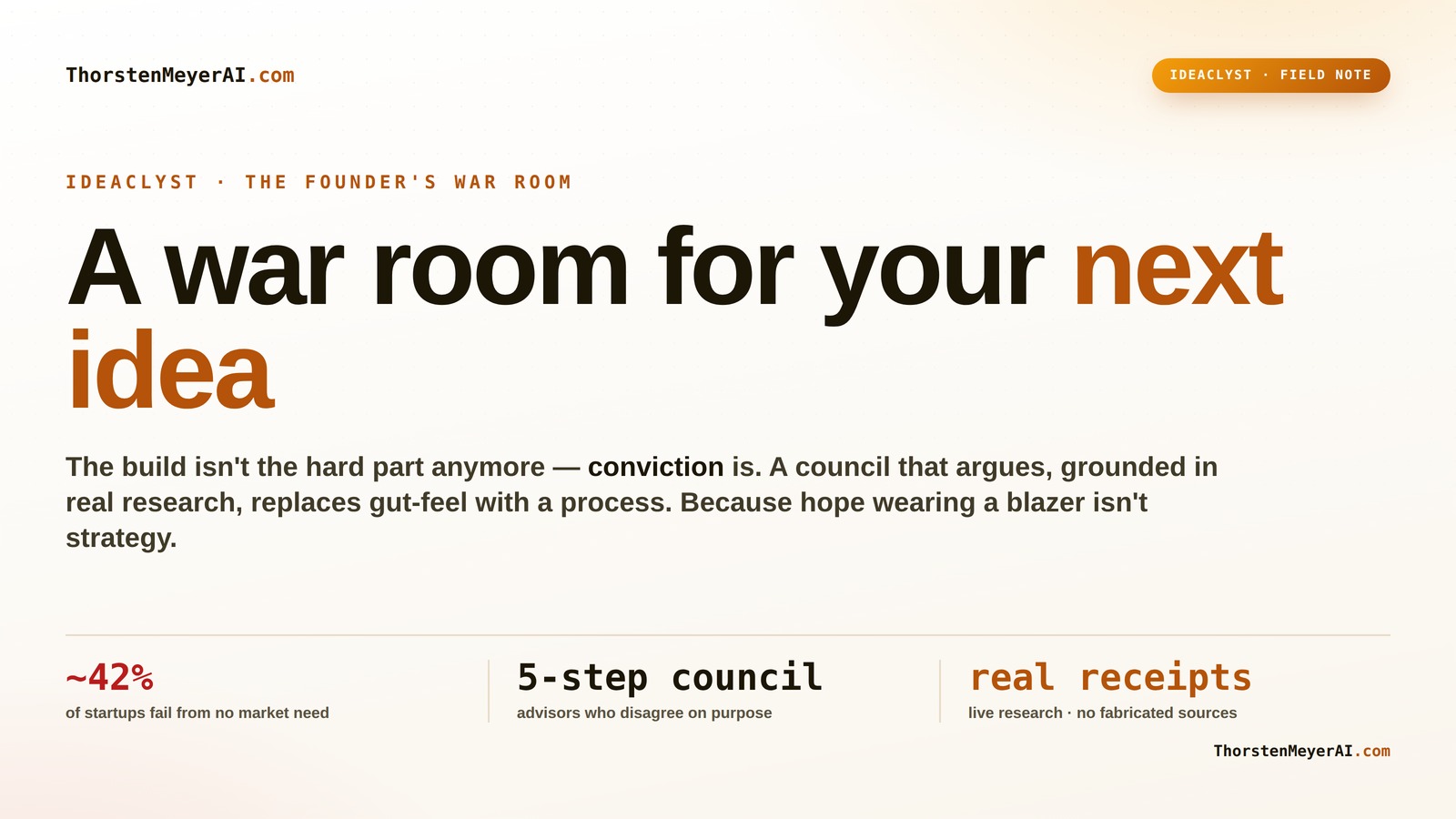
A war room for your next idea
The build isn’t the hard part anymore — conviction is. Knowing which idea deserves the next six months, and being able to defend it. Most founders answer with gut feel and optimistic math. That’s hope wearing a blazer. IdeaClyst replaces it with a process.
The most expensive decision is what to build
The single most valuable thing a tool can do is talk you out of the wrong six months. The numbers make the case better than any pitch.
Three tools in one — on your own machine
Strip away the framing and IdeaClyst is three things at once, all running locally with nothing leaving your laptop.
An AI council
Pressure-tests an idea you bring it — advisors who argue on purpose.
A discovery engine
Finds ideas you didn’t know to look for by hunting real demand signals.
A founder’s workspace
Carries winners from “interesting” all the way to “ready to build.”
Advisors who disagree on purpose
Not one confident, agreeable answer — a structured five-step deliberation where models play different roles and turn on their own work. The disagreement is the feature.
The five-step deliberation
A council that leads with the bad news surfaces the objections you’d otherwise find the expensive way, on month five.
Product strategy
Who’s it for, what’s the wedge, why now, what’s the business model.
Technical architecture
What would it actually take to build — and where’s the risk.
Critique pass
The council turns on its own work. Where’s the hand-waving? What kills this?
Second, independent critique
A different voice, a different angle — so blind spots don’t survive.
Final synthesis
Everything into one coherent founder packet: strategy, architecture, validation, plan.
When IdeaClyst cites a source, it actually fetched it
The hard departure from “ask an AI what it thinks of my startup.” It runs in a strict, real-data-only mode — if it can’t gather genuine evidence, it says so plainly rather than inventing a plausible paragraph.
Confidence with receipts
No fabricated statistics, no imaginary competitors, no made-up citations. The packet survives a skeptical co-founder or a sharp investor because the reasoning has receipts.
Market research first
Scouts the landscape before the council reasons about anything.
Competitor read
Real positioning, pricing signals, feature claims — differentiation vs. reality.
Validation with links
Not “talk to customers” — concrete signals & sources you can click.
From the blank page to build-ready
Evaluation is half the problem; the blank page is the other half. And a plan is worthless if it dies in a tab you never reopen.
Bring a space, not an idea
“AI for accountants,” “tools for indie game studios” — plus your goal and real capacity. It hunts demand signals across HN, Reddit, Product Hunt, GitHub, pricing pages.
- An honest market read — leads with the bad news when a space is hard
- An opportunity map — high pain, thin competition
- Ranked candidates — wedge, who pays, effort, risk, confidence
- each with KILL CRITERIA — when to walk away
A home and a forward path
Every promising idea gets carried forward, with every artifact in plain files on your disk.
- Validation tooling — sprint board, interview list, evidence browser
- Founder profile — a personal-fit lens; same discovery, different advice
- Build workspaces — funnel, personas, landing draft, version history
- “Build this idea” → a PRD + task queue, ready for a coding agent
Key Takeaways
- IdeaClyst’s structured council approach surfaces flaws early by intentionally creating disagreement among AI models, reducing costly mistakes.
- Grounding ideas in real-time web research helps founders avoid building products based on outdated or inaccurate assumptions.
- Keeping all data local and in open formats gives founders full control and privacy over their innovation process.
- Using a digital war room like IdeaClyst accelerates decision-making, turning months into hours of focused, evidence-backed validation.
- The tool’s open-source nature and local-first design make it accessible, flexible, and secure for founders at any stage.

SightPro Magnetic Laptop Privacy Screen 14 Inch 16:9 – Patented Removable Laptop Privacy Filter Shield and Protector
- Magnetic Snap-on Attachment: Easy to attach and remove
- Compatible with 14-inch Laptops: Fits various brands and sizes
- Enhanced Privacy Protection: Blocks side viewing, clear front view
As an affiliate, we earn on qualifying purchases.
As an affiliate, we earn on qualifying purchases.
Why a Digital War Room Is a Founder’s Secret Weapon
Think of a war room as your startup’s command center—where every piece of intel, feedback, and strategy converges. Traditionally, that meant sticky notes on whiteboards or endless Zoom calls. Now, imagine doing that on your laptop, with AI as your co-pilot.
IdeaClyst creates a private, digital war room that consolidates your idea development. It’s like having a team of advisors, critics, and strategists all in one place, challenging your assumptions and pointing out blind spots. The benefit of this setup is profound: it enables rapid iteration, reducing the time and resources spent on unviable ideas. Moreover, it fosters a culture of continuous improvement—where every piece of feedback is systematically integrated into your evolving strategy. The tradeoff, however, is that founders must become comfortable with structured critique, which can feel confrontational at first but ultimately leads to stronger ideas.

B5 Foldable Dry Erase Board, Double Sided Reusable Erasable Notebook with Foam Soft Writing Surface, Storage Pouch, Lightweight Portable Whiteboard for Exam Draft, Brainstorming & Kids Doodling
- Double-Sided Dry Erase Pages: Reusable and foldable for versatile use
- Foam Backed Surface: Resistant to indentations and scratches
- Edge Silicone Pad: Ensures durability and easy flipping
As an affiliate, we earn on qualifying purchases.
As an affiliate, we earn on qualifying purchases.
How IdeaClyst Turns Your Idea Into a Full Strategy
IdeaClyst doesn’t just store your ideas. It actively tests them through a structured five-step process, acting as a council of AI advisors. This process isn’t merely a checklist—it’s a strategic framework that encourages deep analysis and iterative refinement. Each step is designed to surface hidden assumptions, evaluate feasibility, and align your idea with market realities. The first step, for example, prompts you to clarify your target audience and value proposition—fundamental elements that determine your idea’s potential. The subsequent stages—technical architecture, critique, secondary critique, and synthesis—are interconnected; each one deepens your understanding and exposes vulnerabilities early. This approach helps you avoid the common pitfall of overconfidence and premature commitment, which often leads to costly pivots or failures. The final output, a comprehensive, well-structured plan stored as Markdown files, provides a clear roadmap for your next steps, whether pitching investors or building prototypes.

Pocket AI Voice Recorder, Auto Transcription, AI Note Taker, Space Grey
- AI Personal Assistant: Capture, transcribe, and summarize instantly
- One-Tap Recording: Effortless recording of meetings and calls
- Smart AI Insights: Automatic summaries and organized notes
As an affiliate, we earn on qualifying purchases.
As an affiliate, we earn on qualifying purchases.
Why Grounding Ideas in Real Data Beats Vibe Checks Every Time
Many founders rely on gut feelings or surface-level research, which can be wildly inaccurate. IdeaClyst grounds its council in live web research, pulling in real-time data to challenge assumptions.
For example, instead of assuming “the market is growing rapidly,” it verifies current trends, competitive landscape, and customer needs. This data-driven approach reduces the chance of building a product nobody wants—saving thousands of dollars and precious months. The importance of this is that it shifts decision-making from intuition to evidence, which significantly boosts the likelihood of market fit. However, founders must recognize that data isn’t infallible; it’s a tool to inform judgment, not replace it. The tradeoff involves the effort required to interpret and act on real-time data, which can be complex but ultimately more rewarding than relying on assumptions alone. This approach fosters a mindset of continuous learning, where decisions are constantly validated against evolving market signals, making your strategy more resilient and adaptable.

The AI Entrepreneur: How to Make Money with AI: From Idea to Launch — Build, Fund, Market, and Scale Your AI Business in 90 Days or Less
As an affiliate, we earn on qualifying purchases.
As an affiliate, we earn on qualifying purchases.
What Makes IdeaClyst Different From Other Idea-Validation Tools
| Feature | Traditional Tools | IdeaClyst |
|---|---|---|
| Data Privacy | Cloud-based, data shared across platforms | Local-first, everything stored on your machine |
| Validation Approach | Vibe-based, often unchallenged opinions | Structured council with opposing AI roles |
| Research Backing | Limited to surveys or external reports | Live web data integrated into decision-making |
| Ownership & Control | Cloud subscriptions, data ownership issues | Own your files, open source, no cloud lock-in |
Unlike typical validation tools, IdeaClyst offers a private, structured debate that surfaces flaws early and grounds decisions in current data. This approach matters because it ensures your ideas are tested against real-world conditions and not just opinions or outdated information. The local-first design also means you retain full control over your data, avoiding privacy concerns associated with cloud-based solutions. This combination of structured critique, real-time data, and data ownership makes IdeaClyst a uniquely powerful platform for founders who want both security and accuracy in their validation process.
How to Make Your Idea War Room Work for You — 3 Actionable Tips
- Set Clear Deliberation Goals: Know what you want to validate—market size, technical feasibility, user pain points. Use IdeaClyst to focus the council on these points. Clear goals help prevent aimless debates and ensure your time is spent on what truly matters, leading to more efficient validation cycles.
- Keep the Files Organized: Regularly update Markdown files, version your work, and revisit past critiques to track progress. Organized files serve as a knowledge base that grows with your project, enabling quick reference and reducing redundant effort. This discipline also helps identify patterns in your thinking and decision-making, which can reveal biases or gaps.
- Use the Disagreement: Embrace the council’s opposing views. Let the disagreements challenge your assumptions and deepen your understanding. Recognizing that conflicting perspectives are a strategic asset can lead to more robust, well-rounded ideas. The tradeoff is that it requires mental flexibility and openness to critique, but the payoff is a stronger, more validated concept ready for market.