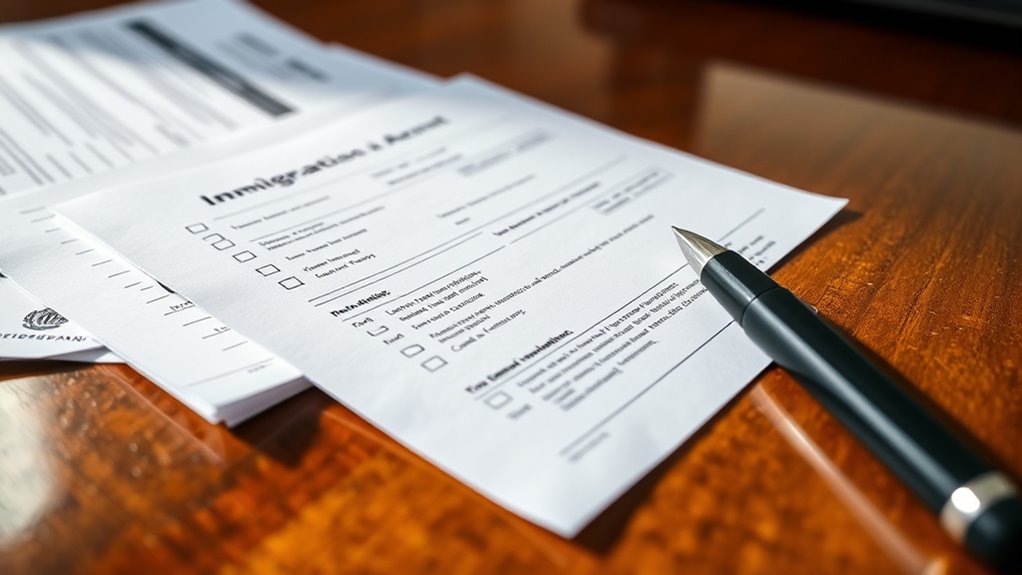

To complete immigration forms accurately, start by gathering all required documents and verifying their validity and completeness. Take your time to carefully fill out each section, double-checking for errors or missing information before submitting. Follow instructions precisely and avoid guesses—seek clarification if needed. Keep digital copies organized and review every detail thoroughly. Staying meticulous now can save you time later; continue exploring these tips to guarantee your application goes smoothly.
Key Takeaways
- Gather and verify all required documents to ensure they are current, complete, and match application details.
- Carefully review each form for accuracy, avoiding guesswork and leaving no blanks.
- Double-check spelling, dates, and personal information before submission to prevent errors.
- Organize digital copies of documents for quick reference and consistency checks.
- Follow instructions closely and seek professional guidance if any part of the process is unclear.

Have you ever felt overwhelmed by the process of completing immigration forms? It’s common to feel stressed, especially when you’re unsure if you’re filling out everything correctly. One of the biggest challenges you might face is avoiding common pitfalls that can delay your application or cause unnecessary complications. To start, pay close attention to details and double-check each answer before submitting. Mistakes like misspelled names, incorrect dates, or incomplete information can easily derail your progress. These errors often stem from rushing through the process or not thoroughly reviewing the forms. To prevent this, set aside ample time and approach each section carefully. Remember, accuracy is vital.
Another essential aspect is document verification. Before you even begin filling out the forms, gather all required documents—passports, birth certificates, proof of residence, or financial statements—and verify their validity. Make sure these documents are current, legible, and match the information you provide on the forms. Incorrect or outdated documents can raise red flags and cause unnecessary delays. It’s wise to keep digital copies and organize everything in a dedicated folder, so you can quickly access and cross-reference when needed.
During the process, be vigilant about verifying the authenticity and completeness of all your documents. For example, check that your passport is valid for the duration of your intended stay or application process. If you notice any discrepancies or missing information, address those issues beforehand. Many applicants overlook small details, like signing the form where required or including the correct supporting documents, which can lead to rejection or requests for additional information. Always read instructions carefully, and if something isn’t clear, consult official guidance or seek professional advice. Additionally, understanding security measures and how they relate to document verification can help you ensure your information remains protected throughout the process.
Furthermore, avoid the temptation to guess or leave blanks if you’re unsure about an answer. It’s better to seek clarification than to submit incorrect information. If you need help, contact the relevant immigration office or an experienced immigration consultant. They can guide you through tricky sections and help ensure your documents are in order. Remember, document verification isn’t just about having the right paperwork; it’s about making sure everything aligns perfectly with the application requirements. Doing this reduces the chances of delays and increases your chances of success.

Huolewa Fireproof Accordion File Organizer, Portable Expanding File Folder with Waterproof Zipper&Labels, Black Document Organizer with 13 Pockets, File Organizer for Important Document/Paper Storage
Super Security Sense of Documents Storage – The surface of Huolewa fireproof accordion file organizer is made of…
As an affiliate, we earn on qualifying purchases.
As an affiliate, we earn on qualifying purchases.
Frequently Asked Questions
How Do I Correct Errors After Submitting My Form?
If you find errors after submitting your immigration form, quickly document the corrections needed. Contact support as soon as possible to inform them about the mistake and ask for guidance on updating your submission. Provide any necessary documentation to support your corrections. Acting promptly helps prevent delays or complications in your process, ensuring your application remains accurate and complete. Remember, support teams are there to assist with making these essential updates.
Can I Use Abbreviations on Immigration Forms?
You should avoid using abbreviations in names or common form abbreviations on immigration forms. Abbreviations can cause confusion or delays in processing. Instead, write out full names and details clearly. If you accidentally use abbreviations, you might need to correct them later, which can complicate your case. Always double-check your form to verify you’ve written everything in full, especially names and key details, to ensure accuracy and smooth processing.
What Should I Do if I Lost My Receipt Number?
If you’ve lost your receipt number, don’t panic. You can try receipt recovery by checking your email for confirmation messages or contacting the agency directly with your personal details to retrieve your lost documentation. Keep in mind, providing proof of your application might be necessary. Staying organized and keeping copies of all related documents will help you avoid issues in the future. Reach out promptly to minimize delays.
Are Handwritten Forms Acceptable or Must They Be Typed?
You should use typed forms whenever possible because they tend to be clearer and easier to read, reducing errors. Handwritten forms are generally acceptable if the handwriting is legible, but typed forms are favored for accuracy and efficiency. Always double-check your entries, whether handwritten or typed, and follow specific instructions on the form or from the immigration authority to ensure your application is processed smoothly.
How Long Does It Take to Process Immigration Forms?
Processing times for immigration forms can feel like waiting for a river to flow—sometimes quick, sometimes slow. Usually, it takes a few months, but application delays can stretch this out even longer. Factors like your specific case, the type of form, and government workload influence how fast it moves. To stay ahead, check the official processing times regularly, and be prepared for some patience as your application makes its journey through the system.

Brother DS-640 Compact Mobile Document Scanner, (Model: DS640)
FAST SPEEDS – Scans color and black and white documents a blazing speed up to 16ppm (1). Color…
As an affiliate, we earn on qualifying purchases.
As an affiliate, we earn on qualifying purchases.
Conclusion
Filling out immigration forms accurately is essential, as errors can delay or jeopardize your application. Remember to double-check your information and follow instructions carefully. Did you know that over 30% of delays are caused by simple mistakes? Staying attentive and thorough can save you time and stress. Keep these tips in mind, and you’ll improve your chances of a smooth process. Accuracy truly makes all the difference in achieving your immigration goals.

Eoehro Passport Holder for Travel Essentials, Passport Wallet Cover Case for Travel Must Haves Accessories,Passport Book Holders for Women and Men(black)
Easy Access and Magnetic Button: Our passport wallet features a convenient magnetic button closure, making it easy to…
As an affiliate, we earn on qualifying purchases.
As an affiliate, we earn on qualifying purchases.
![Immigration Paralegal Form Filler Country [State] Custom Mug](https://m.media-amazon.com/images/I/41Jd25HdbRL._SL500_.jpg)
Immigration Paralegal Form Filler Country [State] Custom Mug
Personalization With custom monogram: Add engraved name, legal consultant name, or phrase printing to create a unique, joyful…
As an affiliate, we earn on qualifying purchases.
As an affiliate, we earn on qualifying purchases.