To effectively document board meetings and corporate minutes, you should focus on creating clear, accurate records of discussions, decisions, and action items. Use standardized formats and include executive summaries that highlight key points for quick reference. Store these records securely through digital archiving, with proper access controls and backups. Implementing best practices guarantees transparency and legal compliance. Keep exploring to discover additional tips that will enhance your record-keeping process.
Key Takeaways
- Maintain detailed, accurate records of discussions, decisions, and actions during board meetings for transparency and accountability.
- Prepare clear executive summaries highlighting key decisions, votes, and follow-up actions for quick reference.
- Use standardized templates and formats to ensure consistency and ease of understanding across all minutes.
- Store minutes securely in a digital archive with proper access controls, backups, and version tracking.
- Implement security measures like encryption and regular backups to protect sensitive information and ensure reliable record-keeping.

Keeping accurate records of board meetings is essential for transparency, accountability, and future reference. When you document these meetings properly, you create a clear record of decisions, discussions, and actions that can be reviewed at any time. One effective way to streamline this process is by including executive summaries at the beginning of your minutes. These summaries offer a concise overview of key points, decisions, and upcoming action items, making it easier for stakeholders to grasp the meeting’s outcomes quickly. They serve as a snapshot that highlights the critical issues discussed, saving time for busy board members who may need to revisit specific topics later.
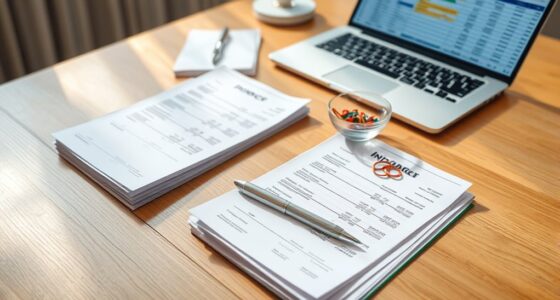
Executive summaries in meeting minutes provide quick insights into key decisions and discussions.
In addition to well-crafted summaries, leveraging digital archiving tools can markedly enhance your record-keeping process. Digital archiving allows you to store all your board meeting minutes securely in a centralized location that’s accessible to authorized personnel. This approach not only saves physical space but also ensures that your records are protected from loss, theft, or damage. When you use digital archiving, you can organize documents systematically, tagging them with relevant keywords, dates, or project names, which makes retrieval simple and efficient. Plus, digital records are easier to update or revise, providing an accurate and current reflection of your organization’s history.
Another advantage of digital archiving is the ability to maintain version control, which helps track changes over time and ensures consistency. If amendments are made to previous minutes or summaries, you can track changes over time, ensuring everyone is working with the most recent information. This is particularly useful during audits or legal reviews, where precise documentation is indispensable. When creating your executive summaries, keep them clear and focused, highlighting only the most relevant details. Avoid lengthy narratives; instead, concentrate on decisions made, votes taken, and action items assigned. This practice not only enhances clarity but also ensures your records serve as practical tools for ongoing governance.
Furthermore, maintaining digital records with proper security measures is indispensable. Use encryption and access controls to restrict sensitive information to authorized personnel. Regular backups are also essential to prevent data loss. As you develop your documentation practices, remember that consistency is key. Standardize your format for minutes and summaries to facilitate easier understanding and comparison over time. By combining succinct executive summaries with robust digital archiving, you’re setting up a streamlined, reliable system that supports effective governance, compliance, and organizational memory.

Epson Workforce ES-580W Wireless Color Duplex Tax Receipt & Desktop Document Scanner for PC and Mac with 100-sheet Auto Feeder (ADF), Intuitive 4.3' Touchscreen
EFFORTLESS WIRELESS SCANNING – With a 4.3" touchscreen and wireless connectivity, this high-speed scanner sends scans straight to...
As an affiliate, we earn on qualifying purchases.
Frequently Asked Questions
How Long Should Board Meeting Minutes Be?
You should aim for meeting minutes that are concise yet exhaustive, typically around one to two pages, depending on the meeting’s length and detail level. Keep the record clear by capturing key decisions, action items, and discussions without unnecessary detail. Focus on the meeting length and essential points, ensuring accuracy and clarity. Well-documented minutes support accountability and provide a reliable record for future reference.
Who Is Responsible for Approving the Minutes?
You are responsible for approving the minutes, ensuring the approval process is thorough and accurate. Typically, the board chair or secretary presents the minutes, and members vote on their approval using established voting procedures. This step is essential because it confirms everyone agrees on what was discussed and decided. By actively participating in this approval process, you help maintain transparency and accountability that’s as critical as the company’s very heartbeat.
Can Meeting Minutes Be Altered After Approval?
Yes, meeting minutes can be altered after approval if proper amendment procedures are followed. You should record any changes to maintain record authenticity, guaranteeing transparency and accuracy. To amend the minutes, you typically need approval from the board or relevant authority, documenting the reasons for the edits. This process helps preserve the integrity of the official record and ensures that all amendments are properly authorized and recorded.
Are Digital Recordings Acceptable as Legal Records?
Digital recordings are like the DNA of your meetings—powerful and precise. They’re often acceptable as legal records, provided they meet jurisdictional standards for authenticity and integrity. To guarantee their legal validity, you should verify that recordings are clear, unaltered, and properly stored. When these conditions are met, digital recordings can serve as reliable evidence, giving you confidence that your meeting documentation stands up in court.
How Should Confidential Information Be Documented?
You should document confidential information by following strict confidentiality protocols and using encryption standards to protect data. Guarantee access is limited to authorized personnel, and use secure, encrypted storage methods. Clearly label sensitive documents, and implement secure communication channels for sharing confidential details. Regularly review and update your confidentiality protocols and encryption standards to stay ahead of potential breaches and maintain the integrity of your confidential information.

Epson Workforce ES-400 II Color Duplex Desktop Document Scanner for PC and Mac with Auto Doc Feeder (ADF), Image Adjustment Tools
FAST DOCUMENT SCANNING – Speed through stacks with the 50-sheet Auto Document Feeder, perfect for office scanning and...
As an affiliate, we earn on qualifying purchases.
Conclusion
Think of documenting board meetings as tending a garden. Your notes are the seeds that grow into a thriving, enduring landscape of transparency and trust. With careful attention and timely recording, you nurture these plants, ensuring they flourish for years to come. Just as a well-tended garden brings beauty and resilience, thorough minutes create a sturdy foundation for your organization’s future. Your diligence today blooms into clarity and confidence tomorrow.

ScanSnap iX2500 Wireless or USB High-Speed Cloud Enabled Document, Photo & Receipt Scanner with Large 5" Touchscreen and 100 Page Auto Document Feeder for Mac or PC, Black
OUR MOST ADVANCED SCANSNAP. Large touchscreen, fast 45ppm double-sided scanning, 100-sheet document feeder, Wi-Fi and USB connectivity, automatic...
As an affiliate, we earn on qualifying purchases.

Epson WorkForce ES-50 Portable Sheet-Fed Document Scanner for PC and Mac
Fastest and lightest mobile single sheet fed document scanner in its class(1) small, portable scanner ideal for easy,...
As an affiliate, we earn on qualifying purchases.