
TL;DR

Prime made for students and young adults
- Fast, free delivery for dorm and study essentials
- Prime Video and Amazon Music included
- Member-only deals
Anthropic’s $65 billion Series H round pushes its valuation to nearly a trillion dollars, but the real story is a massive investment in AI compute capacity. This signals a shift from traditional funding to infrastructure-heavy growth, with compute as the new battleground.
When a startup hits a valuation nearing a trillion dollars, it’s tempting to focus on the headline figure. But behind the numbers, a different story is unfolding. Anthropic’s latest funding isn’t just about valuation — it’s about building an enormous compute backbone for AI’s next leap.
This round reveals a shift in how AI companies are valued and scaled, highlighting the importance of infrastructure investment. It’s less about current revenue and more about the capacity to train, run, and scale massive models, reflecting a computation-first AI strategy. If you want to understand what’s really happening in AI, look beyond the dollar signs — because this is a story about infrastructure, demand, and the future of compute.
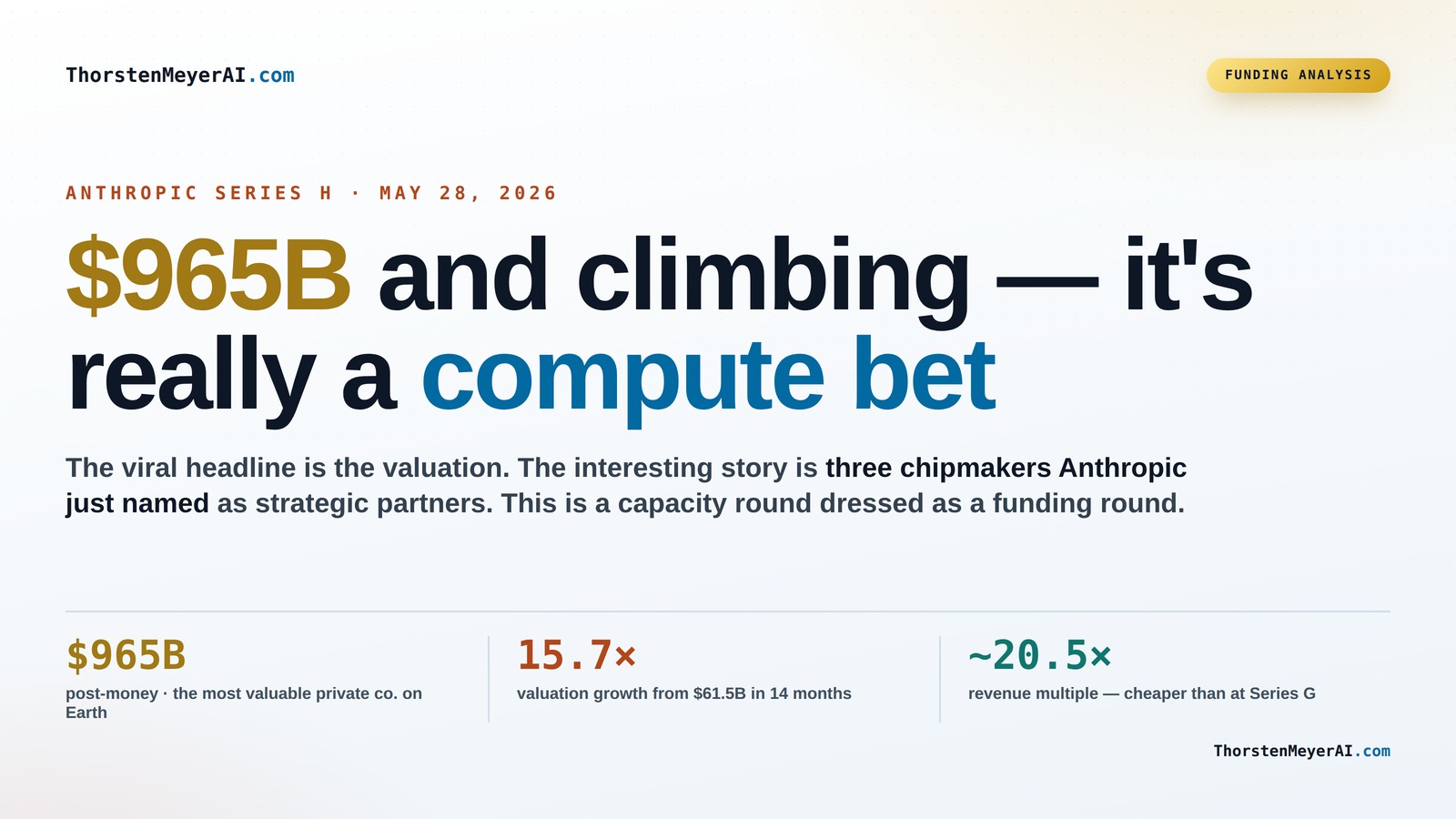
$965B and climbing — it’s really a compute bet
The viral headline is the valuation. The interesting story is in the press release’s middle paragraphs — and in three chipmakers Anthropic just named as strategic partners. This is a capacity round dressed as a funding round.
The numbers nobody can quite parse in sequence
Read together they describe a trajectory with no precedent in enterprise software. Read individually, each looks like a typo.
From $61.5B to $965B in fourteen months
Salesforce took roughly two decades to reach revenue numbers Anthropic just blew past. The sequence below is the part most coverage skips — it’s not the size, it’s the shape.
Anthropic’s valuation ladder · Mar 2025 → May 2026
Five rounds, fourteen months. Bar height is the valuation; the climb itself is the story. Tap any milestone for context.
The multiple actually got cheaper
Bubbles look like multiples expanding while revenue lags. Anthropic’s pattern is the inverse — the valuation tripled, but revenue grew faster, and the multiple compressed.
Revenue-to-valuation multiple · Series G → Series H
Same company, three months apart. The denominator (revenue) is outrunning the numerator (valuation) — exactly the opposite of what a bubble narrative predicts.
10+ gigawatts and three chipmakers
When you name Micron, Samsung & SK hynix alongside your equity backers, you’re saying the binding constraint isn’t demand or model quality — it’s the physical supply of memory chips. The Series H is a capacity round.
Compute commitments backing Anthropic’s capacity bet
$200B+ in announced compute spend across multi-year contracts. The $65B Series H raise has to be read against that bill, not against operating losses.
A genuinely durable bet — or a structural exposure?
Both readings can be true at once. The answer arrives over the next 18–24 months as the gigawatts come online and either fill with paying demand or don’t.
Revenue growth has no precedent in B2B software ($1B → $47B in 17 months). The multiple is compressing, not expanding. Claude is the only frontier model on all 3 major clouds. Enterprise AI spend share went from ~10% to >65% in a year. Compute commitments are tied to specific contracts with capacity dates.
20× revenue is not cheap by any historical software-investing standard. Revenue is reported gross of cloud-reseller pass-throughs, which inflates the top line. Profitability is 2 years out. Amodei’s own warning: a 12-month delay in AI progress “would make him bankrupt” — the compute commitments are a structural exposure to demand persistence.
The valuation race — and the IPO context
Anthropic shipped Opus 4.8 the same morning as Series H — not a coincidence. One week after OpenAI filed confidentially for IPO. The late-2026 frame is set: two frontier AI companies racing to public markets, each pitching durability.
Key Takeaways
- Anthropic’s $65 billion raise is primarily an infrastructure investment, not just a valuation event.
- The company is building the hardware backbone needed to support exploding AI demand and revenue.
- Despite the valuation tripling, its revenue growth has compressed the valuation multiple, signaling real demand.
- Compute capacity is now the critical resource, turning AI companies into hardware and infrastructure players.
- This shift hints at a future where AI success depends on who controls the hardware, not just the models.
As an affiliate, we earn on qualifying purchases.
Why Anthropic’s $65B raise is more about capacity than cash
Anthropic’s latest round isn’t your typical funding event. It’s a capacity push, aimed at expanding compute power. The company is betting that the bottleneck isn’t just talent or data — it’s the chips, datacenters, and infrastructure needed to keep up with demand.
Imagine trying to fill a swimming pool with a small hose. No matter how fast the water flows into the hose, if the pipe is narrow, the pool fills slowly. Anthropic is buying massive pipes — chips from Micron, Samsung, SK hynix — and enough datacenter capacity to pour that water fast enough to meet skyrocketing demand.
In concrete terms, the company committed over 10 gigawatts of compute capacity, enough to power hundreds of large AI models. That’s like building a new city’s worth of data centers just to keep AI running seamlessly, underscoring the focus on AI compute infrastructure.
Why does this matter? Because in AI, hardware limitations directly constrain what’s possible. Without sufficient compute, even the most innovative algorithms and talented teams can’t scale effectively. This infrastructure focus indicates a strategic shift: the future of AI growth hinges on hardware capacity, not just software advancements, as discussed in the compute-heavy future of AI. It’s a tradeoff — investing heavily now to avoid bottlenecks later, which could determine who leads in frontier AI.

high performance GPU for AI training
As an affiliate, we earn on qualifying purchases.
As an affiliate, we earn on qualifying purchases.
How the numbers reveal a shift — from hype to real growth
Anthropic’s valuation soared from $61.5 billion in March 2025 to nearly $1 trillion just over a year later. But here’s the kicker: its revenue didn’t just grow — it exploded. From about $9 billion at the end of 2025 to over $47 billion in early May 2026.
That’s a 5.4× increase in just 14 weeks. And analysts expect Q2 revenue to hit around $11 billion — more than the entire previous year. This rapid revenue growth is pulling the valuation multiple *down*, from 27× to roughly 20.5× — meaning revenue is growing faster than valuation, indicating a maturing market where real demand is backing the hype.
This multiple compression is critical: it signals that investors are now valuing AI companies based on tangible growth and capacity rather than speculative hype. The rapid revenue surge shows that AI services are becoming mainstream, and the infrastructure investment is what’s enabling this transition. It’s a validation that the market is moving from a hype-driven frenzy to sustainable, demand-driven expansion — a sign that AI’s future growth is grounded in hardware scalability and capacity, not just clever algorithms.

As an affiliate, we earn on qualifying purchases.
What “compute” really means in Anthropic’s world
When people say ‘compute,’ they mean the chips, servers, and data centers that process and train AI models. For Anthropic, this means hundreds of thousands of GPUs running round-the-clock to keep Claude and other models alive and improving.
Think of it like a power grid. The more AI models are used, the more electricity (compute) they need. Anthropic is investing billions to build a robust, scalable power grid for AI — ensuring it doesn’t run out of juice just when users flood in.
For example, a single large AI model can require thousands of GPUs working in sync. The new capacity from Micron, Samsung, and SK hynix isn’t just for training new models — it’s about maintaining inference speed for millions of user requests every day.
Why does this matter? Because in AI, compute isn’t just a cost — it’s a strategic enabler, a key component of AI infrastructure. Adequate compute capacity means faster training, lower latency, and the ability to serve more users simultaneously. Without it, even the most advanced models can’t reach their full potential. This infrastructure is the backbone that allows AI to scale reliably and efficiently, making compute a key competitive advantage in the race for frontier AI dominance.

As an affiliate, we earn on qualifying purchases.
The real strategic play: infrastructure over hype
Many see AI companies as software firms, but Anthropic’s latest move hints at a different game. It’s investing heavily in the infrastructure needed to stay competitive. This isn’t just about making models smarter — it’s about making them faster, more reliable, and more accessible.
Imagine trying to run a marathon with a flimsy pair of shoes. Now, upgrade to high-tech sneakers designed for speed and endurance. That’s the shift — from just building models to building the *entire* infrastructure ecosystem that powers AI at scale.
Leading AI labs are now valued partly on how well they convert capital into compute capacity, emphasizing the importance of compute power. It’s a shift from a pure model game to a capacity game — a race for the hardware, the chips, and the datacenters that make AI feasible at scale. This focus on infrastructure reflects a recognition that the true bottleneck and competitive advantage lie in hardware scalability, not merely algorithmic innovation. Companies that can rapidly expand their compute capacity will have a significant edge in deploying larger, more complex models and in supporting a broader user base, ultimately shaping the landscape of AI leadership for years to come.

Compare: How Anthropic stacks up against OpenAI
| Metric | Anthropic |
|---|---|
| Valuation (March 2026) | $965 billion |
| Revenue (Q2 2026 estimate) | $10.9 billion |
| Multiple (valuation/revenue) | 20.5× |
Compare this with OpenAI — valued at around $852 billion with about $13 billion in revenue, giving a multiple closer to 65×. While OpenAI’s valuation is higher, Anthropic’s multiple is significantly lower, indicating a different investor perspective — more on capacity and growth potential than hype.

What does this mean for the future of AI and your Claude access?
This isn’t just big money — it’s a sign of what’s to come. Anthropic is positioning itself not just as a model builder, but as an infrastructure powerhouse that can handle rapid growth and customer demand.
For users and enterprise clients, it means smoother, faster AI experiences. For the industry, it signals that the race to build and scale AI models is now a battle over hardware and capacity — not just code and algorithms.
Expect more massive infrastructure plays, more capacity-driven valuations, and a world where AI’s future hinges on who can keep the power flowing fastest.
Frequently Asked Questions
Why did Anthropic raise so much money?
Anthropic’s large raise is primarily to expand its compute infrastructure, ensuring it can meet rising demand for its AI models like Claude. It’s a strategic move to secure hardware capacity rather than just funding growth.What does ‘compute’ mean here?
‘Compute’ refers to the chips, servers, and data centers that process and train AI models. For Anthropic, it’s about acquiring enough GPU power to handle training, inference, and scaling models for millions of users.How is the money being used?
Most of the funds are allocated to buying chips from Micron, Samsung, and SK hynix, and expanding datacenter capacity. This infrastructure allows Anthropic to keep up with increasing model complexity and user demand.Is the valuation justified by revenue?
While Anthropic’s valuation is enormous, its revenue growth is even faster, pulling the valuation multiple down. This suggests investors see real, scalable demand for its AI services, not just hype.How does this compare to OpenAI?
Anthropic’s valuation is higher, but its multiple (around 20.5× revenue) is much lower than OpenAI’s (about 65×). This indicates a shift toward valuing capacity and growth potential over current revenue levels.Conclusion
What’s clear is that Anthropic’s latest funding is a bold declaration: the future of AI depends on who can build the biggest, fastest, most reliable compute capacity. It’s not just about clever algorithms; it’s about hardware, infrastructure, and relentless scaling.
Keep an eye on the chips, datacenters, and the strategic partnerships shaping this new frontier. Because in AI today, the biggest investments aren’t just in software — they’re in the power grid that keeps AI alive.

Halloween Picks
halloween
As an affiliate, we earn on qualifying purchases.