
TL;DR

Prime made for students and young adults
- Fast, free delivery for dorm and study essentials
- Prime Video and Amazon Music included
- Member-only deals
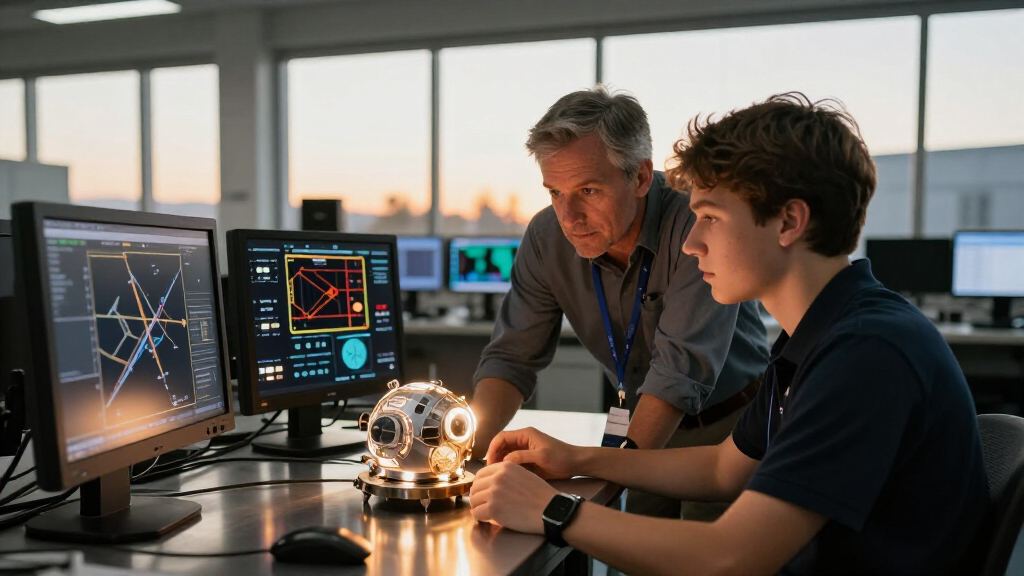
NASA’s Johnson Space Center has highlighted how engineer Daniel Cohen mentors Rice University student and intern Malvika Bhardwaj. Her work includes tools and simulations related to the U.S. Deorbit Vehicle, which is intended to safely remove the International Space Station from orbit at the end of its operational life.
NASA’s Johnson Space Center has profiled Rice University intern Malvika Bhardwaj and the mentorship she receives from Daniel Cohen, a guidance, navigation and control engineer, as she contributes analysis tools and simulations related to the U.S. Deorbit Vehicle. NASA said Bhardwaj’s internship combines technical work with support from a mentor who sets aside time each week to teach interns, offering a specific example of how the agency connects early-career talent with work tied to the International Space Station’s eventual retirement.
Bhardwaj studies computational and applied mathematics at Rice and interns with Johnson’s guidance, navigation and control team. NASA said she is developing tools to analyze thruster firings on the U.S. Deorbit Vehicle, the spacecraft intended to help safely deorbit the International Space Station at the end of its operational life. She also uses computer simulations to test the vehicle’s control system and identify conditions under which it could fail.
Cohen, a Rice alumnus with a master’s degree in mechanical engineering, joined NASA as a flight operations intern in 2020. After internships in docking dynamics, propulsion systems and GN&C analysis, he became a full-time Johnson engineer in August 2024. His current responsibilities include modeling and simulation work on the deorbit vehicle, analysis of its control algorithms and performance, and evaluation of SpaceX’s design at multiple life-cycle reviews, according to NASA.
NASA reported that Cohen spends a couple of hours each week teaching interns subjects including orbital mechanics and control systems. He also introduces Bhardwaj to colleagues and includes her in team conversations and meetings. The agency’s account presents the arrangement as both technical instruction and a way for an intern to see how engineering work is coordinated across a larger team.
Mentoring Meets Deorbit Engineering
The profile links workforce development to a concrete NASA engineering challenge: planning the International Space Station’s eventual deorbit. Bhardwaj’s tools and simulations are part of analysis work related to the U.S. Deorbit Vehicle, though NASA’s account does not say that her work alone determines the vehicle’s design or flight readiness. The example shows how an intern can contribute to ongoing technical work while learning methods used by agency engineers.
It also illustrates a practical part of early-career training that can be hard to capture through project descriptions alone: access to experienced colleagues, regular instruction and participation in team discussions. Bhardwaj said the experience helped her understand that problem-solving is rarely an individual effort and that contributors need to see how their work connects to a wider project. That perspective matters in spacecraft engineering, where navigation, control, propulsion and mission operations must function together.
For students considering NASA internships, the story offers an account of a pathway into agency work rather than evidence of a broad program outcome. NASA says interns contribute to projects while building technical skills and hands-on experience. The profile does not provide figures on how many interns later enter NASA careers, but Cohen’s own progression—from student intern to full-time engineer—shows one route through the agency’s internship system.
Popular right now

Ninja Luxe Café Mini Plus Espresso and Drip Coffee Machine with AutoFroth, Stainless Steel, ES351

Ninja CREAMi 7-in-1 Ice Cream Maker, NC301

KitchenAid Artisan Series 5-Quart Tilt-Head Stand Mixer, Dried Rose (KSM150PS)
As an affiliate, we earn on qualifying purchases.
From Intern to Johnson Engineer
Cohen’s career began with a NASA flight operations internship in 2020. He subsequently completed internships in docking dynamics, propulsion systems and GN&C analysis before joining Johnson as a full-time employee in August 2024. His experience spans areas relevant to spacecraft movement and operations, the same broad technical environment in which Bhardwaj is now learning and contributing.
Beyond the deorbit vehicle, Cohen analyzes settings for the Orion spacecraft’s docking camera. NASA said the camera provides positioning measurements that can inform navigation during future Artemis rendezvous activities. The work is separate from Bhardwaj’s described internship tasks, but it gives a sense of the range of spacecraft systems addressed by Johnson’s GN&C staff.
NASA published the profile in recognition of National Mentoring Day on Oct. 27. The agency says its Office of STEM Engagement supports internships that let students contribute to projects and learn from NASA mentors. The source describes Bhardwaj’s experience and Cohen’s mentoring practices; it does not present an evaluation of the internship program as a whole.
“No matter what interests you, there’s likely a role for you here.”
— Malvika Bhardwaj
Limits of the Profile’s Evidence
NASA’s report does not give technical performance results for Bhardwaj’s tools or simulations, or say whether they have been incorporated into a final vehicle design. It also does not describe the specific failure conditions she is testing, the status of the U.S. Deorbit Vehicle’s development, or the timing of the project’s next review.
The article is a profile of one intern and mentor, not an independent assessment of NASA’s internship program or a measure of how mentoring affects recruitment and retention. The source does not state the year of the Oct. 27 publication, and it provides no broader data on internship applications, placements or subsequent employment.
Internship Work and Vehicle Reviews
Bhardwaj’s internship work, as described by NASA, involves developing analysis tools and testing the deorbit vehicle’s control system through simulations. Cohen’s broader project duties include examining the vehicle’s GN&C performance and evaluating SpaceX’s design at multiple life-cycle reviews. The source does not announce a date for a next review or specify when Bhardwaj’s internship will end.
NASA’s profile also leaves the eventual outcome of the intern’s work open: it does not say which analyses will inform later engineering decisions. The next substantive updates would be project information from NASA about the vehicle’s design and review process, alongside any further account of Bhardwaj’s internship or the agency’s mentoring efforts.
Key Questions
What is Malvika Bhardwaj working on at NASA?
NASA says Bhardwaj is developing tools to analyze thruster firings on the U.S. Deorbit Vehicle and using computer simulations to test its control system and identify possible failure conditions.
Who is mentoring Bhardwaj?
Her mentor is Daniel Cohen, a guidance, navigation and control engineer at Johnson Space Center and a Rice University alumnus. NASA says he sets aside a couple of hours each week to teach interns topics such as orbital mechanics and control systems.
What is the U.S. Deorbit Vehicle intended to do?
NASA describes it as the vehicle intended to help safely deorbit the International Space Station at the end of the station’s operational life. The profile does not give a launch date or a detailed development schedule.
Does NASA say Bhardwaj’s work has been adopted for the vehicle?
No. The report describes the analysis tools and simulations she is developing, but does not say whether they have been incorporated into a final design or have produced specific performance results.
What advice did Bhardwaj give students interested in NASA internships?
She encouraged students to apply even if they do not feel fully prepared, saying much of the learning happens on the job and advising applicants to trust their ability to adapt to new environments.
Source: nasa.gov