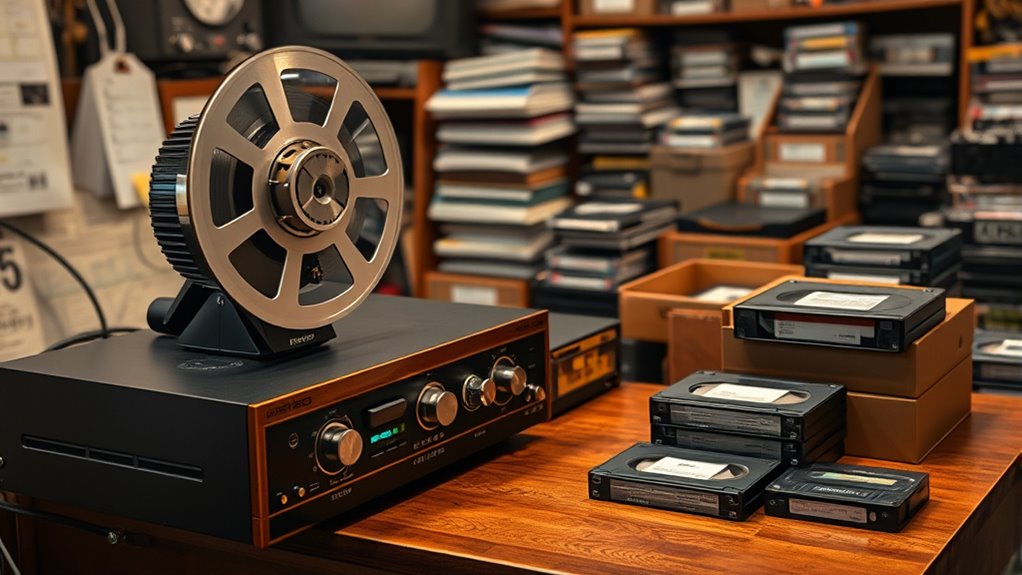

To preserve your audio and video effectively, focus on choosing stable, widely supported formats like WAV or FLAC for audio and MP4 or MOV for video. Regularly evaluate your media’s condition and migrate files to current formats to prevent obsolescence. Store copies in multiple secure locations, including cloud options. Professional digital restoration can enhance quality when needed. Following these best practices guarantees your memories stay accessible and in good quality long-term; there’s more to learn on how to keep your collections safe.
Key Takeaways
- Convert aging media to current, stable digital formats like MP4 or WAV to prevent obsolescence.
- Use professional digital restoration to repair damaged audio and video, ensuring high-quality preservation.
- Regularly evaluate media condition and migrate files proactively to newer formats for longevity.
- Store copies in multiple secure locations, including cloud and external drives, to safeguard against data loss.
- Follow best practices by maintaining detailed metadata and documentation for easy future access and management.

In today’s digital age, preserving audio and video recordings is more important than ever to guarantee that your memories, cultural heritage, and historical records remain accessible for future generations. As media formats evolve rapidly, it’s essential to understand how digital restoration and format migration play crucial roles in safeguarding your collections. Digital restoration involves cleaning up and repairing damaged or degraded recordings to restore their original quality. This process can remove noise, correct distortions, and enhance clarity, ensuring your media remains as close to the original as possible. By investing in digital restoration, you prevent the deterioration caused by aging tapes, discs, or degraded files, making sure that your recordings are preserved in the best possible condition.
Digital restoration preserves quality and prevents deterioration of your valuable audio and video recordings.
However, restoration alone isn’t enough if the media is stored in outdated formats. Format migration becomes critical in this context. It involves transferring your audio and video files from obsolete or unsupported formats to modern, widely compatible ones. For example, old VHS tapes or Betamax recordings need to be digitized into formats like MP4 or WAV to guarantee they’re playable on current devices. Without proper format migration, you risk losing access to your recordings due to hardware obsolescence or software incompatibility. By regularly migrating files to current formats, you extend their lifespan and maintain ease of access for future use or sharing.
You should consider creating a clear preservation plan that includes routine digital restoration and proactive format migration. Start by evaluating the current condition of your media—note any signs of deterioration or format obsolescence. Then, invest in professional digital restoration services when needed, especially if your recordings have significant damage or degradation. Next, convert your files into current, stable formats, and store them securely in multiple locations, such as external drives and cloud storage, to prevent data loss. Keeping your media in updated formats also simplifies future migration efforts, reducing potential complications down the line. Additionally, understanding the importance of media format compatibility can help you choose the most suitable formats for long-term preservation.
Ultimately, staying proactive with digital restoration and format migration ensures your audio and video collections endure over time. It’s about more than just preserving files; it’s about safeguarding your personal memories, cultural stories, and historical records for generations to come. By understanding and implementing these key practices, you make sure that your recordings remain accessible, high-quality, and protected against the relentless march of technology change. Proper preservation isn’t a one-time task—it’s an ongoing process that guarantees the longevity and relevance of your media collections well into the future.

Kosbees 500 GB External Hard Drives,Portable Hard Drive for Windows,Ultra Slim External HDD Store Compatible with PC, MAC,Laptop,PS4, Xbox one, Xbox 360;Plug and Play Ready
- Plug-and-Play Compatibility: No software needed, ready to use in Windows
- Fast Data Transfer: USB 3.0 with speeds up to 133MB/s read
- High Capacity Portable Storage: 500GB capacity in a lightweight, compact design
As an affiliate, we earn on qualifying purchases.
As an affiliate, we earn on qualifying purchases.
Frequently Asked Questions
How Can I Detect Obsolete or Unsupported Formats?
To detect obsolete or unsupported formats, regularly review industry updates and format obsolescence reports. Use media migration tools that identify outdated formats and recommend conversion options. You can also check codec compatibility and file headers for clues about unsupported formats. Staying proactive helps prevent data loss, ensuring your media remains accessible over time. Keep a maintenance schedule to review and update your media formats, avoiding potential future compatibility issues.
What Are the Best Methods for Digital File Verification?
To guarantee your digital files stay intact, you should regularly perform checksum verification, which helps confirm file integrity. Use tools like MD5 or SHA-256 to generate checksums and compare them over time. This process detects any alterations or corruption, giving you confidence your files remain authentic and unaltered. Incorporating checksum verification into your digital preservation routine is the best way to maintain the integrity of your files long-term.
How Do I Handle Copyright Restrictions During Preservation?
Imagine steering a maze of copyright restrictions, where each turn requires careful planning. To handle copyright restrictions during preservation, you must prioritize copyright compliance and licensing considerations. Always seek permission or make certain your use falls within fair use or fair dealing. Keep detailed records of licenses and permissions. This way, your preservation efforts respect creators’ rights and avoid legal pitfalls while maintaining the integrity of your collection.
What Are Cost-Effective Preservation Techniques for Archives?
To save costs, focus on file migration to newer, more stable formats and manage metadata effectively. Regularly updating files guarantees compatibility and reduces hardware reliance. Use open-source or widely supported formats to cut licensing costs. Maintain organized metadata to streamline retrieval and preservation efforts, minimizing the need for costly reformatting. These practices help you preserve your archives efficiently without overspending, ensuring long-term access and integrity.
How Can I Ensure Long-Term Accessibility Across Devices?
Think of your media as a treasure chest, and metadata management as its map, guiding you through its contents across devices. To guarantee long-term accessibility, use reliable storage media and regularly update formats to prevent obsolescence. Keep detailed metadata to track formats, origins, and storage conditions. By maintaining this map and updating your treasure, you preserve your content’s accessibility, allowing it to shine clearly on any device, now and in the future.

Blaupunkt EP-1200XPRO Digital Bass Enhancer Processor – Digital Sound Restoration, Maximizer & Reproducer – Car Audio Booster – Black
- Digital Bass Enhancer: Enhances bass performance and tuning
- Advanced Audio Features: Offers personalized sound customization
- Dashboard Remote Control: Adjusts settings conveniently from dashboard
As an affiliate, we earn on qualifying purchases.
As an affiliate, we earn on qualifying purchases.
Conclusion
By embracing thoughtful preservation practices and choosing suitable formats, you guarantee your audio and video treasures gracefully endure the passage of time. While technology continually evolves, your careful stewardship helps these moments quietly transcend their fleeting nature, maintaining their essence for future generations. With attentive care and subtle adaptation, you safeguard memories in a way that respects their delicate beauty, allowing them to softly continue whispering stories long after the initial moment has passed.

iView 3300STB ATSC Converter Box with Recording, Media Player, Built-in Digital Clock, Analog to Digital, QAM Tuner, HDMI, USB
- Digital Converter for Analog TVs: Converts digital air channels to analog TVs
- Supports ClearQAM: Compatible with unscrambled cable channels
- TV Program Recording: Save TV programs for later viewing
As an affiliate, we earn on qualifying purchases.
As an affiliate, we earn on qualifying purchases.

As an affiliate, we earn on qualifying purchases.