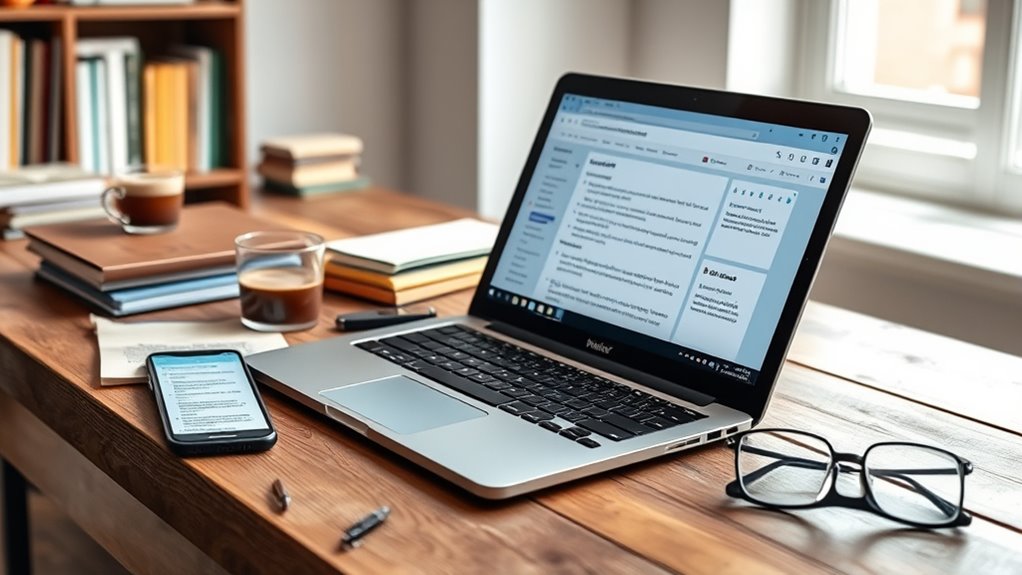

To improve your online research skills, start by critically evaluating each source’s credibility—check the author’s expertise, the publication’s reputation, and whether the content is current. Look for supporting evidence like citations and references, which boost trustworthiness. Use tools or systems to organize your references with details like author, title, and URLs, making verification easier. Cross-verify facts across trusted sources and adopt consistent citation formats. Keep honing these skills, and you’ll become more confident in finding and managing reliable information.

Prime made for students and young adults
- Fast, free delivery for dorm and study essentials
- Prime Video and Amazon Music included
- Member-only deals
Key Takeaways
- Verify author credentials and publication reputation to ensure source credibility.
- Look for supporting evidence, citations, and references to validate information accuracy.
- Use digital tools to organize and manage references systematically during research.
- Cross-check facts across multiple reputable sources to ensure consistency.
- Adopt a consistent citation style to maintain professionalism and facilitate source verification.

Have you ever wondered how to find reliable information quickly in today’s digital world? Navigating the vast sea of online content can feel overwhelming, but mastering credibility assessment can help you identify trustworthy sources. When you evaluate a website or article, start by checking the author’s credentials and the publication’s reputation. Is the author an expert in the field? Does the site have a clear editorial process? These questions help determine if the information is credible. Also, consider whether the content is up-to-date and supported by evidence. If a source lacks citations or references, it should raise suspicion about its accuracy. Conversely, reputable sources often cite studies, official reports, or academic research, which bolsters their reliability. Additionally, understanding how to assess the accuracy of online content can further improve your research quality.
Evaluating author credentials and evidence supports trustworthy online information.
Citation management plays an essential role in maintaining the integrity of your research. As you gather information, develop a system for organizing your references. Using digital tools or software can streamline this process, allowing you to save, annotate, and retrieve sources efficiently. Proper citation management not only saves time but also helps you avoid accidental plagiarism and gives credit to original authors. When you quote or paraphrase information, always record the source details—author, title, publication date, URL, and access date if applicable. This habit ensures you can easily verify your references later and helps you weave a well-documented argument.
Applying these skills means being intentional about the sources you select. Don’t settle for the first piece of information you find; instead, cross-verify facts across multiple credible sources. This practice enhances your credibility assessment skills, making certain your work is built on solid foundations. As you organize your references, adopt consistent citation formats like APA, MLA, or Chicago style, depending on your field or purpose. Consistent citation management makes your research more professional and easier to review or share with others.
In essence, developing your ability to evaluate sources critically and managing your citations effectively are essential components of successful online research. They help you sift through the clutter, identify trustworthy information, and produce work that is accurate and ethically sound. With practice, these skills become second nature, empowering you to navigate the digital information landscape confidently. Whether you’re working on a school project, a professional report, or personal learning, honing these skills ensures your research is reliable, organized, and credible from start to finish.
As an affiliate, we earn on qualifying purchases.
Frequently Asked Questions
How Can I Identify Biased Online Sources Effectively?
To identify biased online sources, you should apply critical thinking and analyze the content carefully. Look for signs of source transparency, such as author credentials and publication date, to assess credibility. Question the motives behind the information and check if multiple reputable sources support the claims. By being skeptical and evaluating the transparency of the source, you can better detect bias and guarantee you’re using reliable information for your research.
What Tools Are Best for Organizing Research References?
You should use reference managers like Zotero or EndNote, which act as digital organizers to keep your research references neat and accessible. These tools help you save, categorize, and cite sources effortlessly, saving you time and reducing errors. By integrating with your browser or word processor, reference managers streamline your workflow, making it easier to manage multiple sources and stay organized throughout your research process.
How Do I Verify the Credibility of a Website?
You verify a website’s credibility by checking its website design—professional, clear, and free of errors signals trustworthiness. Look at the domain extensions; .gov and .edu are generally reliable, while others like .com or .net require more scrutiny. *Guarantee* the site provides transparent authorship, citations, and recent updates. Avoid sites with excessive ads or suspicious links, and cross-reference facts with reputable sources for confirmation.
What Are Common Citation Styles for Online Sources?
You should use common citation styles like APA format and MLA style for online sources. APA format is often used in social sciences and emphasizes the author’s name and publication date, while MLA style, common in humanities, focuses on the author and page number. Make sure to include all necessary details like URLs and access dates to give proper credit and help others find your sources easily.
How Can I Avoid Plagiarism When Using Online Materials?
To avoid plagiarism, you should practice proper paraphrasing by rewriting information in your own words and citing sources. Use quoting when you include exact words, and summarize to condense ideas, always giving credit. Be sure to differentiate between quoting and summarizing, and provide clear citations for every source. This way, you respect original work and maintain your integrity in online research.
As an affiliate, we earn on qualifying purchases.
Conclusion
Mastering online research skills means you can separate the wheat from the chaff with confidence. By carefully evaluating your sources and saving references, you build a solid foundation for your work. Remember, the proof is in the pudding—quality sources make all the difference. With practice, you’ll find that staying sharp and organized turns the research process from a thorn in your side into a smooth sail. Keep honing these skills, and you’ll always be ahead of the curve.
As an affiliate, we earn on qualifying purchases.
As an affiliate, we earn on qualifying purchases.
Columbus Day / Indigenous Peoples' Day Picks
long weekend sales
As an affiliate, we earn on qualifying purchases.