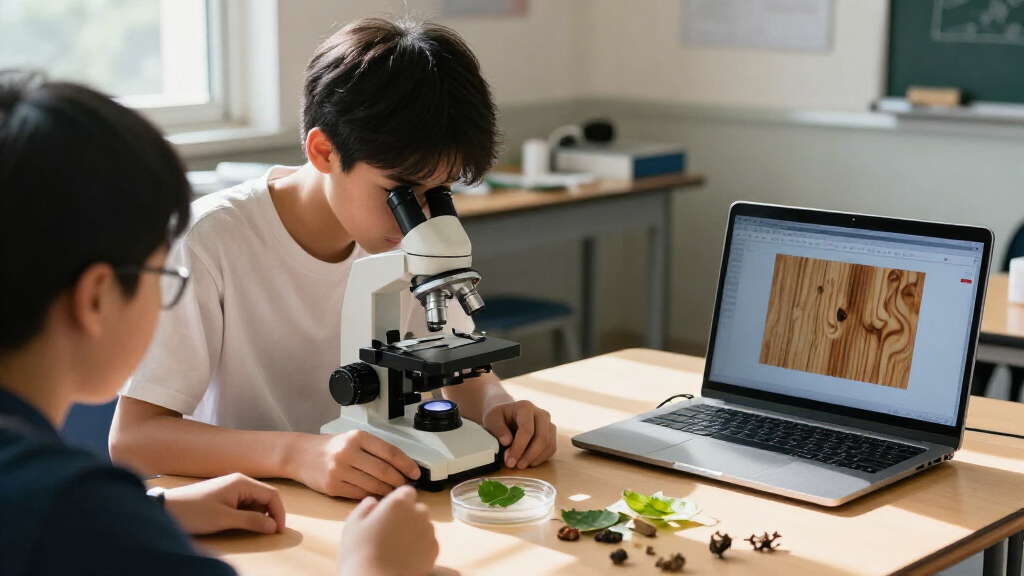

For most students, I would start with the TOMLOV DM301 Pro: its 7-inch screen supports shared viewing, making classroom demonstrations and at-home study easier than peering through an eyepiece. The Celestron TetraView is a stronger fit for students who need a compound microscope for prepared slides, while the VOBU Compound Microscope stands out for beginners who want specimens included. The main choice is between a simple screen-based microscope for larger objects and a compound design for thin samples and biology work. Screen size, useful magnification, lighting, and the ability to capture images matter more than the biggest magnification figure on the box. Read on for how all nine options compare and which type of student each one suits.

Prime made for students and young adults
- Fast, free delivery for dorm and study essentials
- Prime Video and Amazon Music included
- Member-only deals
Key Takeaways
The DM301 Pro leads for general student use because its 7-inch display favors shared viewing and straightforward observation over specialized coin or slide work.
Compound microscopes serve a different lesson plan: the Celestron TetraView, AmScope DM300HD, Woehrsh RM, and VOBU are more relevant for students studying prepared slides than the coin-focused LCD models.
More listed magnification does not automatically mean more useful detail. Lighting, focus control, sample preparation, and optical design shape what students can actually see.
Built-in screens reduce setup friction for younger students and group viewing, while a trinocular microscope such as the Woehrsh RM favors a more traditional, expandable workspace.
Included extras target distinct needs: the VOBU’s specimen set supports first explorations, and the TOMLOV DM4W Max’s scale is aimed at coin study rather than broad classroom biology.
| TOMLOV DM301 Pro Digital Microscope with 7-Inch Screen |  | Best Overall for Shared Student Viewing | Display: 7-inch IPS screen | Magnification: Up to 1200× | Lenses: Three achromatic lenses | VIEW LATEST PRICE | See Our Full Breakdown |
| Elikliv EDM4 LCD Digital Coin Microscope 1000x with 4.3″ Screen and 8 LED Lights |  | Best Compact Pick for Hands-On Inspection | Display: 4.3-inch HD LCD | Resolution: 720P HD | Magnification: Up to 1000× | VIEW LATEST PRICE | See Our Full Breakdown |
| TOMLOV DM301 Max Digital Microscope with 7-Inch Screen |  | Best for Measured Slide Work | Display: 7-inch adjustable IPS LCD | Magnification: Up to 1200× | Lenses: Three achromatic lenses | VIEW LATEST PRICE | See Our Full Breakdown |
| TOMLOV DM4W Max Coin Microscope with Weighing Scale |  | Best for Coin and Material-Science Projects | Screen: 7-inch; 800 × 480 resolution | Photo resolution: 16MP (5440 × 3060) | Video resolution: 2K | VIEW LATEST PRICE | See Our Full Breakdown |
| OOZSTAR Digital Microscope with 4.3-Inch Display and 5 MP Camera |  | Best for Experiment Kits and Specimen Preparation | Display: 4.3-inch | Camera: Built-in 5MP | Eyepieces: WF10x and WF16x | VIEW LATEST PRICE | See Our Full Breakdown |
| Celestron TetraView LCD Digital Microscope with 180° Swivel Screen |  | Best for Shared Classroom Viewing | Screen: 4.3-inch full-color TFT LCD with 180° rotating head | Camera: 5MP | Magnification: 40x–1600x; optical settings are 40x, 100x, 200x, and 400x | VIEW LATEST PRICE | See Our Full Breakdown |
| AmScope DM300HD Digital Compound Microscope with 7-Inch HD Display |  | Best for Portable Classroom Lessons | Display: 7-inch Full HD 1080p monitor | Camera: 2MP CMOS | Magnification: 40x–1200x with up to 20x digital zoom | VIEW LATEST PRICE | See Our Full Breakdown |
| Woehrsh RM Trinocular Microscope 40X-5000X with HD USB Camera and Dual Mechanical Stage |  | Best for Advanced Biology Students | Magnification range: 40x–5000x | Optical system: Infinity optical system with achromatic objective lens | Eyepieces: Two WF10x eyepieces and two WF25x eyepieces | VIEW LATEST PRICE | See Our Full Breakdown |
| VOBU Compound Microscope with 7-Inch HD Display, 40–5000x Magnification, and 40 Specimens |  | Best for Hands-On Specimen Study | Display: 7-inch HD display with 2K resolution | Magnification: 40x–5000x | Objectives: 4x, 10x, 40x, and 100x achromatic | VIEW LATEST PRICE | See Our Full Breakdown |
| digital microscopes for student | Display | Magnification | Lighting | Included accessories |
|---|---|---|---|---|
| TOMLOV DM301 Pro Digital Micro | 7-inch IPS screen | Up to 1200× | Adjustable top and bottom LED lights | Carrying case, microSD card, power cable and adapter, TV cable, 5 prepared slides, and 5 blank slides |
| Elikliv EDM4 LCD Digital Coin | 4.3-inch HD LCD | Up to 1000× | 8 adjustable LED lights | Adjustable bracket, microscope base, USB cable, and user manual |
| TOMLOV DM301 Max Digital Micro | 7-inch adjustable IPS LCD | Up to 1200× | Adjustable top and bottom LED lights | — |
| TOMLOV DM4W Max Coin Microscop | — | — | — | — |
| OOZSTAR Digital Microscope wit | 4.3-inch | — | LED | Phone holder, specimens, slides, coverslips, knife, tweezers, pipette, burette, petri dish, cotton swabs, blotting paper, microscope paper, cleaning cloth, data cable, and gauze |
| Celestron TetraView LCD Digita | — | 40x–1600x; optical settings are 40x, 100x, 200x, and 400x | — | Prepared slides, memory card, carrying case, dust cover, AV out cable, USB cable, touch pen, and international AC adapter |
| AmScope DM300HD Digital Compou | 7-inch Full HD 1080p monitor | 40x–1200x with up to 20x digital zoom | — | — |
| Woehrsh RM Trinocular Microsco | — | — | — | — |
| VOBU Compound Microscope with | 7-inch HD display with 2K resolution | 40x–5000x | Adjustable LED | Carrying case, phone mount, slides, cover slips, and starter tools |
More Details on Our Top Picks
TOMLOV DM301 Pro Digital Microscope with 7-Inch Screen
The DM301 Pro makes a strong classroom or home-study pick because its 7-inch IPS display lets students inspect specimens together without crowding around an eyepiece. Its adjustable top and bottom lighting supports both opaque objects and prepared slides, while the included slides and measurement scale give new users a useful starting point. Compared with the more specialized TOMLOV DM4W Max, this model is better suited to broad biology activities rather than coin weighing. It also captures 8MP photos and 1080p video and can send the image to a larger display, which helps with presentations. The tradeoff is a battery rated for up to three hours, and wireless app viewing depends on a compatible phone or tablet.
Pros:- Large adjustable IPS screen makes group viewing more comfortable than sharing a small handheld display.
- Top and bottom LED lighting supports both solid objects and slide specimens.
- Captures 8MP photos and 1080p video, with USB and HD output for larger displays.
- Includes prepared and blank slides, a measurement scale, and a carrying case.
Cons:- Battery life is limited to up to three hours.
- Wireless app viewing requires a compatible iOS or Android device.
Best for: Students or families who want a large built-in screen for shared observations, basic measurement, and recording class projects.
Not ideal for: Students who need all-day untethered use or want a dedicated compound-microscope setup with clearly specified high-power objectives.
- Display:7-inch IPS screen
- Magnification:Up to 1200×
- Lenses:Three achromatic lenses
- Camera:8MP photos; 1080p video
- Connectivity:Wi-Fi app support, USB, and HD output
- Lighting:Adjustable top and bottom LED lights
- Battery life:Up to 3 hours
- Included accessories:Carrying case, microSD card, power cable and adapter, TV cable, 5 prepared slides, and 5 blank slides
Our verdict“Choose the DM301 Pro for student projects that benefit from a large shared screen, dual lighting, and easy image capture.”
Elikliv EDM4 LCD Digital Coin Microscope 1000x with 4.3″ Screen and 8 LED Lights
The Elikliv EDM4 is a practical choice for students who want a screen-equipped microscope they can move between a desk, workshop, and field activity. Its 4.3-inch display keeps live viewing on the device, while the height-adjustable stand helps students bring a specimen into focus without relying on a separate monitor. Eight adjustable LEDs make it easier to tune illumination for reflective or uneven surfaces. Unlike the larger TOMLOV DM301 Max, the EDM4 has no 7-inch display or described X-Y stage, so it is less suited to carefully tracking slide position during a shared lesson. In return, its simpler handheld format is easier to carry. Computer connection supports live viewing and file saving, but a memory card is not included, and the stated 1000× magnification varies with viewing distance and screen size.
Pros:- Built-in 4.3-inch display enables viewing without a computer.
- Eight adjustable LED lights help illuminate different specimen surfaces.
- USB connection supports live viewing and saving images or videos on Windows and Mac.
- Rechargeable battery supports up to three hours of portable use.
Cons:- A memory card for saving photos and videos is not included.
- Actual magnification depends on screen size and the distance between camera and specimen.
Best for: Students who need a portable digital viewer for inspecting coins, small objects, or circuit boards and want to connect it to a Windows or Mac computer.
Not ideal for: Students who need a large group-viewing screen, a supplied memory card, or a clearly specified compound-slide workflow.
- Display:4.3-inch HD LCD
- Resolution:720P HD
- Magnification:Up to 1000×
- Lighting:8 adjustable LED lights
- Connectivity:USB; Windows and Mac compatible
- Battery life:Up to 3 hours
- Included accessories:Adjustable bracket, microscope base, USB cable, and user manual
- Warranty:1 year
Our verdict“Pick the EDM4 for portable, screen-based inspection when compact handling matters more than a large display or slide-position controls.”
TOMLOV DM301 Max Digital Microscope with 7-Inch Screen
For student assignments that involve positioning specimens and recording measurements, the DM301 Max has a more classroom-oriented setup than the handheld Elikliv EDM4. Its metal X-Y stage gives students controlled movement across a slide, while the 1.0 mm scale divisions and on-screen measuring overlay support observations they can document. The adjustable 7-inch display keeps the image easy to share, and dual lighting works with both solid samples and transparent slides. It also records 8MP images and 1080p video, with Wi-Fi app viewing and USB or HD connections for sharing. The tradeoff is a battery life of up to three hours, and app use requires a compatible mobile device. Students who mainly inspect coins may get more value from the DM4W Max, which adds weighing instead of a mechanical slide stage.
Pros:- Metal X-Y stage supports controlled movement across a specimen.
- On-screen measuring overlay and 1.0 mm stage divisions aid documented observations.
- Adjustable 7-inch IPS screen and dual lighting suit shared viewing of slides and solid objects.
- Includes an 8GB microSD card and supports 8MP photos, 1080p video, app viewing, USB, and HD output.
Cons:- Battery life is limited to up to three hours.
- Wireless app viewing requires a compatible Android or iOS device.
Best for: Students completing biology projects that require controlled slide movement, simple measurements, and shareable photo or video records.
Not ideal for: Students who prioritize longer battery use, or coin-focused learners who would make greater use of the DM4W Max’s built-in scale.
- Display:7-inch adjustable IPS LCD
- Magnification:Up to 1200×
- Lenses:Three achromatic lenses
- Stage:Metal X-Y stage with 1.0 mm scale divisions
- Image and video:8MP images; 1080p video
- Connectivity:Wi-Fi app control, USB, and HD connections
- Lighting:Adjustable top and bottom LED lights
- Storage and battery:8GB microSD card included; up to 3 hours of battery life
Our verdict“Choose the DM301 Max when student work calls for slide control and measurement rather than a compact handheld format or coin-weighing feature.”
TOMLOV DM4W Max Coin Microscope with Weighing Scale
The DM4W Max is the most specialized student option here: it combines a digital microscope with a built-in scale, making it useful for lessons or projects comparing a coin’s visible condition with its mass. Its 7-inch screen gives a larger viewing area than the Elikliv EDM4, and the stated full-view coverage for coins up to 32 mm can reduce repositioning during inspection. Students can capture 16MP photos and 2K video to document surface details. That combination is less flexible for general slide-based biology than the DM301 Max, which has an X-Y stage and prepared slides. The scale also has a stated accuracy of ±0.5 g, so it is not a substitute for finer measurement equipment or reliable bullion verification. This pick makes sense when weighing and close inspection belong in the same activity.
Pros:- Combines magnified viewing and a built-in scale for paired visual and weight observations.
- 7-inch screen provides more viewing area than the Elikliv EDM4’s 4.3-inch display.
- 16MP photos and 2K video support detailed project documentation.
- Supports grams, ounces, carats, and troy ounces.
Cons:- Weighing accuracy is ±0.5 g, which may be insufficient for fine measurement or bullion verification.
- Coins larger than 32 mm require repositioning for inspection.
Best for: Students studying coins, materials, or collection objects who want to compare magnified surface details with weight in one setup.
Not ideal for: Students focused on biological slide work, or anyone needing high-precision weighing or a full view of coins larger than 32 mm.
- Screen:7-inch; 800 × 480 resolution
- Photo resolution:16MP (5440 × 3060)
- Video resolution:2K
- Weighing resolution and accuracy:0.1 g resolution; ±0.5 g accuracy
- Supported weighing units:g, oz, ct, and ozt
- Maximum coin diameter:32 mm for full view
- Connectivity:USB output; Windows and Mac compatible
- Included items:Microscope base, stand, microscope unit, and 2 USB cables
Our verdict“Choose the DM4W Max for student projects centered on coins or materials where visual inspection and weighing are both useful.”
OOZSTAR Digital Microscope with 4.3-Inch Display and 5 MP Camera
The OOZSTAR RM is aimed at students who want to prepare specimens as well as view them. Its included slides, coverslips, pipette, petri dish, tweezers, and other lab accessories provide more activity materials than the Elikliv EDM4, which focuses on a stand, screen, and computer connection. The 4.3-inch display and 5MP camera keep observation and image capture on the device, while the phone holder offers another way to frame or share work. Its achromatic objectives and several stated magnification settings offer a familiar microscope-style format, but the listed maximum of 2500× is not clearly reconciled with those settings. Unlike the TOMLOV DM301 Max, the product details do not specify an X-Y stage, image output options, or a battery runtime, so buyers should not assume it supports the same measurement or classroom-display workflow.
Pros:- 4.3-inch display and built-in 5MP camera support on-device viewing and capture.
- Includes a phone holder for alternative viewing or recording setups.
- Broad specimen-preparation kit includes slides, coverslips, pipette, petri dish, and handling tools.
- Achromatic objective lenses and coarse focus support adjustable observation.
Cons:- Listed magnification settings do not clearly explain the advertised 2500× maximum.
- The eyepiece configuration is not consistent across the product details.
- The supplied data does not specify battery runtime, a mechanical stage, or computer-output options.
Best for: Students or families who want a small-screen digital microscope bundled with tools for preparing and handling specimens.
Not ideal for: Students who need clearly documented magnification, mechanical stage control, large-group viewing, or specified computer and display connections.
- Display:4.3-inch
- Camera:Built-in 5MP
- Eyepieces:WF10x and WF16x
- Objective lenses:4×, 10×, and 40× achromatic
- Listed magnification settings:100×, 250×, 1000×, 200×, 500×, and 2000×; maximum listed as 2500×
- Lighting:LED
- Power:Data cable or batteries
- Included accessories:Phone holder, specimens, slides, coverslips, knife, tweezers, pipette, burette, petri dish, cotton swabs, blotting paper, microscope paper, cleaning cloth, data cable, and gauze
Our verdict“Choose the OOZSTAR RM when included specimen-preparation tools matter more than clearly defined magnification or advanced stage and sharing controls.”
Celestron TetraView LCD Digital Microscope with 180° Swivel Screen
The 180° swivel LCD makes this a practical pick for students presenting observations to a partner or teacher without passing around an eyepiece. Its mechanical stage and separate coarse and fine focus controls also support more deliberate slide positioning than a simple fixed-screen microscope. The 5MP camera records images and video to a memory card, while prepared slides help students start exploring right away. Compared with the AmScope DM300HD, the Celestron has a higher stated camera resolution and a screen that turns toward a group, but its 4.3-inch display is much smaller than AmScope’s 7-inch monitor. Its 1600x headline figure also relies on digital zoom beyond the 400x optical range, so it should not be read as added optical detail. The AA batteries are not included, which matters for lessons away from an outlet.
Pros:- 180° rotating 4.3-inch screen helps partners view the same specimen.
- 5MP camera captures still images and video to a memory card.
- Mechanical stage and coarse and fine focus support controlled slide positioning.
- Can run from an AC adapter or four AA batteries.
Cons:- The 4.3-inch display is less suited to group viewing than the AmScope DM300HD’s 7-inch screen.
- Magnification above 400x uses digital zoom rather than additional optical magnification.
- AA batteries must be supplied separately.
Best for: Students and teachers who regularly share live slide observations in small groups and want onboard photo and video capture.
Not ideal for: Learners who need a large screen for group demonstrations or expect the maximum stated magnification to provide additional optical detail.
- Screen:4.3-inch full-color TFT LCD with 180° rotating head
- Camera:5MP
- Magnification:40x–1600x; optical settings are 40x, 100x, 200x, and 400x
- Objectives:4x, 10x, 20x, and 40x
- Stage:Adjustable mechanical stage
- Illumination:Adjustable bottom LED with six-position filter wheel
- Power:International AC adapter or four AA batteries, not included
- Included accessories:Prepared slides, memory card, carrying case, dust cover, AV out cable, USB cable, touch pen, and international AC adapter
- Warranty:Two-year limited warranty
Our verdict“Choose the Celestron for shared classroom viewing and image capture, but pick a larger-screen model if several students need to see details at once.”
AmScope DM300HD Digital Compound Microscope with 7-Inch HD Display
The built-in 7-inch 1080p monitor gives students a larger viewing area than the Celestron TetraView’s 4.3-inch screen, and the rechargeable battery makes the AmScope easier to move between rooms or use where outlets are scarce. Its 3-axis mechanical stage helps students guide a slide precisely, while dual LED illumination can handle both transparent slides and opaque samples. The included 32GB microSD card, prepared and blank slides, and carrying case make it a ready-to-teach package. The tradeoff is a 2MP camera, lower than the Celestron’s 5MP, and a fixed screen that may still feel small for a whole class. HDMI output offers a way to show the image on a larger display. Digital zoom can enlarge the view, but it does not add optical detail.
Pros:- 7-inch Full HD monitor provides a larger built-in view than the Celestron TetraView.
- Rechargeable battery supports portable classroom use.
- Dual incident and transmitted LED illumination suits opaque and transparent specimens.
- Includes a 32GB microSD card, prepared and blank slides, and a carrying case.
Cons:- Its 2MP camera has lower stated resolution than the Celestron TetraView’s 5MP camera.
- The fixed 7-inch display may be too small for group analysis without HDMI output.
- Digital zoom can reduce image quality at higher settings.
Best for: Teachers and students who need a self-contained microscope that can move between classrooms and examine both transparent and opaque specimens.
Not ideal for: Buyers prioritizing higher-resolution still captures or large-group viewing without access to an HDMI display.
- Display:7-inch Full HD 1080p monitor
- Camera:2MP CMOS
- Magnification:40x–1200x with up to 20x digital zoom
- Objectives:4x, 10x, 40x, and 100x
- Stage:3-axis mechanical stage
- Illumination:Dual LED, incident and transmitted
- Power:Rechargeable battery or USB-C
- Storage and connectivity:32GB microSD card and HDMI output
- Warranty:Five years
Our verdict“Pick the AmScope for portable lessons and a larger all-in-one screen, while the Celestron is a stronger fit if camera resolution and a swiveling display matter more.”
Woehrsh RM Trinocular Microscope 40X-5000X with HD USB Camera and Dual Mechanical Stage
The Woehrsh RM is the most lab-oriented option here: its infinity optical system and achromatic objectives are aimed at students who want more than a simple screen-based inspection tool. A trinocular head and included HD USB electronic eyepiece let learners connect digital viewing to a more traditional microscope setup, while the dual mechanical stage supports controlled specimen movement. Compared with the VOBU microscope, which pairs a 7-inch display with a large prepared-specimen kit, this model is better suited to students ready to work through a more involved optical setup. The stated 40x–5000x range is broad, but magnification alone does not guarantee useful detail, and the product data does not specify a built-in screen. Its 240V requirement may also call for power compatibility checks before classroom use.
Pros:- Infinity optical system and achromatic objectives suit more advanced specimen study.
- Trinocular design includes an HD USB electronic eyepiece for digital viewing.
- Dual mechanical stage supports controlled slide positioning.
- Includes multiple eyepieces and a biological slide and tool gift pack.
Cons:- The 240V power specification may not match standard 110V outlets without suitable equipment.
- Its multiple eyepieces and optical components make setup more involved than the AmScope DM300HD.
- No built-in display is listed, so digital viewing depends on a connected device.
Best for: Older students or hobby learners with some microscope experience who want a traditional trinocular instrument and USB digital viewing.
Not ideal for: Beginners who want a simple all-in-one screen microscope, or students whose power supply is not compatible with the stated 240V requirement.
- Magnification range:40x–5000x
- Optical system:Infinity optical system with achromatic objective lens
- Eyepieces:Two WF10x eyepieces and two WF25x eyepieces
- Digital viewing:HD USB electronic eyepiece
- Stage:Dual mechanical stage
- Light source:LED
- Head:45° angle of view with 306° swivel head
- Voltage:240V
Our verdict“Choose the Woehrsh for a more advanced, traditional lab-style setup with USB viewing, not for a beginner seeking a ready-to-use display.”
VOBU Compound Microscope with 7-Inch HD Display, 40–5000x Magnification, and 40 Specimens
For students who learn by preparing and comparing many samples, the VOBU stands out for its 40 prepared specimens and slide-making tools. Its 7-inch, 2K display brings observations onto a screen, while four achromatic objectives, an Abbe condenser, and adjustable LED lighting support a more conventional compound-microscope workflow than the AmScope DM300HD’s all-in-one digital emphasis. The broad 40x–5000x range gives students several viewing settings, though the 100x oil-immersion objective requires cedar oil that is not listed among the included supplies. Compared with the Woehrsh RM, the VOBU is more immediately approachable for screen-based study and comes with a larger specimen assortment; the accessory kit still takes time to organize, and its one-year warranty is shorter than the AmScope’s five-year coverage.
Pros:- 7-inch 2K display gives students a substantial built-in viewing area.
- Includes 40 prepared specimens plus slide-preparation tools.
- Four achromatic objectives, an Abbe condenser, and adjustable LED lighting support varied specimen work.
- Adjustable interpupillary distance and independent parallax fine-tuning allow a more tailored viewing setup.
Cons:- The 100x oil-immersion objective requires cedar oil, which is not listed as included.
- The large accessory and specimen kit can take time to organize.
- One-year warranty is shorter than the AmScope DM300HD’s five-year warranty.
Best for: Students who want a broad assortment of prepared samples and tools for practicing slide preparation alongside screen-based viewing.
Not ideal for: Learners who want a minimal setup, need a longer stated warranty, or do not want to source cedar oil for the 100x objective.
- Display:7-inch HD display with 2K resolution
- Magnification:40x–5000x
- Objectives:4x, 10x, 40x, and 100x achromatic
- Eyepieces:10x and 25x
- Condenser:Abbe condenser
- Lighting:Adjustable LED
- Included specimens:40 prepared specimens
- Included accessories:Carrying case, phone mount, slides, cover slips, and starter tools
- Warranty:One year
Our verdict“Choose the VOBU for students who want a large screen and plenty of specimens to study, but budget time for setup and source cedar oil for immersion work.”
How We Picked
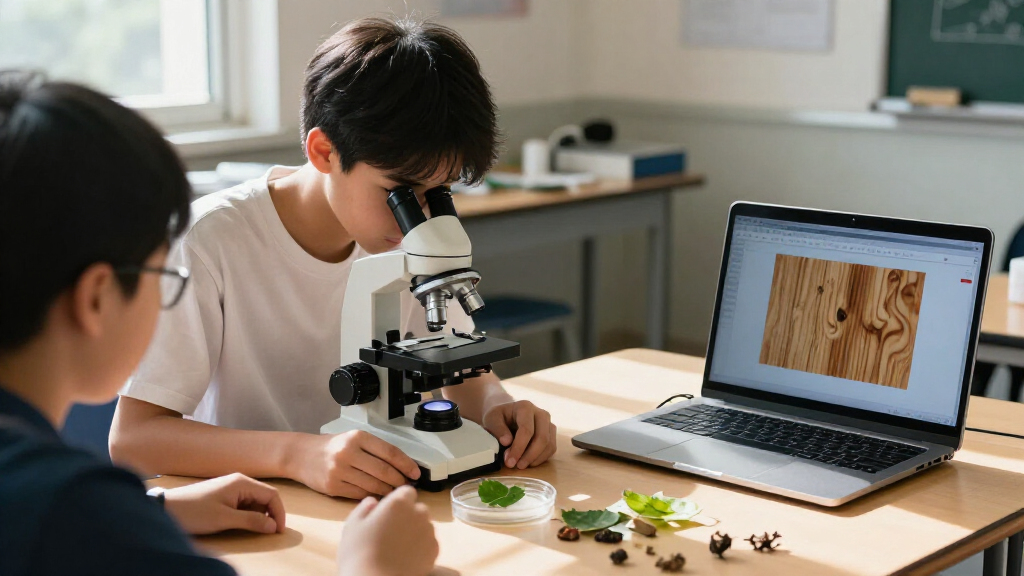
I ranked these digital microscopes for student use by how well their design matches common learning tasks: observing larger objects, examining prepared slides, sharing a view with classmates, and recording images. I weighed usable viewing and focus controls more heavily than headline magnification, then looked at screen size, illumination, camera workflow, build and stage design, and how much setup a student is likely to manage independently.
The order reflects versatility for student work, not a claim that one microscope suits every subject. The TOMLOV DM301 Pro ranks first as a broadly approachable screen-based choice; compound models rise for slide-based biology, while coin-oriented models rank lower for general school use despite their specialized features. I also considered what a student may outgrow: a simple LCD microscope can be easy to start with, but a compound or trinocular setup may fit more advanced coursework. Product details alone cannot establish classroom suitability, so buyers should match the microscope’s sample type and connection needs to the lessons they expect to do.
| digital microscopes for student | Included accessories |
|---|---|
| TOMLOV DM301 Pro Digital Micro | Carrying case, microSD card, power cable and adapter, TV cable, 5 prepared slides, and 5 blank slides |
| Elikliv EDM4 LCD Digital Coin | Adjustable bracket, microscope base, USB cable, and user manual |
| TOMLOV DM301 Max Digital Micro | — |
| TOMLOV DM4W Max Coin Microscop | — |
| OOZSTAR Digital Microscope wit | Phone holder, specimens, slides, coverslips, knife, tweezers, pipette, burette, petri dish, cotton swabs, blotting paper, microscope paper, cleaning cloth, data cable, and gauze |
| Celestron TetraView LCD Digita | Prepared slides, memory card, carrying case, dust cover, AV out cable, USB cable, touch pen, and international AC adapter |
| AmScope DM300HD Digital Compou | — |
| Woehrsh RM Trinocular Microsco | — |
| VOBU Compound Microscope with | Carrying case, phone mount, slides, cover slips, and starter tools |
Factors to Consider When Choosing Digital Microscopes For Students
Before choosing, I would start with the student’s assignments rather than the largest number in a product name. A microscope meant for coins and insects does not automatically replace one designed for thin biological slides, and a camera feature only helps if it fits the way the student will share or save work.
Match the Microscope to the Samples
Students examining pond water, prepared cells, or thin tissue samples generally need a compound microscope, where light passes through a specimen. Larger, opaque objects such as coins, leaves, and small components are better suited to screen-based inspection with reflected light. A common mistake is buying a high-magnification model for every task; increasing magnification cannot make an opaque object behave like a thin slide. Ask what the student’s class actually assigns, and check whether the microscope’s lighting and stage support those samples. If coursework spans both types, decide which task is routine and which can be handled with a separate lens or classroom instrument.
Treat Magnification Claims as a Starting Point
Useful detail matters more than maximum magnification. A large advertised figure may combine optical magnification with digital enlargement, which can make an image bigger without revealing finer structure. For students, clear focus, steady positioning, adequate illumination, and a sensible range of magnification usually produce better learning than an extreme number. On compound models, consider the objective lenses and how smoothly students can move between them. For LCD models, judge the image at the display and the stability of the stand, not just the zoom claim. If specifications do not explain how magnification is achieved, treat the headline number cautiously.
Choose Screen Sharing or Eyepiece Work Deliberately
A built-in display can let several students view the same sample and can reduce the coordination required to look through an eyepiece. That makes an LCD design attractive for demonstrations, younger learners, or students who need to capture observations. A screen does add size and another component to power and position, so it may be less convenient for a compact desk or field activity. Traditional eyepieces can suit students learning standard microscope technique, while trinocular designs may support a separate camera workflow. Before buying, check whether the display or camera can save images and how files reach the student’s computer. Do not assume that a digital camera automatically makes documentation simple.
Prioritize Controls and Sample Stability
Good student equipment should be manageable without constant adult adjustment. A stable base, usable focus controls, and a stage that holds samples in place help students keep track of what they are viewing. Mechanical stages can make small, repeatable movements easier, which matters when comparing neighboring areas on a slide. A large screen cannot compensate for a sample that shifts whenever the student adjusts focus. Check how the microscope sits on the intended desk and whether the student can reach the controls comfortably. For shared classroom use, simple operation may be more valuable than a long list of advanced functions.
Check Lighting, Power, and Classroom Practicalities
Lighting needs change with sample type: transparent slides call for transmitted light, while opaque objects usually need illumination from above. Multiple LED settings can help adapt to different surfaces, but students still need to position the sample and adjust brightness to avoid glare or washed-out detail. Also check how the unit receives power and whether it can be used where the student plans to work. A model that depends on a fixed desk setup may suit home study but not a mobile lesson. Think about storage, cleaning, and whether small accessories could be misplaced between sessions. These practical details shape how often a microscope gets used.
Pay for Features the Student Will Use
Higher-end designs make sense when a student will benefit from a more capable stage, a dedicated camera connection, or a microscope suited to sustained slide work. They are harder to justify when the main goal is occasional exploration of coins, leaves, or classroom specimens. Included specimen sets can help a beginner start quickly, but they should not decide the purchase if the student’s course requires a different sample type. Specialized additions, such as a coin scale, add value only for a matching project. Compare the complete workflow—setup, observation, image capture, and storage—rather than paying for one headline feature. A simpler model that fits the student’s actual lessons can be the more useful choice.
Frequently Asked Questions
Should I buy an LCD microscope or a compound microscope for school biology?
For lessons centered on prepared slides, cells, or other thin samples, I would favor a compound microscope because its design supports transmitted-light viewing. An LCD microscope is often easier for several people to view at once and can suit larger objects, but that convenience does not make it a direct substitute for slide-focused equipment. Check the teacher’s requirements before buying, especially if the class names objective lenses or standard microscope techniques. If the student needs both slide study and group demonstrations, prioritize the assignment that will recur most often. A classroom may also provide one type, making a complementary home model more useful than a duplicate.
Is a 7-inch screen worth choosing over a smaller display?
A larger screen can make it easier for a student to inspect an image without leaning close, and it helps when parents or classmates are sharing the view. It may be especially useful for demonstrations where more than one person needs to follow the same sample. The tradeoff is a larger unit that can take up more desk and storage space. Screen size alone does not tell you whether the image is sharp or whether the camera can save usable files. I would choose the larger display when shared viewing is a regular part of study, not simply because the number looks more impressive.
Can one student microscope handle coins and biological slides?
Some models can cover a range of tasks, but coins and biological slides place different demands on the optics and lighting. Coins are opaque and benefit from light on the surface, while thin slides are usually viewed with light passing through them. A general-purpose digital microscope may be convenient for exploration, yet it may not deliver the same experience as a compound model during biology coursework. Check which illumination modes and sample supports are included, and compare them with the class’s needs. If slide work is a graded requirement, do not assume a coin-focused microscope will suffice because it lists high magnification.
Does a USB camera make a microscope better for remote classes?
A USB camera can help a student show observations on a computer, but the connection alone does not guarantee a smooth remote-class workflow. Confirm that the camera works with the student’s computer and the software used for lessons, and check whether images or video can be saved in a usable format. A built-in LCD can be simpler for local viewing, while a camera-based arrangement may offer more flexibility for online sharing. The camera also adds setup and cable management that younger students may find distracting. For remote learning, choose based on the full route from sample to screen to submitted assignment.
When does it make sense to choose a more advanced trinocular microscope?
A trinocular model is most useful when the student has ongoing slide-based work and a reason to use a separate camera alongside the eyepieces. A mechanical stage can also help with careful, repeatable positioning during more involved observation. These features can be unnecessary for casual exploration, where a self-contained LCD model may be simpler to set up and share. Consider whether the student has a stable workspace and will use the camera workflow regularly. If the microscope is intended for introductory activities, an advanced setup may add complexity without improving the assignments at hand.
Conclusion
For a single microscope that suits varied student activities, I recommend the TOMLOV DM301 Pro as best overall, particularly when a shared screen is useful. The OOZSTAR is my best value-style pick for students who want a compact 4.3-inch display and a 5 MP camera without needing a large screen. For beginners who benefit from included learning materials, the VOBU Compound Microscope is the most approachable option in this lineup. Students focused on slide-based biology should compare the Celestron TetraView for its swivel screen and the Woehrsh RM for its trinocular setup and mechanical stage; the latter is the best premium fit for more demanding study. For coin projects, choose the TOMLOV DM4W Max when its weighing scale matches the work, or the Elikliv EDM4 for a compact coin-viewing setup. The TOMLOV DM301 Max and AmScope DM300HD make more sense when their specific screen-based or compound-microscope format matches the student’s assignments. My final rule is simple: pick for the samples and lessons first, then compare screens, camera workflow, and extras.
Evergreen bestsellers Picks

Vitamix Touch & Go Advance 32-Ounce Bar Blender, White

Ninja Foodi Smart 6-in-1 Indoor Grill and Air Fryer, 4 qt, FG551

De'Longhi Classic Signature Espresso Machine
As an affiliate, we earn on qualifying purchases.