

For most families, I’d start with the Makeblock mBot Arduino Robot Kit: its Scratch coding and wheeled build offer a clear path from first commands to more involved projects. Botley is a strong screen-free choice for younger children, while the mBot Ranger suits kids ready to build different robot forms. The main tradeoff is between simple, guided play and kits that demand more assembly, troubleshooting, or coding time. App control, construction complexity, and age fit can matter as much as the number of robot configurations. Read on for my full comparison of all 15 kits and the buyer types each one suits.

Prime made for students and young adults
- Fast, free delivery for dorm and study essentials
- Prime Video and Amazon Music included
- Member-only deals
Key Takeaways
- mBot stands out as the most balanced coding pick: Scratch-based programming gives it a clearer learning path than kits centered mainly on remote control or assembly.
- Botley and Robot Mouse serve the youngest learners best: both make sequencing tangible without requiring a coding app, though their activities offer less room for advanced projects.
- Multi-build kits trade focus for variety: the Sillbird, Apitor, and mBot Ranger kits offer several configurations, but children may spend more time building and rebuilding than programming.
- The ELEGOO and ACEBOTT car kits lean toward tinkering: their programmable vehicle formats suit older or more technically curious children who are ready to troubleshoot hardware.
- Control methods are not interchangeable: app and remote control can make a robot easy to operate, but buyers should check whether the kit teaches coding or mainly supports manual driving.
| Learning Resources Botley the Coding Robot |  | Best for Screen-Free Coding Basics | Recommended age: 5+ | Programming capacity: Up to 80 steps | Programming method: Remote programmer | VIEW LATEST PRICE | See Our Full Breakdown |
| Sillbird 5-in-1 STEM Robot Building Kit with Remote Control |  | Best for Multi-Model Building | Recommended age: 8–14 years | Build models: 5 | Block count: 596 | VIEW LATEST PRICE | See Our Full Breakdown |
| Teach Tech Mech-5 STEM Coding Robot Building Kit for Ages 10+ |  | Best for Mechanical Coding | Age range: 10+ | Programming method: Mechanical coding wheel with snap-on coding buttons | Robot actions: Throwing, lifting, kicking, drawing, and movement | VIEW LATEST PRICE | See Our Full Breakdown |
| Learning Resources Code & Go Robot Mouse Activity Set |  | Best for Young Maze Beginners | Recommended age: 4+ years | Maze board size: 20 x 20 inches | Robot features: Lights, sounds, and two speeds | VIEW LATEST PRICE | See Our Full Breakdown |
| ELEGOO UNO R3 Smart Robot Car Kit V4 with Camera |  | Best for Advanced Teen Projects | Recommended age: 12 years and up | Controller: ELEGOO UNO R3 | Programming environment: Arduino IDE | VIEW LATEST PRICE | See Our Full Breakdown |
| Makeblock mBot Arduino Robot Kit with Scratch Coding for Kids Ages 8–12 |  | Best for a First Coding Robot | Recommended age: 8–12 years | Coding platforms: Scratch-style block coding and Arduino | Guided projects: 4 | VIEW LATEST PRICE | See Our Full Breakdown |
| ACEBOTT QD106 Programmable Robot Car Kit for Kids |  | Best for Older Beginners | Brand and model: ACEBOTT QD106 | Controller: ESP32 | Programming languages: Scratch, Arduino, and Python | VIEW LATEST PRICE | See Our Full Breakdown |
| ACEBOTT Programmable Robot Kit with App and Remote Control |  | Best for Omnidirectional Movement | Controller: ESP32 | Coding compatibility: Arduino and Scratch | Movement: 4WD with 360° omnidirectional Mecanum wheels | VIEW LATEST PRICE | See Our Full Breakdown |
| Makeblock mBot Ranger 3-in-1 Coding Robot Building Kit |  | Best for Multiple Robot Builds | Robot designs: Land Raider, Nervous Bird, and Dashing Raptor | Programming languages: Scratch and Arduino | Mainboard: Me Auriga | VIEW LATEST PRICE | See Our Full Breakdown |
| Thames & Kosmos My Robotic Pet: Coding Chameleon STEM Kit |  | Best Screen-Free Coding Kit | Length: 15 inches | Play modes: Coding, Wild, and Pet | Sensors: Color and infrared | VIEW LATEST PRICE | See Our Full Breakdown |
| Sillbird 5-in-1 STEM Robot Building Kit with App and Remote Control |  | Best for Multi-Model Building | Pieces: 488 | Builds: Robot, dinosaur, car, tank, and more | Controls: Bluetooth app or remote control | VIEW LATEST PRICE | See Our Full Breakdown |
| Makeblock mBot Programmable STEM Robot Kit for Kids Ages 8+ | 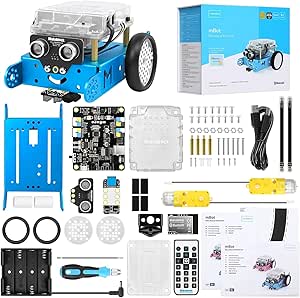 | Best for Learning Scratch and Arduino | Model: 90053 | Recommended age: 8 years and up | Programming platforms: Scratch and Arduino | VIEW LATEST PRICE | See Our Full Breakdown |
| Sillbird 5-in-1 Programmable Robot Building Kit with App and Remote Control |  | Best for Younger Builders | Model: US-B897R1 | Pieces: 488 | Builds: Robot, car, tank, dinosaur, or custom model | VIEW LATEST PRICE | See Our Full Breakdown |
| Apitor 6-in-1 STEM Coding Robot Building Kit, 480 Pieces |  | Best for Snap-Together Variety | Models: 6 | Building pieces: 480 colorful blocks | Control module: 1 with 2 high-speed motors | VIEW LATEST PRICE | See Our Full Breakdown |
| ACEBOTT 4-in-1 Smart Robot Arm and Tank Car STEM Coding Kit |  | Best for Advanced Robotics Projects | Build configurations: 4 | Robotic arm: Programmable 5DOF | Controller: ESP32 | VIEW LATEST PRICE | See Our Full Breakdown |
| kids’ coding robot kit | Recommended age |
|---|---|
| Learning Resources Botley the | 5+ |
| Sillbird 5-in-1 STEM Robot Bui | 8–14 years |
| Teach Tech Mech-5 STEM Coding | — |
| Learning Resources Code & Go R | 4+ years |
| ELEGOO UNO R3 Smart Robot Car | 12 years and up |
| Makeblock mBot Arduino Robot K | 8–12 years |
| ACEBOTT QD106 Programmable Rob | 12 years and up |
| ACEBOTT Programmable Robot Kit | 8–16 years |
| Makeblock mBot Ranger 3-in-1 C | 8–12 years |
| Thames & Kosmos My Robotic Pet | 8+ with adult help; 12+ for independent play |
| Sillbird 5-in-1 STEM Robot Bui | 8 years and up |
| Makeblock mBot Programmable ST | 8 years and up |
| Sillbird 5-in-1 Programmable R | 6 years and up |
| Apitor 6-in-1 STEM Coding Robo | 7–12 years |
| ACEBOTT 4-in-1 Smart Robot Arm | — |
More Details on Our Top Picks
Learning Resources Botley the Coding Robot
Botley makes early coding tangible: children enter commands with a remote programmer, then watch the robot follow a path they have planned. Its support for loops and if/then logic gives it more room to grow than a simple button-controlled maze toy such as the Learning Resources Code & Go Robot Mouse. Coding cards, tiles, obstacles, and detachable arms let families set up fresh challenges without an app or screen. The tradeoff is that Botley’s activities depend on having floor or table space to lay out paths, and its focus stays on sequencing rather than building a robot from parts. I’d choose it for younger learners who want to experiment with coding concepts hands-on; older children ready to assemble and program a more complex machine may get more from the ELEGOO UNO R3 Smart Robot Car Kit.
Pros:- Teaches sequencing, loops, and if/then logic without a screen.
- Remote programmer makes commands concrete and easy to revise.
- Coding cards, tiles, obstacles, and detachable arms support varied activities.
Cons:- Path and obstacle activities need clear play space.
- Does not offer the robot-building and app-based programming found in more advanced kits.
Best for: Families and early elementary educators seeking screen-free practice with sequencing, loops, and simple conditional logic.
Not ideal for: Children who want to build a robot themselves or families without space to lay out paths and obstacle courses.
- Recommended age:5+
- Programming capacity:Up to 80 steps
- Programming method:Remote programmer
- Learning features:Sequencing, loops, and if/then logic
- Included accessories:Detachable arms, 40 coding cards, tiles, and obstacles
- Screen-free:Yes
Our verdict“Choose Botley for a screen-free first step into coding concepts, especially for younger children who learn by arranging and testing commands.”
Sillbird 5-in-1 STEM Robot Building Kit with Remote Control
Five buildable models give this Sillbird kit a different appeal from ready-to-code options: children first assemble a robot, tank, car, or another included design, then control their creation by remote or Bluetooth app. Its 596 blocks and rechargeable battery suit older kids who want building to be part of the robotics activity, while LED expressions and sound effects add feedback during play. Compared with the Teach Tech Mech-5, which teaches mechanical coding through a physical coding wheel, this kit puts more emphasis on rebuilding and electronic controls. Assembly takes time, and up to 40 minutes of play per charge can interrupt a session. I’d pick it for children who enjoy construction and model variety; those chiefly seeking a guided introduction to coding may find Botley more direct.
Pros:- Five models let builders change the project instead of repeating one design.
- 596 blocks provide a substantial hands-on construction activity.
- Remote and Bluetooth app controls offer two ways to operate the builds.
- Rechargeable battery avoids disposable batteries.
Cons:- Assembly is required before play and may need adult help.
- Play time is limited to up to 40 minutes per charge.
- The feature-rich app and effects may distract from learning coding fundamentals.
Best for: Ages 8–14 who enjoy assembling different robot forms and switching between remote and app control.
Not ideal for: Children who want to start coding right away without assembly, or families seeking longer uninterrupted play sessions.
- Recommended age:8–14 years
- Build models:5
- Block count:596
- Controls:Remote control and Bluetooth app
- Features:LED expressions, sound effects, and water mist function
- Battery:Rechargeable
- Play time:Up to 40 minutes per charge
Our verdict“Choose this Sillbird kit for an older child who values rebuilding and controlling several models more than a screen-free coding curriculum.”
Teach Tech Mech-5 STEM Coding Robot Building Kit for Ages 10+
Mech-5 turns a program into a physical mechanism: builders snap coding buttons onto a wheel to set the robot’s actions, making the relationship between command order and movement easy to see. Its activities include throwing, lifting, kicking, and drawing, so a finished sequence has a visible task to complete. That gives it a distinct learning angle from Botley, which uses a remote programmer for screen-free path challenges, and from the ELEGOO car, which relies on electronic controls and sensors. The tradeoff is the substantial build: assembly can take multiple hours, and the 10+ age guidance makes it a less suitable first robot for younger children. I’d choose Mech-5 for patient builders interested in how mechanisms work, but skip it if quick setup or app-based coding is the priority.
Pros:- Mechanical coding wheel makes the sequence of commands visible.
- Combines robot assembly with introductory programming and engineering concepts.
- Multiple actions give missions varied physical outcomes.
- Mission-based activities encourage problem solving.
Cons:- Building can take multiple hours before the robot is ready.
- Designed for ages 10 and up, limiting its fit for younger beginners.
- Mechanical button programming offers a different and narrower path than app-based coding.
Best for: Builders aged 10 and up who want to connect a physical coding sequence with mechanical movement and task-based challenges.
Not ideal for: Younger children or families wanting a robot that is ready for coding with little assembly.
- Age range:10+
- Programming method:Mechanical coding wheel with snap-on coding buttons
- Robot actions:Throwing, lifting, kicking, drawing, and movement
- Educational objectives:Coding, problem solving, programming, and STEM
- Build time:Multiple hours
- Included components:Assembly parts and instructions
Our verdict“Choose Mech-5 for an older child who wants a build-heavy, mechanical introduction to how programmed commands produce movement.”
Learning Resources Code & Go Robot Mouse Activity Set
Colby the mouse makes the first coding challenge approachable: children arrange maze walls, enter simple button commands, and see whether the robot reaches the cheese. The 20-by-20-inch maze board, activity cards, and guide give parents or teachers a ready framework for practicing sequencing and problem solving. Compared with Botley, this set is more tightly focused on navigating a maze, while Botley adds loops and if/then logic for children ready to build longer programs. Code & Go is aimed at ages 4 and up, which gives it an earlier starting point, though its command set and maze format offer less scope for open-ended robot play. It also needs three AAA batteries, not included. I’d choose it for a first coding activity; skip it if the child wants to assemble a robot or explore more advanced programming ideas.
Pros:- Maze-building makes each command sequence easy to plan and check.
- Activity and coding cards provide structured challenges for home or classroom use.
- Lights, sounds, and two speeds give clear feedback during play.
- Screen-free button controls suit early learners.
Cons:- Requires three AAA batteries, which are not included.
- Maze-focused activities offer less open-ended programming than Botley.
- The 20-by-20-inch board needs a dedicated flat play surface.
Best for: Parents and early-childhood educators introducing children aged 4 and up to sequencing through guided maze challenges.
Not ideal for: Older beginners who want robot construction, extended programs, or coding concepts beyond simple button sequences.
- Recommended age:4+ years
- Maze board size:20 x 20 inches
- Robot features:Lights, sounds, and two speeds
- Maze components:16 maze grids, 22 maze walls, and 3 tunnels
- Cards:30 double-sided coding cards and 10 double-sided activity cards
- Other included items:Cheese wedge and Activity Guide
- Batteries:3 AAA batteries required; not included
Our verdict“Choose Code & Go for a young child’s first guided, screen-free coding challenges, especially if maze play is a good fit.”
ELEGOO UNO R3 Smart Robot Car Kit V4 with Camera
This ELEGOO kit is the most electronics-focused pick here: builders assemble a robot car, then program it with Arduino IDE and explore line tracking, obstacle avoidance, and camera-based FPV video. Its UNO R3 controller and guided materials make it a more ambitious coding project than Botley’s screen-free command sequences or Code & Go’s maze buttons. The app and IR remote also give new builders a way to control the car while they learn how its systems work. That breadth brings a real tradeoff: assembly and programming can be demanding for first-time builders, and the 12+ recommendation is a better guide to its audience than the younger ages served by the mouse and Botley. I’d choose it for a teen ready to work with code and sensors; skip it for a child seeking immediate, simple play.
Pros:- Arduino IDE programming supports a deeper coding project than button-sequence kits.
- Line tracking and ultrasonic obstacle avoidance create interactive driving challenges.
- Camera and Wi-Fi module enable FPV video.
- App and IR remote offer different control approaches.
Cons:- Assembly and programming may require adult guidance for beginners.
- The electronics and coding setup is less accessible than Botley or Code & Go.
- The supplied battery capacity is specified, but the product data gives no play-time estimate.
Best for: Teens aged 12 and up who want an Arduino-based robot car project with sensors, camera video, and guided coding materials.
Not ideal for: Younger children or first-time builders who need a simple, screen-free kit with minimal assembly and programming.
- Recommended age:12 years and up
- Controller:ELEGOO UNO R3
- Programming environment:Arduino IDE
- Camera and Wi-Fi module:ESP32-WROVER-based
- Battery:2000 mAh rechargeable lithium-ion
- Sensors:Line-tracking and ultrasonic
- Control methods:App and IR remote
- Warranty:Half year
Our verdict“Choose the ELEGOO car for a teen ready to build and code a sensor-equipped robot, rather than a younger child looking for quick coding play.”
Makeblock mBot Arduino Robot Kit with Scratch Coding for Kids Ages 8–12
The Makeblock mBot is a straightforward starting point for kids who want to make a robot move by writing code. Its four guided projects cover line following, obstacle avoidance, and remote control, giving beginners clear goals without the broader build choices of the mBot Ranger. Assembly takes about 15 minutes, so children can get to the coding activities quickly. The path from Scratch-style blocks to Arduino adds a next step as their skills grow. That progression makes this a more focused introduction than the ACEBOTT QD106, which offers Python alongside Scratch and Arduino but is aimed at ages 12 and up. The tradeoff is a narrower recommended age range and no stated battery details, so buyers may need to check power requirements before starting.
Pros:- Four guided coding projects give beginners concrete activities to follow.
- Quick assembly helps children get to coding without a lengthy build.
- Scratch-style coding and Arduino offer a progression in programming complexity.
- Visual instructions and troubleshooting tips support independent learning.
Cons:- The recommended age range is limited to 8–12 years.
- The provided product details do not specify batteries or power requirements.
Best for: Families with children ages 8–12 who want a quick-build robot and a guided path from block coding toward Arduino.
Not ideal for: Older beginners looking for Python lessons, or families who need confirmed battery requirements before purchase.
- Recommended age:8–12 years
- Coding platforms:Scratch-style block coding and Arduino
- Guided projects:4
- Assembly time:About 15 minutes
- Robot activities:Line following, obstacle avoidance, and remote control
- Learning support:Visual instructions and troubleshooting tips
Our verdict“Choose the mBot for an ages 8–12 beginner who wants guided projects and a quick route from block coding to Arduino.”
ACEBOTT QD106 Programmable Robot Car Kit for Kids
The ACEBOTT QD106 suits older children who want room to move beyond block-based lessons. It supports Scratch, Arduino, and Python, while 16 story-based tutorials give each language a structured starting point. The iOS and Android app and included IR remote offer two ways to control the car, and no-solder assembly keeps the build accessible. Compared with the Makeblock mBot, this kit reaches further into text-based coding, but its recommended age of 12 and up makes it a less suitable pick for younger first-time coders. Batteries are not included, so buyers need to supply them before the car can run. It is a better fit for a child ready to explore programming choices than for a family seeking a simple, younger-child introduction.
Pros:- Three programming languages allow learners to progress from Scratch to Python or Arduino.
- Sixteen story-based tutorials provide a structured learning sequence.
- App and IR remote control offer different ways to operate the car.
- No-solder assembly makes building more approachable.
Cons:- The manufacturer recommends it for ages 12 and up, limiting its fit for younger children.
- Batteries are not included.
Best for: Families with a child aged 12 or older who wants guided lessons in Scratch, Arduino, and Python on a robot car.
Not ideal for: Younger beginners who need an age-targeted first robot, or buyers who expect batteries to come in the box.
- Brand and model:ACEBOTT QD106
- Controller:ESP32
- Programming languages:Scratch, Arduino, and Python
- Tutorials:16 story-based tutorials
- Control methods:iOS and Android app, and IR remote
- Assembly:No soldering required
- Recommended age:12 years and up
- Batteries:Not included
Our verdict“Pick the QD106 for an older beginner who wants a guided robot car with multiple programming languages to grow into.”
ACEBOTT Programmable Robot Kit with App and Remote Control
The defining reason to choose this ACEBOTT robot is its 4WD base with omnidirectional Mecanum wheels: it can move sideways and diagonally as well as rotate, creating movement challenges that a conventional robot car such as the ACEBOTT QD106 does not offer. It pairs that unusual motion with Scratch and Arduino, 16 story-based tutorials, and app or IR remote control. The recommended age range of 8–16 gives it a wider stated audience than the Makeblock mBot. Expansion options such as a camera or robotic arm could add new building projects, but those kits are sold separately. Batteries are also not included. This is the more distinctive mobility platform in the lineup, though families should account for the extra purchases if they want the add-ons.
Pros:- Mecanum wheels enable sideways, diagonal, and rotational movement.
- Scratch and Arduino support both block-based and text-based coding.
- Sixteen story-based tutorials provide guided activities.
- App and IR remote control provide two control options.
Cons:- Batteries are not included.
- Camera, robotic arm, tank track, and solar panel expansions are sold separately.
Best for: Families with children ages 8–16 who want coding activities built around sideways, diagonal, and rotational robot movement.
Not ideal for: Buyers seeking a complete expansion setup in one purchase, since add-on kits and batteries are separate.
- Controller:ESP32
- Coding compatibility:Arduino and Scratch
- Movement:4WD with 360° omnidirectional Mecanum wheels
- Control:IR remote and iOS/Android app
- Tutorials:16 story-based tutorials
- Recommended age:8–16 years
- Optional expansions:Camera, robotic arm, tank tracks, and solar panel kits sold separately
- Batteries:Not included
Our verdict“Choose this ACEBOTT kit if unusual omnidirectional movement is a bigger draw than a conventional robot-car design.”
Makeblock mBot Ranger 3-in-1 Coding Robot Building Kit
The mBot Ranger makes the most sense for children who want to rebuild and reprogram rather than stick with one robot shape. Its three designs—a tracked tank, a self-balancing robot, and a three-wheeled racer—change the kind of movement and control challenges available. The Me Auriga mainboard, gyroscope, ultrasonic and line-tracking sensors, light sensors, LEDs, buzzer, temperature sensor, and Bluetooth module give Scratch and Arduino projects plenty of inputs and outputs to work with. Compared with the simpler Makeblock mBot, this kit offers substantially more build variety and hardware to explore, but that breadth also makes it a tougher first assembly and programming project. It needs six AA batteries or lithium batteries, neither included, so plan for that before the build begins.
Pros:- Three distinct robot designs offer varied building and movement projects.
- Scratch and Arduino support different levels of coding.
- A broad selection of sensors and modules enables varied input and output activities.
- Designed for indoor and outdoor play.
Cons:- Assembly and programming may challenge beginners.
- Six AA batteries or lithium batteries are required and not included.
Best for: Ages 8–12 who enjoy rebuilding kits and are ready to explore sensors, movement, Scratch, and Arduino.
Not ideal for: First-time builders who want a quick, guided setup, or families who prefer a kit with batteries included.
- Robot designs:Land Raider, Nervous Bird, and Dashing Raptor
- Programming languages:Scratch and Arduino
- Mainboard:Me Auriga
- Sensors and modules:Ultrasonic sensor, line-tracking sensor, 2 light sensors, gyroscope, 12 RGB LEDs, buzzer, temperature sensor, and Bluetooth module
- Battery requirement:6 AA batteries or lithium batteries; not included
- Recommended age:8–12 years
- Play environment:Indoor and outdoor play
Our verdict“The mBot Ranger is a strong choice for an ages 8–12 builder who values three robot designs and a broad sensor set over a simple first build.”
Thames & Kosmos My Robotic Pet: Coding Chameleon STEM Kit
The Coding Chameleon takes a different route from wheeled kits such as the Makeblock mBot: children build an animal-shaped robot and program its behavior with physical action cards, rather than starting with Scratch or Arduino. Its coding, wild, and pet modes combine those sequences with touch and gesture responses, color changes, and a moving tongue. That makes the kit a fit for children who learn through tangible play or families seeking a screen-free coding activity. The 48-page guide adds assembly instructions and robotics and engineering concepts. The tradeoff is that it does not offer the same computer-based programming progression as the ACEBOTT QD106, and younger builders may need adult help. Because the chameleon must be assembled before play, it is less immediate than a ready-to-use robot.
Pros:- Physical action cards introduce coding without a screen.
- Three play modes vary the way children interact with the chameleon.
- Color-changing, touch-responsive behavior and a moving tongue make its actions visible.
- The 48-page guide covers assembly, robotics, and engineering concepts.
Cons:- Younger children may need adult help with assembly.
- Building is required before play, and the coding approach is not computer-based.
Best for: Families seeking a screen-free, hands-on coding activity for an 8+ child, with adult help available for younger builders.
Not ideal for: Children ready to learn Scratch, Arduino, or Python on a programmable wheeled robot, or families seeking a ready-to-play kit.
- Length:15 inches
- Play modes:Coding, Wild, and Pet
- Sensors:Color and infrared
- Lighting:RGB LEDs
- Coding method:Physical action cards
- Manual:48 pages
- Recommended age:8+ with adult help; 12+ for independent play
Our verdict“Choose the Coding Chameleon for a child who will enjoy building an interactive pet and learning basic coding through physical cards.”
Sillbird 5-in-1 STEM Robot Building Kit with App and Remote Control
Five rebuildable models give this kit more variety than the Makeblock mBot, which focuses on one robot platform with expandable electronics. With 488 pieces, kids can assemble a robot, dinosaur, car, tank, and other creations, then try basic programming and path control. App and remote operation offer an accessible way to start: a child can drive a build before exploring programmed movement. Illustrated instructions help guide assembly, though the piece count still asks for patience and adult help may be useful for younger builders. The tradeoff is that the rechargeable battery lasts up to 40 minutes per charge, and app control depends on Bluetooth. I’d choose it for families who want repeated rebuilds; mBot is a stronger fit for a longer coding path into Scratch and Arduino.
Pros:- Five model types provide varied building and play
- App and remote control let children try both programmed and direct movement
- Illustrated instructions guide assembly
- Rechargeable battery avoids replacing disposable robot batteries
Cons:- Play time is limited to up to 40 minutes per charge
- Bluetooth is required for app control
- The 488-piece assembly can take patience
Best for: Families with children 8 and up who want to rebuild one kit into several different vehicles and creatures
Not ideal for: Kids who want a ready-to-code robot with deeper Scratch or Arduino projects, or families who prefer longer sessions between charges
- Pieces:488
- Builds:Robot, dinosaur, car, tank, and more
- Controls:Bluetooth app or remote control
- Programming features:Basic programming and path control
- Recommended age:8 years and up
- Play time:Up to 40 minutes per charge
- Power:Rechargeable battery
Our verdict“Choose this Sillbird kit if rebuilding into different models matters more than advancing through Scratch or Arduino lessons.”
Makeblock mBot Programmable STEM Robot Kit for Kids Ages 8+
The mBot earns its place for children ready to connect a physical robot with Scratch and Arduino. Compared with the Sillbird 5-in-1 kits, it offers fewer rebuildable forms, but its tutorials and activities guide kids toward coding concepts that can grow with them. Assembly takes about 15 minutes, so the first session can move quickly from construction to line following, obstacle avoidance, or remote control. Makeblock’s expandable system also gives curious learners room to add modules and parts over time. That path has limits: the four AA batteries and CR2025 remote battery are not included, and some projects need extra components. I’d favor mBot for structured coding progression; Apitor’s six snap-together models offer more immediate building variety with less emphasis on Arduino.
Pros:- Supports Scratch and Arduino programming
- Line following and obstacle avoidance connect code to visible robot behavior
- Tutorials, coding cards, and app activities help structure learning
- Compatible with more than 100 electronic modules and 500 parts
Cons:- Four AA batteries and the remote’s CR2025 battery are not included
- Some projects and features require additional parts
- Offers less model variety in the box than multi-build kits
Best for: Families with children 8 and up who want guided Scratch activities now and a route into Arduino and add-on electronics later
Not ideal for: Buyers who want batteries included, multiple model builds in the box, or projects that work without optional add-ons
- Model:90053
- Recommended age:8 years and up
- Programming platforms:Scratch and Arduino
- Assembly time:About 15 minutes
- Robot batteries:4 AA batteries, not included
- Remote battery:CR2025, not included
- Expandable system:Compatible with 100+ electronic modules and 500+ parts
Our verdict“Pick the mBot for a guided coding progression that can extend into Arduino and add-on electronics.”
Sillbird 5-in-1 Programmable Robot Building Kit with App and Remote Control
Among the multi-build kits here, this Sillbird is the one aimed at the youngest stated age: 6 years and up. Its 488 pieces can become a robot, car, tank, dinosaur, or a custom model, while colorful step-by-step instructions make the build process easier to follow. App and remote control give children two ways to interact with their creation, and the rechargeable battery keeps battery replacement out of the routine. Compared with the Apitor 6-in-1, it offers one fewer named model and a similar reliance on app connectivity, but its lower age recommendation may suit families starting earlier. The tradeoff is substantial hands-on assembly before play and up to 40 minutes per charge. It fits patient young builders better than children seeking a quick-start coding robot.
Pros:- Five model types plus custom creations encourage rebuilding
- Colorful instructions support step-by-step assembly
- App and remote controls offer different ways to operate builds
- Rechargeable battery removes the need for disposable robot batteries
Cons:- Building from 488 pieces can be demanding for younger children
- Play time is limited to up to 40 minutes per charge
- App control requires Bluetooth
Best for: Families with children 6 and up who enjoy following illustrated build steps and want several ways to remake a robot kit
Not ideal for: Children who want a simple ready-to-use coding toy or extended play without charging breaks
- Model:US-B897R1
- Pieces:488
- Builds:Robot, car, tank, dinosaur, or custom model
- Controls:Bluetooth app and remote control
- Recommended age:6 years and up
- Battery:Rechargeable
- Play time:Up to 40 minutes
Our verdict“Choose this kit for a younger child who enjoys hands-on assembly and can benefit from adult support during complex builds.”
Apitor 6-in-1 STEM Coding Robot Building Kit, 480 Pieces
Six models and tool-free blocks make Apitor a good match for kids who want to build, take apart, and build again without handling screws. It offers one more stated model than either Sillbird 5-in-1 kit, while its app brings coding activities and four movement modes: dual-motor, single-motor, gyro, and path control. Those modes give children several ways to see how control inputs change a robot’s movement. Compared with the Makeblock mBot, Apitor prioritizes quick model variety over Scratch and Arduino progression or a large expandable electronics system. Its limits are practical: Bluetooth app control is central, and the kit needs three AA batteries that are not included. I’d choose it for repeat building and varied motion; mBot suits a child more focused on structured coding lessons.
Pros:- Six model options provide more stated builds than the Sillbird 5-in-1 kits
- Snap-together blocks need no screws or tools
- Four control modes vary how the robot moves
- App-based coding activities connect building with programming
Cons:- Requires three AA batteries, which are not included
- Bluetooth control depends on the companion app
- Does not list the Scratch and Arduino learning path offered by mBot
Best for: Families with children ages 7–12 who want several tool-free builds and app-based movement activities
Not ideal for: Buyers who want batteries included, app-free operation, or Scratch and Arduino compatibility
- Models:6
- Building pieces:480 colorful blocks
- Control module:1 with 2 high-speed motors
- Lighting:2 multicolor LED lights
- Control modes:Dual-motor, single-motor, gyro, and path
- Connectivity:Bluetooth
- Battery requirement:3 AA batteries, not included
- Recommended age:7–12 years
Our verdict“Pick Apitor for a child who values tool-free rebuilding and varied movement more than a deeper coding curriculum.”
ACEBOTT 4-in-1 Smart Robot Arm and Tank Car STEM Coding Kit
ACEBOTT shifts this roundup toward robotics mechanics and programming: its four configurations combine a car, tank tracks, and a programmable 5DOF arm, with an ESP32 controller. Arduino and Scratch support give older or more experienced learners a clearer coding path than the basic programming on the Sillbird kits. Sixteen guided tutorials, assembly videos, an iOS and Android app, and an IR remote support different stages of learning and control. In exchange for that depth, this kit asks more of its builder. Assembly and programming may challenge beginners, and tutorials and code downloads require visiting the manufacturer’s website. Compared with the Makeblock mBot, it offers a robotic arm and tank configurations, while mBot has a shorter stated assembly time and a more approachable first build. This ACEBOTT suits learners ready for a project with more moving parts.
Pros:- Four configurations combine car, tank, and robotic arm builds
- Programmable 5DOF arm introduces movement beyond driving
- Arduino and Scratch compatibility supports different coding levels
- Guided tutorials and assembly videos provide project support
Cons:- Assembly and programming may be challenging for beginners
- Tutorials and code downloads require visiting the manufacturer’s website
- More complex mechanisms may take longer to build and troubleshoot than mBot
Best for: Older children or classroom learners with some building patience who want to explore robot arms, tracked movement, and Arduino or Scratch
Not ideal for: First-time builders who need a low-complexity introduction or families who want all tutorials and code available in the box
- Build configurations:4
- Robotic arm:Programmable 5DOF
- Controller:ESP32
- Programming compatibility:Arduino and Scratch
- Control methods:iOS and Android app, IR remote
- Tutorials:16 guided tutorials
- Track type:Rubber tank treads
- Included modules:Robot car (QD001), tank track expansion (QD004), robotic arm kit (QD007)
Our verdict“Choose ACEBOTT for a learner ready to tackle a more complex robot arm and tracked vehicle project with Arduino or Scratch.”

How We Picked
I ranked these kids’ coding robot kits by how well they connect play to learning: the clarity of their coding path, the amount of meaningful interaction, age fit, and room to advance. I also weighed assembly demands, the usefulness of included activities, and whether a kit’s control options support programming or mainly provide remote operation. A robot with many builds did not automatically outrank a simpler kit with a more accessible first lesson.
The ranking favors kits that make it easier to move from a first successful activity toward independent experimentation. That puts the Makeblock mBot near the top for its balance of approachable coding and room to grow, while screen-free kits rank well for younger beginners. More complex cars and robot arm builds are better matches for older children willing to handle setup and troubleshooting. Products with overlapping Sillbird or ACEBOTT names are treated as distinct listings; buyers should check the exact model and included control method before ordering.
Factors to Consider When Choosing Kids’ Coding Robot Kits
The right kit depends on what you want a child to do after the first build: follow a sequence, write code, or experiment with sensors and moving parts. I’d match the kit to the child’s patience for setup as carefully as their age. These broader choices can help narrow the field before comparing individual models.
Choose a coding style the child can stick with
Screen-free command cards and buttons let children focus on sequencing without learning an app at the same time. Block-based coding adds a visual way to combine commands and can support longer projects once a child understands cause and effect. A remote control may make a robot fun right away, but manual driving alone does not teach the same skills as writing instructions for it to follow. Check what the child actually programs, rather than assuming that “programmable” in a product title means coding is central. For a first kit, a short activity that leads to a visible result can build confidence before more open-ended tasks. Older beginners may prefer a kit that introduces blocks first and leaves room to explore more complex control later.
Match the build to available patience and adult help
A complex build can be rewarding, but assembly time is part of the experience, not a minor setup detail. Younger children may need an adult to sort parts, follow diagrams, or troubleshoot connections, even when the age label suggests they can use the kit. If the child mainly wants to start programming quickly, a ready-to-use robot or a simple activity set may be a better fit than a large construction kit. For a child who enjoys following plans and rebuilding, multiple configurations can keep the kit engaging over time. Look for clear instructions and think about whether small pieces and repeated rebuilding will suit your household. Choosing for the child’s actual patience often matters more than choosing the most ambitious-looking set.
Treat age ranges as a starting point
Age guidance is a rough signal about reading, fine motor skills, and expected independence; it cannot capture every child’s experience with building or coding. A younger child who enjoys puzzles may handle sequencing activities, while an older newcomer may benefit from a gentle introduction to blocks. Consider whether an adult will join in, since that can make a more demanding kit manageable without making it a poor fit. Watch for the difference between activities that demonstrate a concept and instructions that assume the child already understands it. A kit that is too easy can lose its appeal, while one that needs constant adult fixes can frustrate a child who wants to work alone. Use age guidance alongside the child’s interests and willingness to ask for help.
Look for learning beyond driving
Moving a robot with a remote can be satisfying, but it may not offer much coding practice on its own. Look for ways to set a sequence, respond to an obstacle, follow a route, or change behavior by editing instructions. Sensors and interactive challenges can help connect code to a result the child can observe, though they also add setup and troubleshooting demands. A construction set may teach planning and spatial reasoning even when its coding tools are modest. Think about which outcome matters most: an introduction to logic, a coding project, mechanical building, or a combination. That answer can help you judge whether a kit’s feature list supports your goal or simply adds complexity.
Check the full setup before choosing an app-based kit
App-based kits can make programming more visual, but the child will need access to a compatible device and a comfortable way to use it. Check the product’s supported operating systems and device requirements against what your family already owns. Consider whether the app provides instructions and coding activities or mainly acts as a controller. If device access is limited, a screen-free kit may be easier to use regularly, even if it offers fewer advanced features. Also think about where the robot will run: a smooth floor, a clear table, or a space where small parts can stay organized. Practical access shapes how often a child can return to a kit after the first session.
Decide whether variety or depth matters more
Multi-configuration kits can extend play by letting children rebuild a robot into different forms, but each rebuild takes time and may repeat familiar steps. A focused robot can offer a steadier route into coding because the child spends less time changing its structure. Neither approach is automatically better: variety can suit a child who enjoys construction, while a stable platform may help one who wants to experiment with commands. Consider whether the child tends to finish a project and move on or keep refining the same one. Also check which parts and functions are shared across builds, since the configuration count alone does not show how different the activities are. Choose variety for mechanical exploration and depth for sustained programming practice.
Frequently Asked Questions
Which kind of coding robot kit makes sense for a child who has never coded?
Start with the child’s age, reading comfort, and interest in following directions. For younger beginners, screen-free options such as Botley or Robot Mouse can make sequencing visible without adding an app to learn. A child ready for a tablet may prefer block-based coding, which offers a gradual way to combine commands. A kit that starts with short guided tasks and permits small changes can bridge the two styles. Choose an entry point that lets the child succeed early, then build on that success.
Does a remote-controlled robot kit teach coding?
Not by itself: remote control generally lets a child steer the robot directly. Some kits also offer programming modes, where the child creates instructions that the robot follows on its own. Check the included activities and app descriptions for examples of writing or sequencing commands, rather than relying on the word “programmable.” If coding is the main goal, prioritize a kit whose activities make the child create and revise instructions. Remote driving can still be a fun introduction to movement and controls.
Is a multi-configuration building kit a better choice than a single robot?
It depends on whether the child enjoys construction as much as coding. Multiple builds can give a mechanically curious child new ways to assemble and explore a kit, but rebuilding can take time away from programming. A single, stable robot may make it easier to focus on changing code and observing its effects. Before choosing, look for differences in the actual activities and functions across configurations. A larger build count alone does not tell you how much new learning each version offers.
Should I choose a screen-free kit or one with app-based coding?
Screen-free kits can be a comfortable start for children who benefit from direct, tactile activities or have limited device access. App-based kits can support more flexible coding tasks, but the experience depends on device compatibility and the quality of the app’s lessons. Think about whether your goal is an early introduction to sequences or a path toward editing and expanding programs. A child can learn useful logic without a screen, while an app is not automatically a better teacher. Pick the format the child can use regularly with the devices and support available at home.
What should I check before buying a robot kit for independent use?
Look beyond the age label and check the assembly steps, instruction style, and whether a phone or tablet is required. A child may be able to operate a finished robot independently but still need help building it or connecting it to an app. If independent use matters, prefer a clear setup path and activities that explain the next step without extensive adult troubleshooting. Also consider small parts, workspace, and whether the robot needs a clear area to move. A little adult help at the start may be reasonable, but ongoing setup demands can affect how often the kit gets used.
Conclusion
For the broadest mix of accessible coding and room to explore, I recommend the Makeblock mBot Arduino Robot Kit as best overall. Botley is my best beginner pick for younger children who benefit from screen-free sequencing, while Robot Mouse is a focused option for guided route-planning activities. Families seeking variety in building can look at mBot Ranger or the multi-build Sillbird and Apitor kits; the exact model and coding features deserve a close check. For older children who want a more involved vehicle or hardware project, the ELEGOO and ACEBOTT kits are the more technical direction. My best value choice is the kit that matches the child’s interests and gets used repeatedly: a simpler robot can be the stronger buy when its activities fit, while a premium build makes sense when the child wants to assemble, program, and troubleshoot over time.
Halloween Picks
halloween
As an affiliate, we earn on qualifying purchases.