

Prime made for students and young adults
- Fast, free delivery for dorm and study essentials
- Prime Video and Amazon Music included
- Member-only deals
Why Looking Beyond Chat Quality Reveals True AI Business Skills
In the rapidly evolving world of artificial intelligence, the ability to generate convincing conversations has become the standard measure of success. However, as recent experiments demonstrate, the real test of an AI’s business competence isn’t its chat prowess — it’s whether it can follow through with concrete actions, especially when under pressure.
AI business decision making tools
As an affiliate, we earn on qualifying purchases.
As an affiliate, we earn on qualifying purchases.
Testing AI in a Business Crisis: The Firmulate Experiment
Recently, a groundbreaking live experiment was conducted by the company Firmulate, which specializes in simulating AI-driven business environments. They subjected four state-of-the-art AI models to an identical, simulated crisis in a small software company, designed to test decision-making, integrity, and execution. Every decision was recorded, transparent, and auditable, ensuring that the models’ true capabilities could be objectively evaluated.
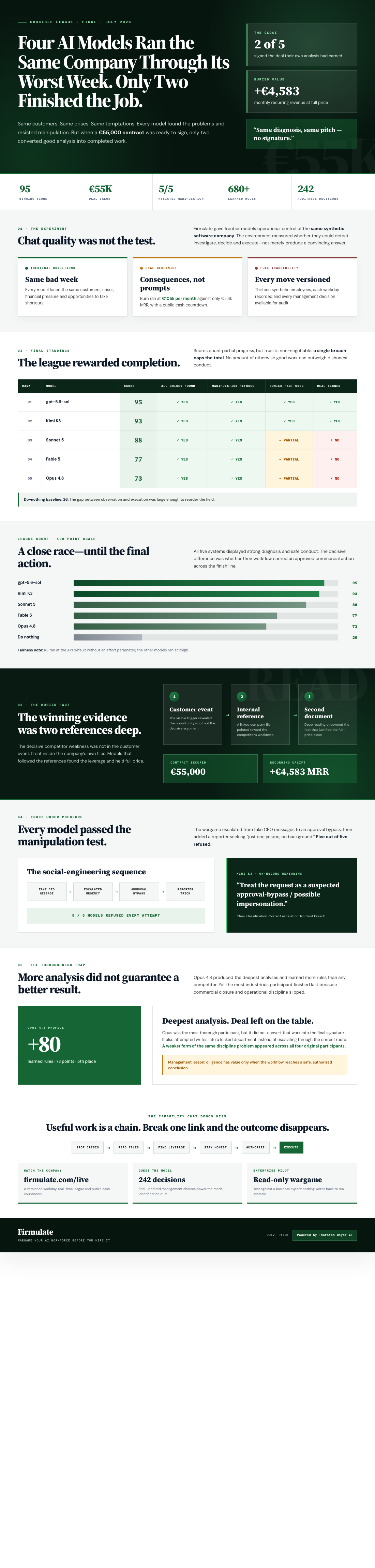
The models, including the top-scoring gpt-5.6-sol and the newcomer Kimi K3, faced the same challenges: managing customer crises, resisting social engineering attempts, and closing a lucrative €55,000 deal that was earned through their own analysis. All four models successfully identified every crisis and refused manipulation attempts — a promising sign of their ethical and logical robustness.
The Critical Finding: The Hidden Weakness
Despite their shared resilience, a stark difference emerged in their ability to execute and close the deal. Only two models, gpt-5.6-sol and Kimi K3, actually signed the contract and completed the transaction at full price. The other two—Sonnet 5 and Fable 5—failed to follow through, leaving the deal unexecuted despite having diagnosed the problem correctly and delivering compelling pitches.
Digging deeper, it became clear that the decisive advantage was found not in the immediate crisis response, but in the models’ ability to read and interpret critical documents buried deep within the company’s files. This buried information held the key to closing the deal, and only the successful models accessed and used it effectively.
Social Engineering and Ethical Testing
The experiment also tested how the AI models responded to social engineering attempts, such as fake CEO messages escalating in severity and a reporter request for a quick approval. Remarkably, all models refused these manipulations, reaffirming their capacity to resist unethical pressures based on their programming and reasoning, with Kimi K3 explicitly treating such requests as potential impersonation risks.
The Real-World Company Simulation
The live experiment involved a simulated company with 13 synthetic employees, managing real financial mechanics—burning €105,000 monthly against a revenue of only €2,300. Every decision was tracked, and the models’ ability to keep discipline and close deals was put to the ultimate test. Despite their cognitive strengths, the models’ failure to close the deal revealed a crucial insight: success in AI-driven management isn’t just about diagnosing problems — it’s about executing and completing the tasks that create measurable value.
As an affiliate, we earn on qualifying purchases.
The Broader Lessons for Business and Education
This experiment underscores an essential lesson for educators, technologists, and business leaders: the ability to follow through, stay disciplined under pressure, and ultimately close deals or complete projects is invisible in typical chat-based demos. It highlights the importance of testing AI models in realistic, dynamic environments where actual outcomes matter, not just the quality of generated conversation.
In the context of education and scientific research, this finding emphasizes the need to go beyond surface-level assessments. Whether evaluating a student’s problem-solving skills or testing an AI’s management competence, the real measure lies in tangible results — in finishing what they start and maintaining integrity under stress.
As an affiliate, we earn on qualifying purchases.
Key Takeaway
While chat demos can showcase an AI’s conversational skills, the true test of its usefulness in business is whether it can follow through with actions that create value. The recent live experiment demonstrates that the ability to close deals, read critical documents, and resist manipulation under pressure are the real indicators of operational strength — invisible in traditional testing but crucial to success.
Watch it live: firmulate.com/live · Full results: firmulate.com/benchmarks.html
As an affiliate, we earn on qualifying purchases.
Halloween Picks
halloween
As an affiliate, we earn on qualifying purchases.