TL;DR

Prime made for students and young adults
- Fast, free delivery for dorm and study essentials
- Prime Video and Amazon Music included
- Member-only deals
Vesuvius Challenge researchers Liam Warner and Nicola Bodill recovered readable Greek letters from PHerc. 306B, a carbonized scroll buried in the eruption of Mount Vesuvius in AD 79. Their work earned a $50,000 prize and clarified that this portion is the upper section of the original scroll; the short text is still being interpreted.
Readable Greek writing has been identified in PHerc. 306B, a carbonized scroll buried in the eruption of Mount Vesuvius in AD 79, the Vesuvius Challenge announced. The group awarded a $50,000 First Letters Prize to Liam Warner and Nicola Bodill, whose work made it possible for the project’s papyrology team to agree on a reading from the scroll for the first time.
The award followed a review of 25 submissions from Vesuvius Challenge participants. The prize criteria called for at least 10 readable characters within a four-square-centimeter area. Several teams examined the same segment and recovered seven, eight or nine characters, but Warner and Bodill’s submission met the target. The project acknowledged eight other teams and contributors whose efforts came close.
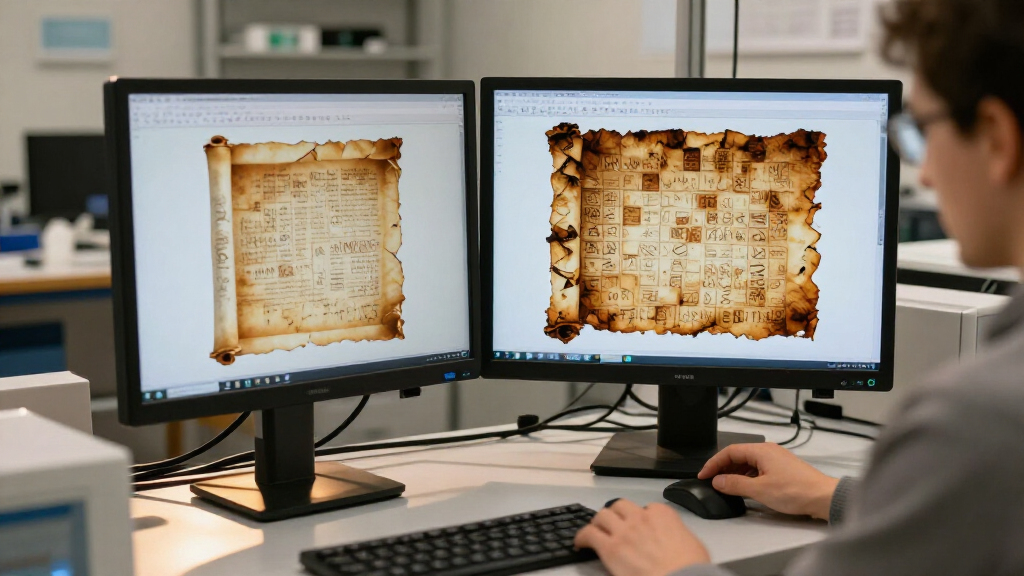
The writing was found on a papyrus sheet deep inside the scroll’s tightly wound layers. According to the Challenge, the papyrus is severely distorted and compressed, consistent with the damage suffered by Herculaneum scrolls during the eruption. The team used micro-CT scans made at the European Synchrotron Radiation Facility in Grenoble to examine the roll without physically opening it.
The key improvement was a clearer view of the Greek letters after the sequence το δι᾽ αὐτὸ. Researchers had debated whether the next marks represented a mu, a nu or other letter forms. The Challenge says Warner and Bodill’s image revealed a diagonal middle stroke that supported reading the letters as αι. The proposed phrase, τὸ δι᾽ αὑτὸ αἱρετόν, can be translated as “that which is in itself desirable.”
A New Reading in a Sealed Scroll
The finding shows that a scroll too fragile to unroll can still yield text through imaging and digital analysis. Rather than separating the papyrus physically, researchers use scans to map its layers and seek traces of ink. Recovering even a short sequence can give classicists evidence about the contents of a work that has remained inaccessible since antiquity.
The proposed phrase has potential links to ancient philosophical writing. The Vesuvius Challenge report notes parallels in works by Aristotle and Sextus Empiricus, as well as a similar expression in Philodemus’ ethical treatise On Anger. Those parallels help scholars consider possible meanings, but they do not establish the scroll’s author or identify the surrounding argument. The readable passage is brief, and interpretation depends on more text and context.
The result also provides a practical signal for future work: improving the visibility of a single stroke can resolve a disputed letter and move a submission across the prize threshold. That matters for a collection whose contents remain difficult to access and whose damaged sheets may be readable only through careful analysis of scan data.
Popular right now

Dyson V8 Cyclone Cordless Vacuum

TCL 65-Inch T7 Series 4K QLED Smart Google TV, 144Hz (65T7)

Shark AI Ultra Robot Vacuum, Black/Silver, AV2511AE
As an affiliate, we earn on qualifying purchases.
From Herculaneum to CT Scans
PHerc. 306 was buried in the AD 79 eruption of Vesuvius and excavated in the 1750s. It is now held at the Biblioteca Nazionale di Napoli, roughly 10 kilometers from the Villa dei Papiri in Herculaneum, where it was originally excavated. The scroll was later divided into two portions, which the Challenge calls PHerc. 306A and PHerc. 306B.
Until the recent identification of ink, the project had not established which portion represented the top or bottom of the original roll. Based on the location of the ink and the orientation of the script, the Challenge now identifies PHerc. 306B as the upper section and the smaller PHerc. 306A as the lower section. The project says that finding gives researchers added reason to scan and virtually unroll the remaining portion.
The Vesuvius Challenge community has been using imaging and computational methods to read Herculaneum papyri without unrolling them. In this case, several submissions identified the same area, and the sequence το δι᾽ αὐτὸ had appeared in multiple entries for nearly a month. Agreement on the following letters came only after the clearer image made the relevant stroke easier to distinguish.
“The sequence τοδιαυτο had been identified in multiple submissions for almost a month. However, what followed remained too faint and uncertain to allow for a consensus among the papyrology team.”
— The Vesuvius Challenge
The Text Beyond These Letters
The announced reading is a short fragment, not a complete passage. The proposed Greek phrase is reported as τὸ δι᾽ αὑτὸ αἱρ̣ε̣τ̣όν̣, with the final letters marked as less certain in the Challenge’s transcription. Although the team reached agreement on the disputed αι, the report does not establish the scroll’s author, title or full subject.
It is also not clear from the announcement how much additional writing in PHerc. 306B can be recovered, or when researchers may publish a fuller transcription. The fragment’s philosophical parallels are useful comparisons, but they cannot by themselves determine the work’s identity. The condition and tight compression of the papyrus remain obstacles to reading more.
Scanning the Remaining Scroll
The Vesuvius Challenge says the identification of ink in PHerc. 306B makes PHerc. 306A more valuable to scan and virtually unroll. The project has not specified a timetable for that work or announced what additional text may be recovered. Further imaging and analysis will be needed to test whether more letters can be read and to place this fragment in a wider passage.
For now, the award recognizes a particular result: a small, readable piece of writing recovered from a scroll that cannot safely be opened. Researchers’ next steps are to examine the remaining portion and continue refining readings where the scan evidence supports them.
Key Questions
What is PHerc. 306B?
PHerc. 306B is one portion of a carbonized Herculaneum papyrus scroll buried by the eruption of Vesuvius in AD 79. The Vesuvius Challenge identifies it as the upper section of the original roll.
Who recovered the writing?
Liam Warner and Nicola Bodill submitted the work that met the Vesuvius Challenge’s First Letters Prize criteria. Warner is a freelance software engineer and Bodill studies ancient languages and manuscripts, according to their descriptions in the project report.
What does the readable Greek phrase mean?
The proposed phrase, τὸ δι᾽ αὑτὸ αἱρετόν, means approximately “that which is in itself desirable.” The fragment is short, and the surrounding text has not yet been established.
How was the writing read without opening the scroll?
Researchers used micro-CT scans to examine the scroll’s internal layers. Digital analysis helped isolate a papyrus sheet and reveal traces of ink without physically unrolling the fragile, compressed scroll.
What happens next?
The Vesuvius Challenge says researchers now have added reason to scan and virtually unroll PHerc. 306A, the other portion of the scroll. The project has not announced a schedule or confirmed how much more writing can be recovered.
Source: scrollprize.substack.com