
TL;DR

Prime made for students and young adults
- Fast, free delivery for dorm and study essentials
- Prime Video and Amazon Music included
- Member-only deals
A study published in April 2026 in Nature Communications found that traveling electrical waves in the human cortex take several forms, including concentric and spiral patterns. The patterns differed between verbal and spatial memory tasks, but the results do not yet establish what causes the waves or whether they directly organize thought.
A team of neuroscientists reported in April 2026 that electrical activity traveling across the human cortex can form concentric, converging and spiral-like waves, rather than only the simple patterns usually described. In a study published in Nature Communications, the researchers found that different patterns were associated with verbal and spatial memory tasks, adding evidence to the idea that traveling waves may help the brain coordinate activity as behavior changes.
The research team, including Joshua Jacobs and Anup Das of the University of Chicago, used electrodes placed inside the brains of people with severe epilepsy. The electrodes had been implanted as part of clinical care to help identify seizure sources; with participants’ permission, the researchers recorded neural activity while they completed memory tasks. Intracranial recordings provide more detailed measurements across space and time than electrodes placed on the scalp, though the clinical setting limits who can take part.
Participants completed a verbal memory task, recalling words shown on a screen, and a more complex spatial task that involved navigating a virtual environment and remembering where objects had appeared. The team observed wave patterns that included activity spreading outward from a location, activity converging toward a point, and vortex-like spirals. The report describes these as distinct classes of traveling waves observed in awake humans.
The results build on earlier work by Jacobs and collaborators. A 2024 study in Nature Human Behavior described waves moving in opposite directions across the cortex during memory tasks: from the back toward the front, or from front to back. Jacobs has suggested that wave direction may reflect how information moves between brain regions. The 2026 findings broaden that account, but an association between task and wave pattern does not, by itself, show that the waves cause a person to remember or navigate.
How Waves May Coordinate Memory
The findings matter because they suggest that brain activity may be organized not only by which regions are active, but also by the shape and direction of activity moving across them. If different tasks are associated with different wave patterns, those patterns could offer researchers another way to study how the brain coordinates information during rapid changes in attention and memory.
Neural connections can change over longer periods, while everyday behavior shifts within seconds. Some neuroscientists propose that large-scale waves could help coordinate activity on that faster timescale. That remains a working interpretation, not a settled explanation. Even if waves are partly a byproduct of neurons firing, their changing patterns could still reveal how activity is organized during different tasks.
Better descriptions of those patterns may help guide future work on memory and cognition. The study does not establish a clinical application, a diagnostic tool, or a treatment. Its immediate contribution is evidence that cortical waves are more varied than simple oscillations and that their forms can differ with the task being performed.
As an affiliate, we earn on qualifying purchases.
From Scalp Signals to Cortical Patterns
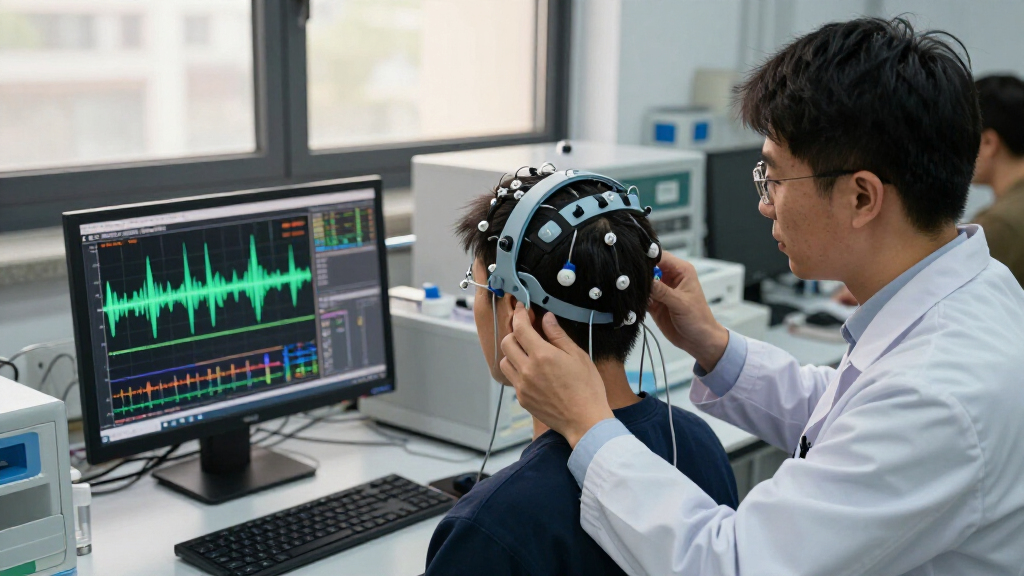
Researchers have measured electrical activity in the brain for roughly a century. Since the 1920s, electroencephalography (EEG) has recorded activity with electrodes on the scalp. Large-scale oscillations are often grouped into frequency bands, including alpha, beta, gamma and theta. These recordings can show changes associated with states such as attention, memory and sleep, but signals recorded outside the skull offer limited detail about where activity travels.
Intracranial recordings can capture activity from electrodes within a brain region. Jacobs’ team used recordings from approximately 100 electrodes in a particular area, according to the source report, while participants performed thinking tasks. Such studies rely on patients who already need electrode placement for epilepsy care; they are not equivalent to sampling the general population.
In the 2024 memory study, collaborators including Uma Mohan, now a neuroengineer at the National Institutes of Health, described waves moving front to back and back to front across the cortex. The 2026 paper added more complex forms to that picture. The developing research shifts the focus from whether waves are present to how their patterns relate to information processing.
“The work coming out is moving this from ‘Are they relevant?’ to ‘This is a major motif of how the cortex processes information,’”
— Earl K. Miller, cognitive neuroscientist at the Massachusetts Institute of Technology
As an affiliate, we earn on qualifying purchases.
What Wave Patterns Cannot Yet Prove
The study reports an association between memory tasks and wave patterns, but the available source material does not establish that the patterns cause memory performance or explain precisely how information is carried. It also does not provide enough detail here to assess the size and composition of the participant group, the strength of each task-pattern relationship, or how consistently the results would appear in other populations.
Because the recordings came from people undergoing epilepsy treatment, it remains unclear how directly the findings generalize to people without epilepsy. The reported observations also do not establish whether every wave form has a distinct functional role, or whether some patterns arise from other features of coordinated neural activity. Those questions require further study.
As an affiliate, we earn on qualifying purchases.
Testing the Waves Across Tasks
The next step is to test whether the reported patterns recur across larger and more varied groups, and whether they appear during other kinds of thinking and behavior. Researchers will also need to determine whether changes in wave direction or shape reliably track specific stages of memory, rather than simply occurring alongside them.
For now, the April 2026 paper adds a set of observations to a growing line of work on traveling waves. The central open question is whether these patterns are active organizers of brain processing, useful signatures of activity organized in other ways, or some combination of the two.
As an affiliate, we earn on qualifying purchases.
Key Questions
What did the 2026 study find?
Researchers reported several forms of traveling electrical waves across the cortex, including outward-spreading, converging and spiral-like patterns. The observed patterns differed across verbal and spatial memory tasks.
How did the researchers record brain activity?
They used intracranial electrodes already placed in people with severe epilepsy to help locate seizures. With participants’ permission, the team recorded neural activity while they performed memory tasks.
Do the waves cause memory or thought?
The findings do not prove that. They show an association between task type and wave patterns; whether the waves directly help organize thought remains uncertain.
How is this different from an EEG?
An EEG measures electrical activity using electrodes on the scalp. Intracranial electrodes record activity from inside the brain and can provide more detailed spatial and timing information, but are generally available for research only when electrodes have been placed for clinical reasons.
Source: hn
Halloween Picks
halloween
As an affiliate, we earn on qualifying purchases.