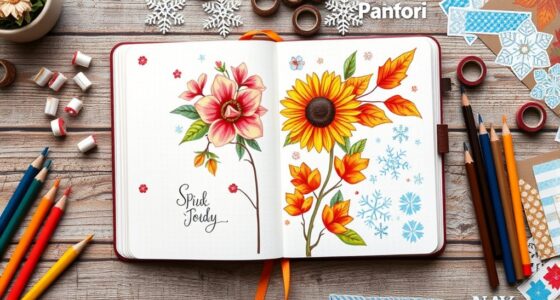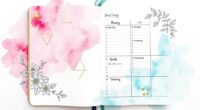
Minimalist bullet journaling helps you do more with less by focusing on essential tasks and eliminating visual clutter. Using a simple layout, 2-3 harmonious colors, and clean handwriting, you create a calming and efficient system. This approach keeps you organized without overwhelming your space or mind, boosting clarity and motivation. Embracing these minimal principles makes it easier to stay committed and productive—if you keep exploring, you’ll discover how to refine your journal even further.
Key Takeaways
- Focus on essential tasks and goals to reduce clutter and enhance productivity.
- Use a simple, consistent handwriting style for clarity and efficiency.
- Limit color schemes to 2-3 harmonious hues to create visual harmony.
- Minimize decorative elements to emphasize content and streamline pages.
- Design pages with clean layouts for quick scanning and mental clarity.
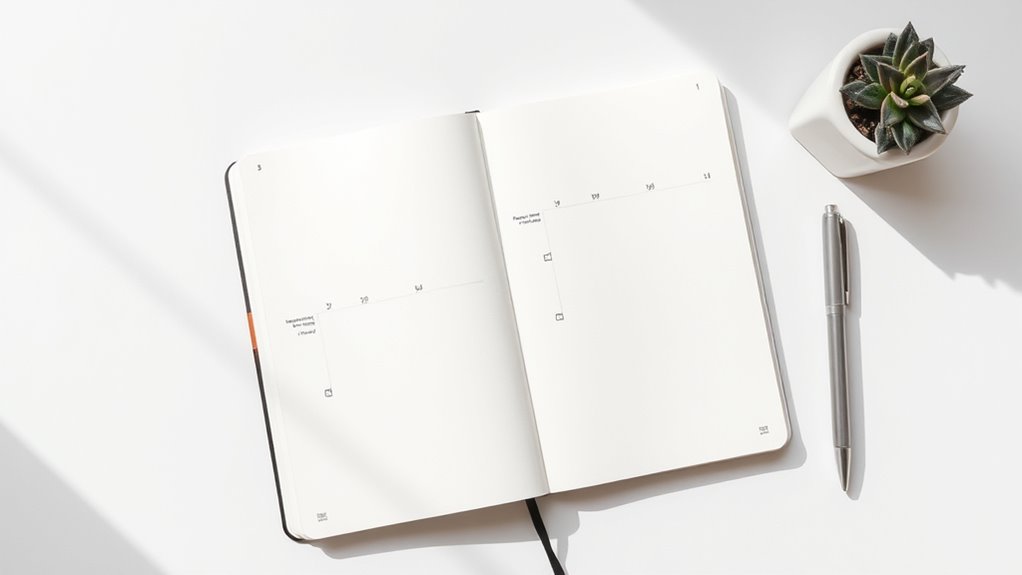
If you’re looking for a simple way to stay organized without the clutter, minimalist bullet journaling offers a streamlined approach. This method emphasizes clarity and purpose, helping you focus on what truly matters. One of the key elements of minimalist journaling is choosing a cohesive color scheme. Instead of overwhelming your pages with a rainbow of hues, pick two or three complementary colors. This creates visual harmony and makes your entries easier to scan. For example, a soft gray paired with a muted blue can evoke calmness, while a monochrome palette keeps things sleek and sophisticated. Consistent color schemes also help you quickly identify different sections or types of entries, reducing mental clutter and making your journal more functional.
Choose 2-3 harmonious colors for a clean, organized, and visually calming journal.
Another essential aspect is your handwriting style. Minimalist bullet journaling encourages you to adopt clean, simple, and uniform handwriting. You don’t need to be a calligraphy master—just aim for legibility and consistency. Using a straightforward handwriting style ensures your journal remains neat and easy to read over time. You might choose a modern sans-serif font or a minimal cursive, but the key is maintaining uniformity across entries. This consistency minimizes distractions, allowing your mind to focus on the content rather than the presentation. Additionally, using a single, clear handwriting style saves you time, as you don’t have to constantly switch between different styles or embellishments.
The beauty of minimalist bullet journaling lies in its adaptability. Your color schemes and handwriting styles can evolve over time, but keeping them simple helps you stay committed. When your pages look streamlined and organized, you’re more motivated to keep up with your journaling habit. You’ll find that less is often more—fewer colors and straightforward handwriting make your journal less visually overwhelming, yet more effective for planning, tracking, and reflecting. This approach also encourages you to focus on the content itself rather than decorative elements, making your journal a true productivity tool rather than just a decorative keepsake. Furthermore, understanding visual harmony can enhance the overall aesthetic and function of your journal.
In essence, by carefully selecting a limited color palette and maintaining consistent handwriting styles, you create a minimalist bullet journal that’s both functional and visually appealing. It’s about doing more with less—streamlining your pages so they serve your needs without unnecessary embellishments. This method not only declutters your physical space but also clears mental space, allowing you to concentrate on your goals, tasks, and ideas with clarity and purpose.
minimalist bullet journal supplies
As an affiliate, we earn on qualifying purchases.
As an affiliate, we earn on qualifying purchases.
Frequently Asked Questions
How Do I Adapt Minimalist Bullet Journaling for Digital Formats?
To adapt minimalist bullet journaling for digital formats, embrace digital customization to streamline your layout and focus on key elements. Use apps that support an analog-digital hybrid approach, combining handwritten notes with digital tools for quick edits and backups. Keep your design simple, prioritize functionality, and utilize minimal colors or icons. This way, you maintain the minimalist ethos while enjoying the flexibility and convenience of digital journaling.
What Are the Best Tools for Minimalist Bullet Journaling?
Think of your tools as the brushes in your creative kit. You’ll want a sleek, reliable pen that glides smoothly, like a whisper across high-quality paper that feels like a soft canvas. Minimalist bullet journaling thrives with simple, versatile tools—consider fine-tip pens for precision, and choose paper that’s sturdy yet unobtrusive. These essentials keep your flow seamless, turning your journal into a quiet powerhouse of productivity and clarity.
Can Minimalist Bullet Journaling Improve Productivity?
Yes, minimalist bullet journaling can improve your productivity by enhancing your time management and reducing stress. When you keep your journal simple, you avoid overwhelm and stay focused on your priorities. It helps you plan effectively, track progress, and stay organized without clutter. As a result, you’ll find it easier to meet deadlines, stay motivated, and enjoy a clearer, calmer mind, boosting your overall efficiency.
How Do I Maintain Motivation With a Minimalist Approach?
Staying motivated isn’t about complexity; it’s about clarity. When you focus on habit tracking and clear goal setting, you see progress without clutter. Keep your minimalist journal simple, celebrate small wins, and revisit your goals regularly. This straightforward approach keeps your motivation alive, making it easier to stick with your habits. Less noise, more focus—your motivation grows as you clearly see how your efforts pay off.
Is Minimalist Bullet Journaling Suitable for Visual Learners?
Yes, minimalist bullet journaling suits visual learners well. Its focus on aesthetic simplicity and clear visual clarity helps you quickly grasp information without clutter. With clean lines, simple icons, and organized layouts, you can easily identify tasks and priorities. This streamlined approach reduces distractions, making it easier for you to stay focused and motivated. Overall, minimalist journaling enhances your learning experience by emphasizing clarity and visual effectiveness.
As an affiliate, we earn on qualifying purchases.
Conclusion
By embracing minimalist bullet journaling, you simplify your life and boost your productivity without feeling overwhelmed. Less is truly more when you focus on what matters most, helping you stay organized and centered. So, why not give this streamlined approach a try? Isn’t it time you declutter your mind and create space for what truly counts? With just a few intentional tools, you can do more with less and enjoy the journey along the way.
neutral color pens for journaling
As an affiliate, we earn on qualifying purchases.
As an affiliate, we earn on qualifying purchases.
clean handwriting practice notebooks
As an affiliate, we earn on qualifying purchases.
As an affiliate, we earn on qualifying purchases.