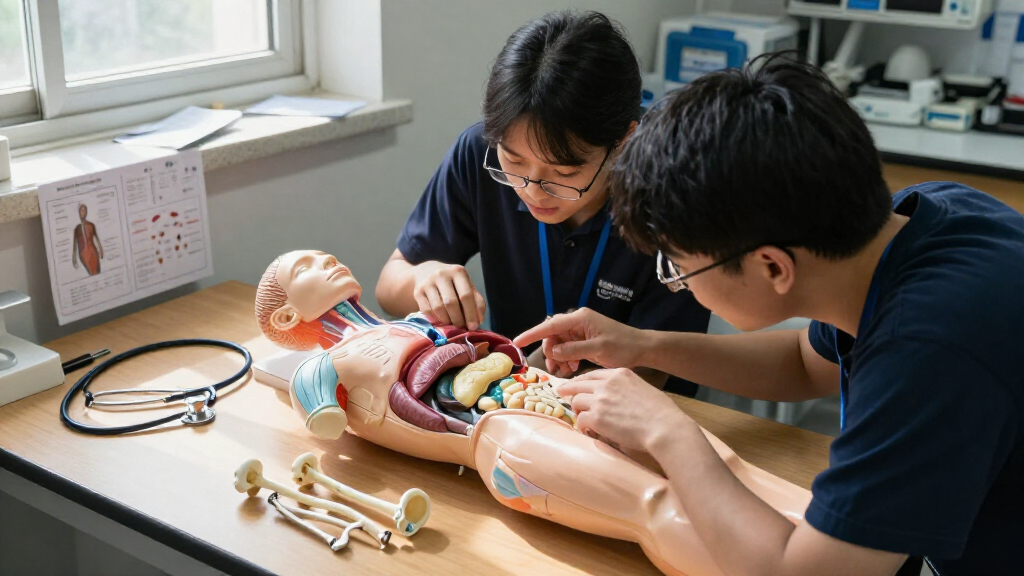

Educational anatomy models for students range from simple, tactile kits to detailed torso, brain, heart, and full-skeleton displays. I name the EVOTECH SCIENTIFIC 16-piece torso best overall for its removable parts and broad introductory coverage, while the National Geographic 32-piece kit stands out for guided STEM learning and the life-size skeleton with nervous system for classroom display. The main tradeoff is between portability and anatomical detail: compact kits are easier to handle and store, while larger models show more structures at once. Age, lesson goals, and the amount of adult guidance needed also change which model makes sense. Read on for how all 15 options compare and which student each one suits best.

Prime made for students and young adults
- Fast, free delivery for dorm and study essentials
- Prime Video and Amazon Music included
- Member-only deals
Key Takeaways
The EVOTECH SCIENTIFIC 16-piece torso ranks first for combining removable anatomy with a useful overview, while its larger format is less convenient to store than a mini model.
The National Geographic 32-piece kit and Science Can interactive model lean toward guided, child-friendly exploration; they suit early learners better than students seeking detailed regional anatomy.
The life-size skeleton with nervous system, stand, and posters is the strongest display-centered choice, but its footprint makes it a poor fit for a crowded desk or small home study area.
For focused lessons, a 48-structure heart model, exploded skull, or cross-section brain can teach more about one system than a general body model, but each leaves other systems out.
The roundup separates into three useful formats: hands-on kits for assembly and play, detachable torso models for broad study, and specialty or full-size displays for focused instruction or reference.


| educational anatomy models for student | Material |
|---|---|
| GobiDex Human Body Skeleton Mo | Plastic |
| EVOTECH SCIENTIFIC Human Torso | — |
| Life-Size Human Heart Model wi | PVC |
| Life‑Size Human Skeleton Model | Non-toxic PVC |
| Human Body | — |
| Science Can Human Body Model f | Plastic |
| New Horizon 15-Piece Exploded | PVC |
| Merinden 11-Inch Human Torso A | — |
| Cross-Section Foam Brain Model | Molded plastic |
| Be Amazing! Toys Interactive H | — |
| National Geographic Human Body | Polypropylene |
| EVOTECH SCIENTIFIC 2026 New Hu | PVC |
| Human Skeleton Model for Anato | — |
| Human Anatomy Squishy Body Mod | — |
| Learning Resources Anatomy Mod | Durable plastic |
More Details on Our Top Picks
GobiDex Human Body Skeleton Model Kit – Glow-in-the-Dark Science Kit for Kids
The GobiDex kit is the clearest fit here for younger students who learn by putting a model together rather than just viewing one. Its 40 plastic pieces, illustrated manual, and glow-in-the-dark bones turn anatomy into a guided activity, while the parts can be taken apart and reused. Compared with the EVOTECH SCIENTIFIC 17-inch torso, it gives less focused detail on removable internal organs, but it asks less of a student and supports broader hands-on exploration. The glow feature adds visual appeal, not anatomical information, so older learners may outgrow it if they need precise classroom reference. Its plastic construction is practical for repeated assembly, though it lacks the heft and display presence of larger models. I’d choose it for an ages 8–16 learning activity, not as a substitute for a detailed medical teaching model.
Pros:- 40 pieces give students an active role in assembling the model
- Illustrated manual provides guidance for independent or parent-supported learning
- Glow-in-the-dark bones add a memorable visual element
- Plastic components can be assembled and disassembled for repeat use
Cons:- Does not offer the detailed removable organ study provided by the EVOTECH torso
- Plastic construction may feel less substantial than display-oriented models
- Assembly may be challenging for children younger than the stated age range
Best for: Students ages 8–16 who want a guided, hands-on anatomy activity at home or in a small learning group
Not ideal for: Medical students or teachers who need large, detailed organs or a life-size classroom demonstration model
- Brand:GobiDex
- Age range:8–16 years
- Number of pieces:40
- Material:Plastic
- Dimensions:12.6 × 5.71 × 3.15 inches
- Item type:Educational science kit
- Manufacturer part number:GO-HB-01
Our verdict“Choose the GobiDex for an engaging, guided anatomy activity for school-age students, but pick a torso model for closer organ study.”
EVOTECH SCIENTIFIC Human Torso Anatomy Model, 16-Piece Removable 17-inch Medical Learning Tool
For students who need to see how major organs fit inside the torso, the EVOTECH SCIENTIFIC 17-inch model offers a more focused lesson than the GobiDex assembly kit. Its 16 removable parts include the brain, heart, lungs, digestive organs, and male and female parts, letting learners examine components individually before returning them to the body. The oak-wooden base supports a stable display, and the included brochure gives students a reference alongside the model. At 17 inches, it is easier to place on a desk than the full-size breesky skeleton, but its small pieces and detailed layout suit supervised study better than play for young children. It also concentrates on the torso rather than offering the whole-body bone articulation of the breesky. I’d favor it for classroom or independent organ lessons, while beginners may prefer a simpler kit.
Pros:- 16 removable components support hands-on study of major organs and reproductive systems
- Includes an instructional brochure for accompanying lessons
- Oak-wooden base helps keep the model steady for display and handling
- 17-inch height suits desks and classroom work surfaces
Cons:- Small removable organs require care and supervision around young children
- Torso-focused design does not provide the articulated full skeleton of the breesky model
- The model’s 5.02-pound weight makes it less convenient to carry than compact kits
Best for: Middle- and high-school students, anatomy learners, and teachers seeking a desk-sized model for supervised organ lessons
Not ideal for: Young children who may handle small removable parts unsupervised, or classes needing a full-size skeleton demonstration
- Brand:EVOTECH SCIENTIFIC
- Height:17 inches
- Removable parts:16
- Included parts:Trunk, skull cap, brain, heart, lungs, stomach, liver, intestines, pancreas, caecum, and male/female parts
- Materials:Non-toxic PVC and oak-wooden base
- Item weight:5.02 pounds
- Package dimensions:18.11 × 8.66 × 5.94 inches
Our verdict“Pick this torso for hands-on study of organ placement and systems; choose a skeleton model if bone structure is the lesson priority.”
Life-Size Human Heart Model with 48 Numbered Anatomical Structures
Students working on cardiac anatomy get more specific learning value from this model than from the broader EVOTECH SCIENTIFIC torso. The heart separates into two magnetic sections, and its 48 numbered structures give learners a way to connect visible anatomy with labels in the included study guide. That focused detail makes it useful for a lesson, revision session, or small-group demonstration without asking students to sort through organs unrelated to the heart. The tradeoff is scope: it cannot teach how the heart relates to the full body as effectively as a torso model. Although described as life-size and 1X enlarged, its listed dimensions are only 4.33 × 4.33 × 8.27 inches, which may limit visibility from across a larger classroom. I’d choose it for targeted heart study, not as the sole anatomy model in a course.
Pros:- 48 numbered structures support detailed, label-based heart study
- Two magnetic sections can be separated and reassembled readily
- Study guide is included to accompany the model
- Compact dimensions suit a desk or individual study station
Cons:- Heart-only scope offers less whole-body context than the EVOTECH torso
- Small listed dimensions may make details difficult to see from a distance
- The study guide’s depth and level are not specified
Best for: Students studying heart structure who want a labeled, detachable model for desk-based revision or small-group instruction
Not ideal for: Learners seeking a broad overview of body systems or teachers who need a heart model visible across a large classroom
- Brand:WLLFS
- Model number:xz-01
- Anatomical structures:48 numbered structures
- Design:Two-part detachable model with magnets
- Material:PVC
- Size description:1X enlarged
- Dimensions:4.33 × 4.33 × 8.27 inches
- Included:Study guide/manual
Our verdict“Choose this model for concentrated study of heart anatomy, but pair it with a torso or skeleton for broader coursework.”
Life‑Size Human Skeleton Model with Nervous System, Rolling Stand & 3 Posters – 70.8 in
The 70.8-inch breesky skeleton is the strongest choice in this group when a teacher needs anatomy visible at classroom scale. Its life-size frame and 206 articulated bones let students relate skeletal structure to the proportions of a standing human, while three posters provide supporting visual references. The detachable rolling stand adds a practical advantage over the stationary EVOTECH SCIENTIFIC torso: a teacher can move the skeleton between lesson areas rather than carry a desk model. That scale comes with real costs in space and setup. At 22.9 pounds, it is not a casual take-along aid, and assembly across many detachable parts can take time. It also focuses on the skeleton and nervous system rather than removable internal organs. I’d rank it for dedicated classrooms and labs, not compact study spaces or students who need a portable all-in-one kit.
Pros:- Life-size 70.8-inch scale makes skeletal proportions easier to demonstrate
- 206 articulated bones support study of the skeleton’s structure
- Rolling stand makes it easier to reposition than a stationary torso model
- Three anatomical posters add reference material for lessons
Cons:- At 22.9 pounds, it is bulky to transport and requires floor space
- Assembly can take time because of the many detachable parts
- Skeleton-focused design does not provide the removable organ study of the EVOTECH torso
Best for: Teachers and anatomy students with dedicated classroom or lab space who need a full-size skeletal reference for group demonstrations
Not ideal for: Students studying at a small desk or needing a lightweight model with removable organs for individual study
- Height:70.8 inches
- Dimensions:33 × 15.2 × 10.2 inches
- Weight:22.9 pounds
- Bone count:206 articulated bones
- Material:Non-toxic PVC
- Stand:Detachable rolling stand
- Included:Three anatomical posters
- Manufacturer:breesky
Our verdict“Choose the breesky for a permanent or semi-permanent classroom display where life-size bone study matters more than portability.”
Human Body, Skeleton, Heart, Half Size Skull with Brain Models
This EVOTECH bundle makes the most sense for students who need to compare several body structures without committing to one large display model. It combines a 17.7-inch skeleton, an 11-inch torso, an approximately 8-inch heart, and a half-size skull with brain, with a carrying case and separate guides or charts for the included subjects. That breadth gives a learner more variety than the focused WLLFS heart model, while the compact pieces are easier to store than the 70.8-inch breesky skeleton. The tradeoff is that none of the models matches the classroom presence or scale of the breesky, and the torso is smaller than the 17-inch EVOTECH standalone torso. The description emphasizes hand-painted detail, but supplies no full specifications for materials or part counts. I’d choose the bundle for portable, multi-topic study, not for detailed institutional demonstration.
Pros:- Four models cover several anatomy topics in one set
- Carrying case supports storage and transport
- Separate brochures, chart, and manuals provide topic-specific learning references
- Smaller models take less room than the full-size breesky skeleton
Cons:- Models are smaller than dedicated classroom-scale options, including the 17-inch EVOTECH torso
- The product data does not specify materials or component counts for the set
- The smaller scale may limit visibility during group demonstrations
Best for: Students or teachers who want portable models covering the skeleton, torso, heart, and skull for home study or small-group lessons
Not ideal for: Classrooms needing a life-size skeleton, or buyers who require detailed material and component specifications before choosing
- Set contents:Skeleton, torso, heart, and half-size skull with brain
- Skeleton height:Approximately 17.7 inches
- Torso height:11 inches
- Heart height:Approximately 8 inches including base
- Skull size:Half-size; approximately 3.5 inches
- Storage:Carrying case
- Learning materials:Human body and system brochure, skeleton chart, heart manual, and skull-with-brain manual
- Model finish:Hand-painted
Our verdict“Choose this bundle when portable coverage across several anatomy topics matters more than full-size detail or classroom visibility.”
Science Can Human Body Model for Kids, Interactive Anatomy Learning Toys
The Science Can Human Body Model is a good fit for younger students who need prompts as well as parts to handle. Its explanation and quiz modes turn the 15 removable pieces into short, guided learning sessions, while the 26-page illustrated book and knowledge cards give families material to revisit away from the model. Compared with the Be Amazing! Toys Interactive Human Body Anatomy Figure, this model emphasizes spoken instruction and quiz practice rather than a larger, poseable assembly project. That makes it approachable for early learners, but less suited to students seeking extensive component-by-component building. At 11 inches, it is easy to place on a desk, though small parts and the compact scale limit group viewing. It also needs three AA batteries, which are not included.
Pros:- Explanation and quiz modes offer guided practice and recall prompts
- 15 removable parts support hands-on exploration
- Includes a 26-page illustrated book and four double-sided knowledge cards
- Compact 11-inch size fits a home study area
Cons:- Three AA batteries are required and are not included
- Small scale can make details harder to see in group lessons
- Many small removable pieces may be easy to misplace
Best for: Students around ages 6–13 and families who want guided audio prompts, quizzes, and a book for supported anatomy practice
Not ideal for: Older students who need large, highly detailed structures for classroom demonstrations or learners who prefer a battery-free model
- Height:11 inches
- Removable parts:15
- Learning modes:Explanation and quiz
- Included learning materials:26-page illustrated book and four double-sided knowledge cards
- Recommended age:6+
- Material:Plastic
- Power:Three AA batteries, not included
- Item dimensions:11.42 x 6.1 x 9.45 inches
Our verdict“Choose this model for a young student who benefits from spoken guidance and quiz-based practice, rather than a larger, more elaborate assembly set.”
New Horizon 15-Piece Exploded Human Skull Model
For students whose coursework centers on cranial anatomy, the New Horizon Exploded Skull Model offers a more focused lesson than a torso kit. Its 15 color-coded pieces expose teeth, sutures, and internal cavities, helping learners connect individual bones to the overall cranium; the illustrated guide adds identification support. Compared with the Merinden 11-Inch Human Torso Anatomy Model, it gives up coverage of multiple body systems in favor of a close look at one region. Its palm-sized miniature form is easy to carry and store, but that same scale makes it a weak choice for presenting fine structures to a class. The PVC construction keeps it light, though it may not feel as substantial as a larger, higher-end display model. I’d choose it for targeted study, not as a general anatomy centerpiece.
Pros:- 15-piece design reveals cranial structures, teeth, and internal cavities
- Color coding helps learners distinguish bones
- Compact miniature format is portable and easy to store
- Illustrated guide supports identification and review
Cons:- Palm-sized scale limits visibility for group demonstrations
- PVC may feel less substantial than higher-end model materials
- Its skull-only scope does not teach torso or other body systems
Best for: Dental, medical, or art students who need a portable model for identifying skull bones and cranial features
Not ideal for: Younger students or instructors who need a large model that can be seen clearly across a classroom
- Number of pieces:15
- Material:PVC
- Scale:Miniature
- Weight:0.3 kg
- Target audience:Adult
- Included components:15-piece skull model, illustrated guide, connectors
- Model name:Anatomy Exploded Skull Model
- UPC:705644683601
Our verdict“Pick this compact model when skull anatomy is the study priority; choose the Merinden torso instead for broader organ-system coverage.”
Merinden 11-Inch Human Torso Anatomy Model, 15-Piece Detachable
The Merinden 11-Inch Torso Model suits students who want removable organs without giving up much desk space. Its 15 components include a two-part brain, heart, esophagus and aorta, four-part lungs, and skull, giving learners a chance to inspect several connected structures. A colorful educational manual supports identification, while the base keeps the compact model on display between lessons. Compared with the Science Can Human Body Model, Merinden has no stated talking or quiz modes; its appeal is a straightforward, parts-first study experience. It also has fewer pieces than the 60-part Be Amazing! figure, so setup is less involved, but it offers less assembly and movement practice. The 11-inch height is convenient for home study, with the tradeoff that fine details may be hard to see during a class demonstration.
Pros:- 15 detachable components allow hands-on inspection of major structures
- Includes a colorful manual for identification and study
- Stable base supports desk display
- Compact height is suited to home study areas
Cons:- 11-inch size can limit visibility of fine details
- No interactive audio or quiz features are specified
- Fewer components than larger, more involved assembly models
Best for: Students studying organ placement at home or in a small classroom who want a compact torso with a manual and stable base
Not ideal for: Teachers needing a large demonstration model or students seeking extensive articulation and assembly challenges
- Model type:Human torso anatomy model
- Height:11 inches
- Number of pieces:15
- Components:Torso, two-part brain, heart, esophagus and aorta, four-part lungs, skull
- Included materials:Colorful educational manual and stable base
- Package dimensions:12.05 x 5.43 x 4.88 inches
- Item weight:2.07 pounds
Our verdict“Choose Merinden for compact, manual-supported torso study; opt for the Be Amazing! figure if movement and a larger assembly challenge matter more.”
Cross-Section Foam Brain Model with Stand, Answer Sheet, and Digital Worksheet
Students concentrating on neuroanatomy may get more from this two-piece cross-section brain than from a general torso model. Its labeled, color-coded structures help learners connect regions with their names, and the two halves separate for a simple show-and-explain activity. A stand, answer sheet, and digital worksheet add classroom and independent-study options. Compared with the New Horizon Exploded Human Skull Model, this model narrows the focus from cranial bones and cavities to brain regions, so it better fits a lesson on the brain rather than the whole skull. That narrow scope is also its main limitation: it cannot substitute for a model covering multiple organs or body systems. The small package is easy to store, but printed surfaces may need care, and the listed guidance advises avoiding prolonged heat exposure.
Pros:- Labeled, color-coded structures support visual identification
- Two interlocking halves can be separated and reassembled
- Stand supports display during lessons
- Answer sheet and digital worksheet provide guided practice
Cons:- Focuses on the brain rather than broader human anatomy
- Printed surfaces may need protection during storage
- Care guidance advises against prolonged high-temperature exposure
Best for: Students and teachers covering brain regions who want a labeled model for small-group instruction or home review
Not ideal for: Buyers looking for a full-body anatomy model, removable organ systems, or a model suited to prolonged exposure to heat
- Material:Molded plastic
- Pieces:Two interlocking halves
- Package dimensions:6.34 x 5 x 5 inches
- Item weight:10.2 ounces
- Included items:Stand, answer sheet, digital worksheet
- Manufacturer:Merhoff & Larkin
- Model number:1.618
Our verdict“Select this for focused brain-region lessons and guided review; choose a torso model for broader organ-system study.”
Be Amazing! Toys Interactive Human Body Anatomy Figure
The Be Amazing! Toys Interactive Human Body is the most involved build in this group: 60 pieces let students assemble and remove bones, muscles, and organs, then pose the articulated figure on its adjustable stand. That makes it a stronger choice for learning how body parts fit together and how movement relates to anatomy than the Science Can Human Body Model, which offers spoken explanations and quiz prompts but fewer parts. Illustrated instruction cards provide structure, while squishy organs add a tactile contrast to the hard-plastic skeleton. The larger 14-inch figure gives parts more room than the compact Merinden torso, though it still contains small pieces that need supervision around younger children. Its assembly demands may also be more engaging for students who like building than for learners who want quick, guided explanations.
Pros:- 60 pieces support detailed assembly and repeated hands-on study
- Includes bones, muscles, and removable squishy organs
- Articulated figure and adjustable stand allow posing
- Illustrated instruction cards explain body functions and movement
Cons:- Small parts pose a choking hazard for children under 8
- Assembly may be less suitable for learners who want quick, guided instruction
- No manufacturer warranty is specified
Best for: Students ages 8–14 who enjoy assembling, disassembling, and posing a model while learning about bones, muscles, and organs
Not ideal for: Children under 8, students who need a simple ready-to-study model, or classrooms that want a stated manufacturer warranty
- Height:14 inches
- Piece count:60
- Age range:8–14 years
- Materials:Hard-plastic skeleton and squishy organs
- Included components:Articulated skeleton, muscles, removable organs, transparent stand, instruction cards
- Brand:Be Amazing! Toys
- Model name:Science to the Max Interactive Human Body
- Manufacturer part number:2331
Our verdict“Choose this for an older student who learns by building and posing anatomy; choose Science Can for more guided, quiz-based practice.”
National Geographic Human Body Anatomy Model for Kids, 32-Piece STEM Kit
Removable organs, muscles, and glow-in-the-dark bones make this a lively first anatomy set for students ages 8 and up. Its 9-inch body model is compact enough for a desk or shared classroom table, while the chart and learning guide give children a way to connect each piece to its place in the body. Compared with the EVOTECH SCIENTIFIC 11-inch torso, this kit is more explicitly aimed at younger learners and includes bones and muscles alongside organs, but the EVOTECH model offers a more traditional torso display with a wooden base. The small scale limits fine anatomical detail, and the loose pieces call for supervised storage. I’d choose it for introductory, hands-on exploration rather than detailed study of organ structure.
Pros:- Removable organs, muscles, and bones support hands-on identification.
- Glow-in-the-dark bones add a visual way to engage younger learners.
- Includes forceps, an identification chart, a stand, and a learning guide.
- Compact size suits desks and small-group activities.
Cons:- At about 9 inches tall, it offers less detail than larger torso models.
- The multiple small removable pieces require organized storage and supervision.
Best for: Students ages 8 and up who want a compact, tactile introduction to organs, muscles, and bones at home or in a classroom.
Not ideal for: Older students seeking fine anatomical detail or a larger torso model for demonstrations.
- Brand:Blue Marble
- Recommended age:8 years and up
- Piece count:32
- Model height:9 inches
- Removable organs:9
- Glow-in-the-dark bones:18
- Material:Polypropylene
- Included components:Body model, bones, organs, muscles, display stand, forceps, identification chart, and learning guide
Our verdict“Choose this kit for an engaging first anatomy activity for children, not for advanced or highly detailed study.”
EVOTECH SCIENTIFIC 2026 New Human Body Model for Anatomy, 15 Pcs Removable 11 inch Human Torso Anatomical Model with Heart Head Skull Brain Skeleton, School Medical Education Display
Fifteen detachable sections let students examine how major organs sit inside the torso, from the lungs and heart to the stomach and intestines. At 11 inches, this model is small enough to carry to class, and its oak-wooden base gives it a stable display format that differs from the National Geographic kit’s more playful, child-focused setup. The included brochure supports basic identification, while the painted PVC construction is described as easy to clean. Its main limitation is scope: this is an organ-centered torso rather than a broad body-system set, so students looking for separate bones and muscles may prefer the National Geographic model. Some components are small, making it a poor fit around children who put objects in their mouths.
Pros:- Fifteen detachable sections allow students to study organ placement in the torso.
- Portable 11-inch format is practical for classes and limited study space.
- Wooden base supports stable tabletop display.
- Includes a colorful educational brochure.
Cons:- Small parts pose a risk for young children and require careful handling.
- Focuses on torso organs rather than providing a broad, separate skeleton study set.
- At 11 inches, its structures are smaller than those on larger torso models.
Best for: High-school anatomy, nursing, or physiology students who need a portable tabletop model for learning major organ positions.
Not ideal for: Young children or learners who need a full skeleton-and-muscle set or larger structures for close inspection.
- Model type:Human torso anatomy model
- Model size:11 inches
- Detachable pieces:15
- Material:PVC
- Base:Oak-wooden base
- Included learning material:Colorful educational brochure
- Power source:None required
- Listed use:Anatomy, nursing, and physiology education
Our verdict“Pick this portable torso when organ location matters more than a larger scale or a complete skeleton study aid.”
Human Skeleton Model for Anatomy – 17″ Miniature Human Skeleton with Movable Arms and Legs
Movable arms, legs, and jaw give students a simple way to observe how the skeleton is arranged without giving up much desk space. The 17.7-inch miniature format is easier to store and carry than the full-size skeleton model in this roundup, but that convenience comes with a clear sacrifice: the description points to basic spine, rib, and skull detail rather than the depth of a dedicated, larger teaching skeleton. Its easy assembly and disassembly can help students pack it away between study sessions. Compared with the Learning Resources Anatomy Models Bundle Set, this pick concentrates on skeletal structure instead of also providing heart, brain, and body models. I’d treat it as a visual aid for introductory review, not as a detailed reference for advanced anatomy.
Pros:- Compact 17.7-inch height fits desks and smaller study spaces.
- Movable arms, legs, and jaw offer basic interactive study.
- Designed for assembly and disassembly for storage or transport.
- Provides a focused skeleton aid without extra organ models.
Cons:- Anatomical detail is limited to basic features such as spine, ribs, and skull.
- The skull cannot be fully removed, limiting independent inspection.
- Small scale is less suited to classroom demonstrations for a group.
Best for: Students with limited desk or storage space who want a small, movable skeleton for introductory review.
Not ideal for: Learners who need detailed bone anatomy, a fully removable skull, or a large model for group teaching.
- Model height:17.7 inches
- Manufacturer:Fivtyily
- Model number:X-1
- Listed dimensions:11.54 x 6.18 x 0.2 inches
- Weight:1.1 pounds
- Movable parts:Arms, legs, and jaw
- Assembly:Designed for assembly and disassembly
- Date first available:April 29, 2020
Our verdict“Choose this miniature skeleton for compact, entry-level visual study, but look to a larger model for detailed bone learning.”
Human Anatomy Squishy Body Model – STEM Science Kits for Boys & Girls
Thirty removable, squishy body parts make this model the most texture-focused option in the lineup. Students can handle organs and bones, then use the numbered organizer to match pieces to their positions—an active recall task rather than simply looking at a diagram. The guide adds activities about everyday body functions, which gives it more lesson structure than the simpler miniature skeleton. Compared with the National Geographic Human Body Anatomy Model, this kit emphasizes stretchy and squishy materials and lists 30 removable parts, while National Geographic adds glow-in-the-dark bones and specifies an age recommendation of 8 years and up. The playful materials may suit younger learners better than formal classroom instruction, and the listed dimensions are compact rather than life-size. I’d pick it for tactile exploration, not precision-focused anatomy work.
Pros:- Thirty removable body parts support hands-on identification and rebuilding.
- Numbered organizer connects each piece to its matching position.
- Guide includes interactive challenges and activities about body functions.
- Squishy and flexible textures provide a distinct tactile learning experience.
Cons:- Play-focused materials may be less suitable for formal or advanced anatomy study.
- Compact dimensions limit the scale available for examining structures.
- Loose pieces need sorting and storage after activities.
Best for: Children who learn best by handling, sorting, and matching anatomy pieces during guided STEM activities.
Not ideal for: Students seeking realistic, finely detailed structures or a conventional medical-style display model.
- Removable body parts:30
- Material type:Plastic
- Item dimensions:12.8 x 6.5 x 2 inches
- Item weight:0.53 kg
- Included learning feature:Guide with facts, illustrations, and interactive challenges
- Organizer:Numbered body-part organizer with matching outlines
- Featured structures:Brain, heart, lungs, ribs, trachea, fibula, and flexible spine
Our verdict“Choose this kit for tactile, activity-led anatomy lessons rather than realistic detail or medical-style display.”
Learning Resources Anatomy Models Bundle Set
Four separate models—heart, brain, body, and skeleton—give students more ways to study anatomy than any single torso or skeleton in this group. Assembly and disassembly help turn the set into an active lesson, while the included stands make the models practical for display between activities. Compared with the EVOTECH SCIENTIFIC 11-inch torso, this bundle covers more body systems, but it does not center the learning experience on one detachable torso with a specified 15-piece organ layout. The photo-illustrated assembly guide supports independent work and classroom use. Its breadth is the main advantage, though a four-model set takes more storage space than a compact kit, and the supplied information does not specify dimensions or piece counts for each model. I’d favor it for shared lessons or homeschooling with room to store the full set.
Pros:- Includes heart, brain, body, and skeleton models in one set.
- Assembly and disassembly give students active ways to explore structures.
- Photo-illustrated assembly guide supports independent and group learning.
- Display stands help keep models ready for classroom or home use.
Cons:- Four models require more storage space than a single torso or compact skeleton.
- The available product details do not specify dimensions or piece counts for each model.
- No manufacturer warranty is listed.
Best for: Teachers and homeschool families who want several hands-on anatomy models for rotating lessons across body systems.
Not ideal for: Students with limited storage space or buyers seeking a single, highly detailed torso model with specified dimensions.
- Brand:Learning Resources
- Model number:LER3338
- Age range:8 years and up
- Grade level:Grade 3 and above
- Included models:Heart, brain, body, and skeleton
- Material:Durable plastic
- Included accessories:Display stands and photo-illustrated assembly instructions
- Educational objectives:STEM and human anatomy
Our verdict“Choose this bundle for broad, multi-system teaching when you have space for four models and want more than a single anatomy display.”

How We Picked
I ranked these models by how well their format, anatomical scope, and interaction support student learning—not by how many parts a box lists on its own. I looked at whether students can remove or move structures, whether a model focuses on one system or gives a wider body overview, and how readily its size suits a desk, classroom, or shared study space. Build and handling matter too: a model used for repeated lessons should be practical to assemble, examine, and put away.
The ranking favors options with a strong balance of learning value and usability, which puts the EVOTECH 16-piece torso first for broad, hands-on study. More specialized models rank well for their intended lessons but sit lower as all-purpose picks; large displays trade portability for visibility, while playful or simplified kits are easier starting points but offer less depth. Where a product’s listed details do not establish age range, materials, or included learning instructions, I avoid assuming those benefits and recommend checking the listing before buying.
| educational anatomy models for student | Material |
|---|---|
| GobiDex Human Body Skeleton Mo | Plastic |
| EVOTECH SCIENTIFIC Human Torso | — |
| Life-Size Human Heart Model wi | PVC |
| Life‑Size Human Skeleton Model | Non-toxic PVC |
| Human Body | — |
| Science Can Human Body Model f | Plastic |
| New Horizon 15-Piece Exploded | PVC |
| Merinden 11-Inch Human Torso A | — |
| Cross-Section Foam Brain Model | Molded plastic |
| Be Amazing! Toys Interactive H | — |
| National Geographic Human Body | Polypropylene |
| EVOTECH SCIENTIFIC 2026 New Hu | PVC |
| Human Skeleton Model for Anato | — |
| Human Anatomy Squishy Body Mod | — |
| Learning Resources Anatomy Mod | Durable plastic |
Factors to Consider When Choosing Educational Anatomy Models For Students
Before choosing a model, match it to the lesson and the student’s working style. A broad body overview, a close study of one organ, and a tactile first introduction are different jobs, even when all three products are called anatomy models.
Match anatomical scope to the lesson
Start with what the student needs to learn this term, rather than selecting the model with the most pieces. A torso or body kit can introduce several systems, while a heart, brain, or skull model gives more room to focus on one area. A common mistake is expecting one compact product to provide both broad coverage and fine detail. If the course changes topics often, a general model may earn more use; for a unit on neuroanatomy or the cardiovascular system, a dedicated model can make structures easier to discuss. Check whether the listed parts actually correspond to the structures in the curriculum. A focused model works best as a supplement when the student also needs a whole-body reference.
Choose interaction that fits the learner
Removable parts, movable limbs, and tactile materials can make a lesson active, but they help in different ways. Detachable organs support identification and spatial relationships; movable joints are more useful for basic skeletal orientation; soft or playful formats can invite younger students to handle the model without making the lesson feel formal. More pieces do not automatically mean more learning, especially if parts are small, difficult to replace, or need careful assembly. Think about whether the student will work independently or with an adult who can guide labeling and discussion. For self-directed study, look for clear instructions, labels, answer sheets, or worksheets. If those supports are absent, plan to pair the model with a textbook or teacher-created activity.
Measure the real storage and display footprint
Model height is only one part of the space calculation: removable components need room to spread out, and a stand needs a stable place to sit. A life-size skeleton can be easy to see from across a classroom but awkward to keep beside a student’s books. Small torsos and mini skeletons store more readily, though their structures can be harder to see in a group lesson. Measure the intended shelf, desk, or cabinet before ordering and account for the assembled model rather than only its packed size. Also consider whether the model needs to stay assembled between sessions. A display that is repeatedly taken apart may be less practical than a compact model that can be stored in one piece.
Check what the learning materials actually teach
Posters, worksheets, answer sheets, and numbered structures can turn a model into a lesson resource, but they are not interchangeable. Numbered parts help with recall only if students can find a matching key; worksheets are more useful when their level suits the learner. Before buying, inspect the listing for the exact included materials and whether any digital content requires a separate download or device. Avoid assuming that a product described as educational comes with a complete teaching plan. For classroom use, a reusable activity or clearly labeled reference can save preparation time. For home learning, a simpler kit may be enough if a parent or instructor will supply the explanations.
Balance detail against handling and durability
Fine anatomical detail can benefit older students, but it can also create more small components to handle and keep track of. A sturdy, simpler model may serve younger learners better than a delicate-looking display they cannot manipulate freely. Look at the attachment style, the number and size of removable pieces, and whether the product is intended for repeated assembly. A large model can be more visible yet harder to move; a compact one can be convenient but less legible during group instruction. For shared classrooms, prioritize stable placement and parts that are easy to manage. For occasional study at home, portability may matter more than presentation.
Buy for the student’s next learning step
A beginner may benefit most from a model that encourages naming major parts, while a more advanced student may need structures tied to a specific unit. Buying a highly specialized model too early can leave the student without a clear whole-body framework. On the other hand, an introductory kit may feel limiting once the class begins studying individual organs in detail. Consider whether the model will serve more than one age or course level, especially if siblings or classmates may share it. Pay more for added scale, detail, or teaching materials only when those features answer a real need. A good match is the model that will be used repeatedly, not simply the one that looks most elaborate.
Frequently Asked Questions
Which type of anatomy model is best for a student studying several body systems?
A torso or general body model is usually the most useful starting point when lessons cover multiple systems because it gives students a shared reference for organs and their locations. The EVOTECH 16-piece torso ranks well for this broad purpose, while the National Geographic kit adds a more guided, child-oriented approach. A single-organ model can teach its subject in greater depth but will not replace a whole-body overview. Check the included parts against the systems in the student’s course before choosing. If the student is moving into advanced study, pairing a general model with one focused model may be more useful than expecting either to do everything.
Should I choose a life-size skeleton or a compact model for home study?
Choose a life-size skeleton when visibility for a group or room display matters and you have a stable place to keep it assembled. Its scale makes broad skeletal relationships easier to point out, while the included nervous-system features, stand, and posters add reference value. A compact skeleton or torso is easier to store, move, and use at a desk. The tradeoff is that smaller structures may be less visible, especially when several students are sharing the model. Measure your available space and consider how often the model must be packed away before deciding.
Are detachable anatomy models worth choosing over fixed models?
Detachable models are useful when a student needs to identify parts, compare structures, or see where organs sit in relation to one another. They encourage active study, but each removable piece adds a chance of misplacement and can make setup take longer. A fixed model is often simpler for quick reference or display, particularly in a busy classroom. The choice depends on whether the student will handle the model as part of a lesson or mainly look at it. Check that parts are clearly identified and that the student can manage the assembly level before buying.
Is a specialized brain, heart, or skull model enough for a student’s anatomy course?
A specialty model can be an excellent match for a unit focused on that structure, but it is rarely a complete substitute for a general anatomy reference. The 48-structure heart model, exploded skull, and cross-section brain each support a different kind of focused study. They can clarify details that may be hard to see on a general torso, but they do not show the same breadth of body systems. For a course covering anatomy as a whole, use one as a supplement to a broader model or textbook. For a short focused unit, a specialty model may be the more relevant purchase.
What should I check before buying an anatomy model for a young student?
Check the recommended age, the size and number of loose parts, the assembly demands, and whether instructions or learning activities are included. A model with many detailed components may offer more to explore but can frustrate a student who needs simpler, guided tasks. Interactive kits such as the National Geographic or Science Can options are positioned for child-friendly learning, while more detailed torso and specialty models may call for adult explanation. Confirm material and safety details in the product listing rather than inferring them from the product name. Also consider whether the student can put the model away without losing parts.
Conclusion
For most students who need a hands-on introduction across body systems, I recommend the EVOTECH SCIENTIFIC 16-piece torso as best overall. The National Geographic 32-piece kit is my best value-oriented pick for guided, child-friendly exploration, while the life-size skeleton with nervous system is the best premium-style classroom display for buyers who have room and need visibility. For beginners, I would start with the National Geographic or Science Can interactive model rather than a detailed specialty kit. Students focused on a particular unit should choose the heart, brain, or exploded skull model; those who need compact storage can look to the 11-inch torso or 17-inch mini skeleton. Pick by the student’s lesson, age, and available space, not by part count alone.
Black Friday Picks

Bose QuietComfort Headphones (2nd Gen), Wireless Noise-Cancelling Over-Ear Headphones, Black
As an affiliate, we earn on qualifying purchases.