

Every software team eventually holds the meeting where someone says it: “We’ll just translate it.” The sentence sounds cheap because translation, in the popular imagination, is a commodity — a word goes in one end, a word comes out the other, and the invoice is counted in cents per word. Anyone who has actually shipped a product in more than a handful of languages knows that this meeting is where the budget starts to bleed. Translating is not localizing. The distance between the two is measured in legal terms that do not exist yet, in hyphenation rules most native speakers never think about, in buttons that burst their frames, and in a stubborn final ten percent of the work that no large language model will finish for you.
Field Report · Localization Engineering
Translating is not localizing — shipping one product in 27 languages
How Gewerkton learned that the distance between the two is measured in invented legal terms, load-bearing hyphens, bursting buttons — and a stubborn final ten percent no LLM finishes for you.
Each one a fresh negotiation between what the UI can hold and what the language needs to say — German compounds stretch labels, Chinese leaves buttons oddly empty.
In agglutinative Turkish, coined compliance terms looked fluent and passed review — until a late terminology pass flagged strings absent from the glossary. The fix: one approved glossary, deviations treated as build failures.
Malay and Indonesian form plurals by reduplication joined with a hyphen. Word counters split it, search indexes file the plural apart from the singular — a per-language decision none of which appears in a translation quote.
Machine translation gives fluency for free. What it cannot guarantee: the same term rendered the same way every time, legal vocabulary matching the glossary, placeholders and date formats surviving intact — output that reads beautifully and misstates the product.
A solo founder directing Codex and Claude agents — none of it trusted, all of it verified with negative controls and mutation tests. The correct posture toward every machine-generated artifact.
Region-selectable processing across the EU, the US, and Asia including mainland China — as AI-committed as a team can be, and still verifying the residue by hand.
“The failure mode is the KVKK incident at scale: output that reads beautifully and misstates the product.”
- The unit of work is not the word. Per-word pricing treats strings as interchangeable units; everything that decides whether a product works sits between the words.
- Character budgets are a design constraint. Components must expand, wrap, and abbreviate by rule — not a spreadsheet of fixed-width strings.
- Localization is load-bearing. Not a coat of paint at the end — a property of every component, from Field’s glanceable site screens to Studio and Cloud.
This is a field report from building Gewerkton, a voice-first construction documentation and defect management platform for global markets. The product was born in the German market, where it carries its deepest commercial integration — GAEB, REB, XRechnung, DATEV — and it ships today with 27 content languages and a choice of regional AI providers across the EU, the US, and Asia, including mainland China. To be plain about where things stand: Gewerkton is in beta now, with a public beta planned for fall 2026. That makes this a good moment to write the lessons down — early enough that the scars are fresh, far enough along that each one has repeated itself at least once.
The KVKK incident: when a translator becomes a legislator
The most dangerous thing a translator can do is improvise, and the most dangerous place to improvise is legal vocabulary. Somewhere in the Turkish content set, a translator — competent, diligent, working without a controlled glossary — hit compliance terms that had no settled equivalent and quietly invented their own. Turkish makes this easy to get away with: it is an agglutinative language, stacking suffix after suffix onto a stem, so a coined term looks grammatical, feels native, and passes a casual read. The coinages collided with the fixed terminology around Turkey’s data protection law, known everywhere by its initials, KVKK — a domain where words are a matter of statute rather than style, and where a made-up term is not a stylistic slip but a misstatement of what a product does with personal data.
Nobody caught it in review, because the review was looking for ordinary errors: typos, mistranslations, broken placeholders. Invented terms are none of those. They are fluent, confident, and wrong — the linguistic equivalent of a neatly laid pipe connected to nothing. The incident surfaced only because a terminology pass, scheduled late and almost skipped, flagged strings that appeared nowhere in the project glossary. It could easily have shipped.
The lesson generalizes well beyond Turkish. A product that handles personal data, signatures, and contractual records cannot let its legal vocabulary be crowdsourced from the judgment of individual linguists, however good those linguists are. Terms need a single source of truth: an approved glossary, enforced by the tooling, with deviations treated as build failures rather than matters of taste. That is an engineering position, not a linguistic one, and it rhymes with a principle that runs through the entire product — where something matters, you do not want prose that merely sounds right. You want a record that can be checked.

As an affiliate, we earn on qualifying purchases.
The hyphen is a load-bearing character
Ask a German speaker what makes their language awkward for software and they will say compound nouns. Ask the same question about Malay or Indonesian and almost nobody outside the region knows the answer: reduplication. Both languages form plurals — and a family of derived meanings — by doubling a word, and the two halves are joined with a hyphen. The difference between one thing and many of it can hang on a single small horizontal stroke.
That stroke does real work, and software breaks it constantly. Word counters split on hyphens and count one plural as two words. Search indexes tokenize on hyphens and file the plural apart from the singular, so a user searches for one form and finds nothing. Sort order, truncation, full-text matching over dictated notes: every piece of machinery calibrated on European languages quietly assumes that a hyphen joins two different words, when in Malay and Indonesian it often joins two copies of the same one. A hyphenation rule that works beautifully for English compound modifiers silently corrupts a Malay plural.
The fix is not a bigger string table. It is a per-language, per-feature decision about where hyphenation is morphological and must be preserved, and that decision has to be taught explicitly to the tokenizer, the search index, and the UI’s truncation logic. None of this appears in a translation quote. All of it appears in the bug tracker if you skip it — usually reported by the first real user who cannot find something they know they typed.

A Guide to the Project Management Body of Knowledge (PMBOK Guide): Official Russian Translation (Russian Edition)
- Condition: Used Book in Good Condition
As an affiliate, we earn on qualifying purchases.
As an affiliate, we earn on qualifying purchases.
The unit of work is not the word
Translation is bought by the word, and that is precisely the problem. Per-word pricing treats a content set as a bucket of independent units, each one interchangeable, each one finished when a plausible equivalent is typed. Everything that actually decides whether a product works in a language sits between the words: the glossary that keeps a term stable across ten thousand strings, the morphology that decides what a hyphen means, the layout rules that decide whether a label fits, the tests that catch a regression before a user does. Buying words is easy. Building the apparatus that makes words trustworthy is the job.

2Pcs Upgrade Type-C Inductance Tester, Quick Fault Check Inductor Tester for Motherboard Coil, Electronic Circuit Board Detection Tool for PC & Phone Repair Component
- Always-On Power Indicator: Shows device is powered and ready
- Fast Fault Detection: Microsecond-level inductor testing
- Stable Voltage Output: Ensures accurate and reliable readings
As an affiliate, we earn on qualifying purchases.
As an affiliate, we earn on qualifying purchases.
Character budgets are a design constraint, not a translation detail
Every interface is designed in one language and discovered in the others. German stretches labels with its compounds; Chinese compresses a sentence into a handful of characters and leaves buttons looking oddly empty; a diacritic-heavy script pushes line height in the other direction. A character budget is not a suggestion, and “just shorten the translation” produces the clipped, cryptic labels that teach users to distrust an app.

A voice-first product feels this doubly. The premise of Gewerkton Field, the site app, is that a foreman dictates instead of typing: dictation becomes evidence, defects, daywork reports, takt, a portal record. That flow lives or dies on glanceable screens — short labels, unambiguous states, nothing truncated mid-word on a scratched phone in a stairwell. Each added language is a fresh negotiation between what the UI can hold and what the language needs to say, and the negotiation belongs in the design system: components that expand, wrap, and abbreviate by rule, not a spreadsheet of fixed-width strings.
The same discipline reaches the back office. Gewerkton Studio, the browser workspace for plans and models — and the place where, if no model exists, the site team creates one in the browser — must render trade names, annotations, and task lists in every supported language without the layout collapsing. Gewerkton Cloud, which handles operations and model/data coordination between Field, Studio, and third parties, has to keep those labels consistent as data moves between systems and organizations. Localization is not a coat of paint rolled on at the end. It is a load-bearing property of every component.

Vasco V4 Language Translator Device | 112 Languages | Free Lifetime Internet in Almost 200 Countries | Stone Gray
- Number of Languages Supported: 112 languages
- Internet Connectivity: Free lifetime internet in 200 countries
- Voice Translation: Instant voice translation
As an affiliate, we earn on qualifying purchases.
As an affiliate, we earn on qualifying purchases.
Why “just run it through an LLM” fails at the last ten percent
The obvious question of the moment: why not let a large language model do all of this? The honest answer begins with the fact that the team behind Gewerkton is about as AI-committed as a team can be. The product is built by a solo founder directing a fleet of coding agents — Codex and Claude — and in a single night that fleet shipped 21 software packages, verified with negative controls and mutation tests. The platform itself is bring-your-own-AI: 13 providers, customer-held keys, region-selectable processing across the EU, the US, and Asia, including mainland China. Nobody on this project flinches from machine assistance.
And yet the last ten percent of localization is exactly where machine translation fails, and it fails in a recognizable pattern. An LLM gives you fluency for free: the first ninety percent of a content set comes back smooth, idiomatic, and almost right. Almost. What it cannot guarantee is the boring, decisive residue — the same term rendered the same way every single time; legal vocabulary matching the approved glossary; placeholders, units, and date formats surviving intact; tone consistent between a warning and a confirmation. The failure mode is the KVKK incident at scale: output that reads beautifully and misstates the product.
The telling detail is how this team treats its own coding agents. The 21 packages shipped in a night were not trusted; they were verified — negative controls to prove the tests can fail, mutation tests to prove the tests actually catch broken code. That is the correct posture toward every machine-generated artifact, translations included. Machines draft. Glossaries and automated checks constrain. Native reviewers with domain knowledge adjudicate. And every rule discovered along the way — the hyphen rule, the character budget, the forbidden synonym — is encoded as a test, so it never has to be rediscovered. The LLM is a superb junior translator. You still need the editor, the terminologist, and the CI gate.
Structured evidence beats prose notes
There is a reason a documentation and defect management platform cares this much about language, and it is not cosmetic. Construction disputes turn on records. A defect logged with a photo and a deadline, a daywork report dictated at the end of a shift, an instruction captured with its original audio — these artifacts decide what was agreed, what was built, and what is owed. The product’s own line puts it flatly: “On site, what counts is what’s proven.”
Now put a cross-border crew on that site — EU, US, and APAC teams on the same project, each working in their own language. A prose note translated after the fact is an interpretation, and every rewording is a small act of advocacy. A structured record behaves differently. The defect has a photo, a location, a status, a deadline. The dictated report keeps its original audio attached, so the evidence original stays unambiguous however many languages the report is later read in. Translation makes the record readable; structure keeps it true. That is the documentation angle on everything above: the glossary, the hyphen rule, and the character budget all exist to protect a record that may be read years later, in a different language, by someone who was not there.
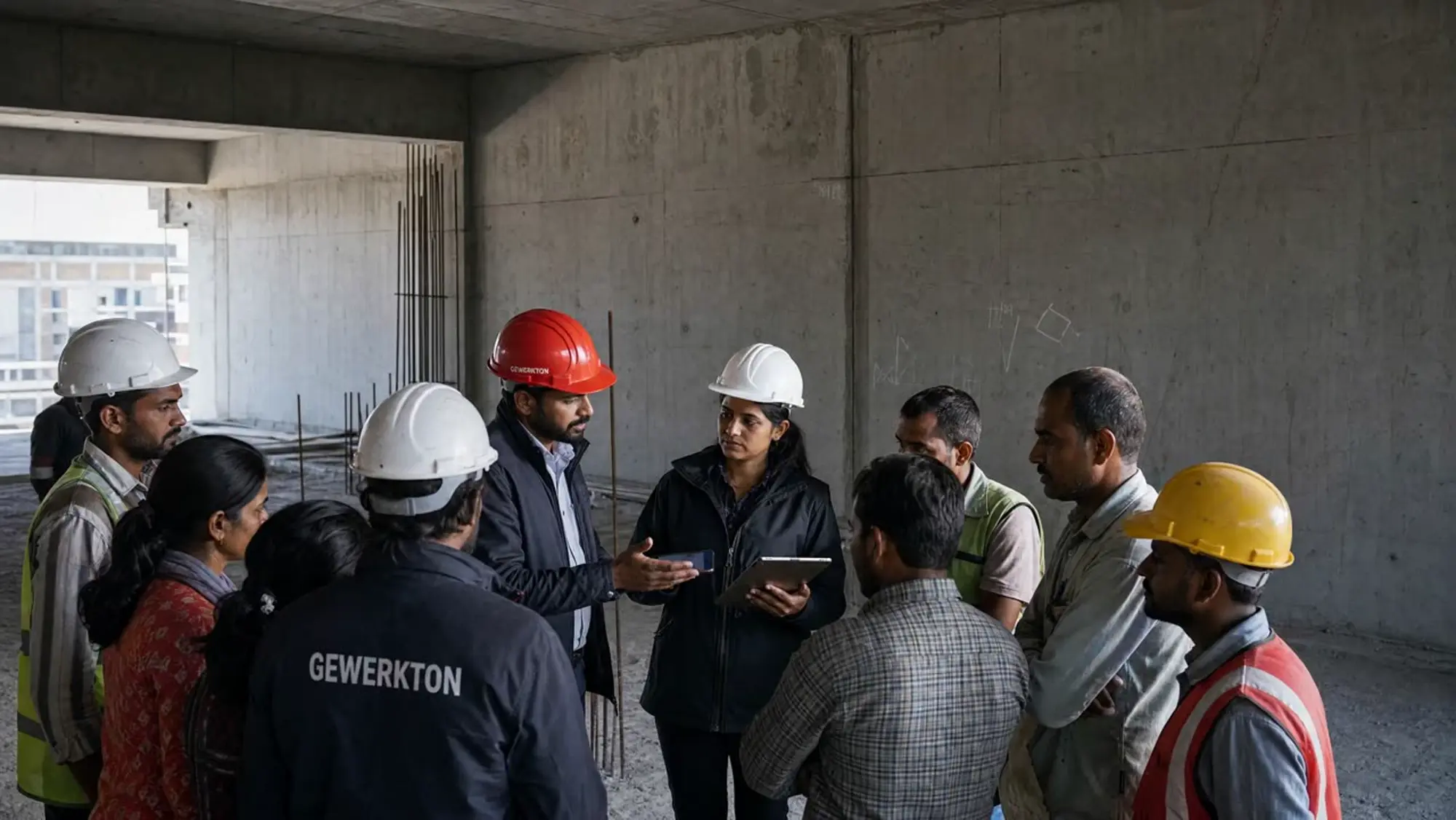
The deployment fields read like a stress test for exactly this discipline:
- Wind farms and renewables: distributed sites, rotating crews, field acceptance, offline capture in dead zones — the record has to be right where there is no signal and no second take.
- Data centers and industrial plants: many trades in parallel on tight deadlines, where meeting decisions become trade-sorted task lists and a mistranslated trade name becomes a misplaced task.
- Housing and building construction: defects with photo and deadline, dictated daywork reports, a signature on the device at handover.
- Infrastructure and tunnels: long durations, many change orders, instructions backed by original audio.
- Projects in Asia: Chinese, Korean, and Vietnamese crews, multilingual from capture to report, with data residency by choice.
- Cross-border teams: EU, US, and APAC on the same project, each in their own language, the evidence original unambiguous underneath it all.
Notice what ties the list together. The languages are the visible part of the product. The structure underneath — typed records, original audio, photos, deadlines, signatures captured on device — is what lets the languages vary without the truth varying with them. A team that gets this right can add a language by adding a locale; a team that gets it wrong adds a liability per locale.
The machine room
Beneath the language work sits an architecture with the same allergy to lock-in. Thirteen AI providers, your own keys, region selectable — no vendor lock-in. Data residency is a choice: EU cloud or your own infrastructure. Even the marketing site practices what the product preaches: 27 languages, zero trackers, no cookie banner, a fully egress-free architecture, and a media bank of more than 51 self-produced clips and posters. That is what respect for a visitor’s data looks like when it is a build property rather than a paragraph in a privacy policy.
What the twenty-eighth language will look like
The next language added to Gewerkton will not begin with a string dump emailed to a translation agency. It will begin with the glossary, the morphological rules, the character budgets, and the test suite that encodes every incident so far — KVKK included. That is what localizing, as opposed to translating, actually means: not words swapped between dictionaries, but a product re-verified, component by component, against the way a new language genuinely works. The scars become checks; the checks become infrastructure. It is slower than running everything through a model once, and infinitely faster than cleaning up after it.
Gewerkton is in beta now, with the public beta planned for fall 2026. Teams running multilingual crews — on wind farms, in data centers, on housing sites, in tunnels, across borders — can watch it come together at gewerkton.com and judge for themselves what a documentation and defect management platform looks like when language is treated as engineering rather than decoration.